THE CLASSIC COLLECTION✦ZoeCLASSIC FREE BOOKS
Zoe
Evelyn Whitaker
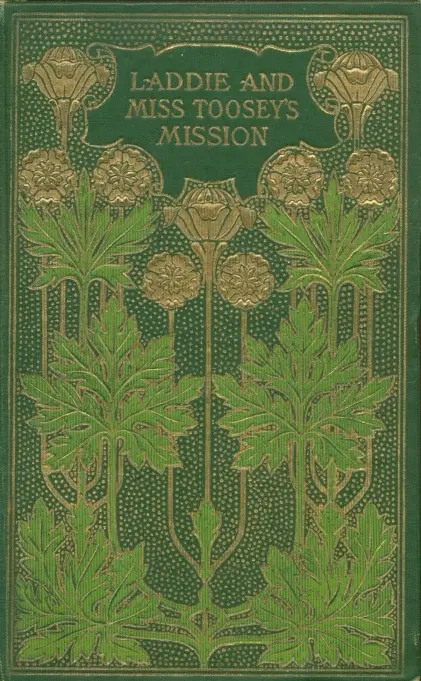
THE CLASSIC COLLECTION · 1897
"Laddie and Miss Toosey's Mission" by Evelyn Whitaker is a novel written in the late 19th century. The story follows a young man known as Laddie, who has grown up and made his way to London as a successful doctor, John Carter. The narrative opens with Laddie's mother, an old country woman, embarking on a journey to visit him, revealing her deep affection and pride in her son, which is juxtaposed against the realities of social class differences and Laddie's attempts to navigate his new life while managing his past. At the start of the book, the scene is set on a train where the old woman, overwhelmed by her journey and new surroundings, is introduced alongside Laddie’s character through her fond recollections of him. As the train rolls forward, she recounts stories of Laddie's childhood to fellow travelers, showcasing the warmth of their relationship. Simultaneously, we are introduced to Laddie as he starts to grapple with his complex feelings about his mother's arrival in his more sophisticated world. The opening establishes a range of themes, including familial love, social class, and the challenges of reconciling one's past with present ambitions, hinting at the emotional conflicts and character developments that will unfold throughout the story.
Introduction adapted from the source catalogue; source summaries may be automatically generated.
Free to read · English · 30,075 words · No account needed
MAKE TIME FOR A GOOD BOOK
On by default. Untick to stop anonymous reading totals. Each page counts after 10 seconds in view. How this works.
Anonymous counting is on unless you have switched it off.
I do not think it ever occurred to Miss Toosey that there was anything amiss in Martel church or its services. She was proud of the fine, old gray stone tower, which had been built when men gave willingly of their best for the service of God, and so built "for glory and for beauty;" and she loved the roof of the nave, which was rich in oak carving, bleached white by time, with angels and emblems of wonderful variety and ingenuity. And all the rest of the church she took for granted, and did not wonder at the narrow, uncomfortable pews, where, as Mr. Malone, the Irish curate, said, "it was quite impossible to kneel down, and very difficult to get up again;" or at the free seats, put behind all the others; or at the large, steep galleries; or at the high pulpit rich in red velvet and dusty fringe on one side, and the reading-desk to match on the other, with the clerk's desk underneath where Mr. Budd did his part of the service, i.e., the responses, as a clerk should do, in a strident, penetrating voice, and took a well-earned nap in the sermon when his duties were discharged. It did not strike her as curious that the seats in the chancel should be occupied by the Peters family on one side and by the Rossitters on the other, while the ladies and gentlemen of the choir displayed their smart bonnets or Sunday waistcoats to great advantage in front of the organ, where, in return for their vocal exertions they were privileged to behave as badly as their fancies led them. You see, Miss Toosey was not critical, and she had not been to any other church for many years, and custom draws a soft curtain over imperfections, and reverence is not quick to see irreverence in others, and prayer fills the air with clouds of incense through which we cannot easily see bonnets, but only Heaven itself; and as Miss Toosey knelt, being very short, you remember, and the pews high she could only with her outward eyes see the angels in the roof and her prayer-book. And it was just the same with the sermons: as church was church to Miss Toosey, so a sermon was a sermon. Whether it was Mr. Peters, Mr. Glover, or Mr. Malone, Miss Toosey looked out the text in her little brown Bible, and put the bookmarker, with "Love the Jews," into the place, and gave her head a little nod, as if to show that the text was there, and no mistake about it; and then took off her spectacles, wiped them, put them into a case, gave her black silk skirt a slight shake to prevent creases, and then settled down to listen. I will not undertake to say that Miss Toosey entered into all the subtleties of doctrine set forth over the red velvet pulpit-cushion; I will not even deny that sometimes the lavender ribbons on Miss Toosey's bonnet nodded, without much connection with the arguments of the discourse, and that the words "election and grace" grew faint and dreamy in her ears, and Mr. Peter's gray hair or Mr. Glover's whiskers disappeared from her sight. I am disposed to think that she did not lose very much; but Miss Toosey took it much to heart, so much so that she could hardly believe herself capable of it, and even contended that she was listening all the time, though she closed her eyes to pay greater attention. But sometimes the sermons kept Miss Toosey awake effectually, and made her feel very uncomfortable for some days afterwards; and this was when they were on the subject of conversion. Mr. Malone was especially strong on this point; and, after one of his powerful discourses, Miss Toosey would have a wakeful night, going through the course of her peaceful, uneventful life, trying to find that moment of awakening which other Christians seemed to find so easily, wondering if she might date her conversion from a day when she was a little child, crying and being comforted at her mother's knee; or in the quiet, sober joy of her Confirmation; or when she followed her mother up the aisle, one Easter Day, in trembling awe to her first Communion; or in the days of her simple, girlish romance long ago, when her heart was overflowing with pure happiness; or to the days following so quickly when it came to an untimely end, and she sobbed herself to sleep, night after night, with her cheek (it was round and smooth then) pressed to that same little brown Bible, with some faded flowers between the leaves; or could it have been when her father died and she stood alone by his grave? None of these events seemed quite to answer to Mr. Malone's descriptions, and sometimes Miss Toosey was driven to fear that she must rank herself with the unconverted, to whom a few scathing words were addressed at the conclusion of the sermon.
Your reading position is saved on this browser. Take it to another device with a library code. Reading pages adapt to text, rather than matching a printed edition.
Evelyn Whitaker
BEHIND THE BOOK
This eBook is for the use of anyone anywhere in the United States and most other parts of the world at no cost and with almost no restrictions whatsoever. You may copy it, give it away or re-use it under the terms of the Project Gutenberg License included with this eBook or online at www.gutenberg.org. If you are not located in the United States, you will have to check the laws of the country where you are located before using this eBook. Read the source licence.
The original source file, including credits and licence, is retained by this library. Request an original-format copy at no charge. Please include the book title and Project Gutenberg identifier #73760.
KEEP YOUR CURIOSITY GOING
Coulson Kernahan

Maurice Baring
Frances Wright
Cécile Tormay

Frederic Jesup Stimson

W. H. P. (William Henry Pope) Jarvis