THE CLASSIC COLLECTION✦ZoeCLASSIC FREE BOOKS
Zoe
Evelyn Whitaker
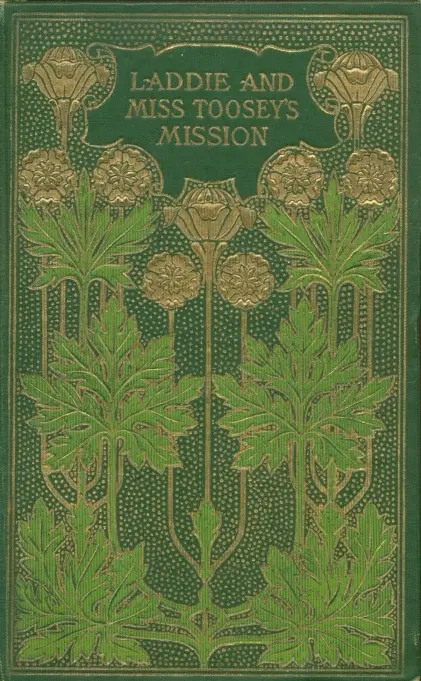
THE CLASSIC COLLECTION · 1897
"Laddie and Miss Toosey's Mission" by Evelyn Whitaker is a novel written in the late 19th century. The story follows a young man known as Laddie, who has grown up and made his way to London as a successful doctor, John Carter. The narrative opens with Laddie's mother, an old country woman, embarking on a journey to visit him, revealing her deep affection and pride in her son, which is juxtaposed against the realities of social class differences and Laddie's attempts to navigate his new life while managing his past. At the start of the book, the scene is set on a train where the old woman, overwhelmed by her journey and new surroundings, is introduced alongside Laddie’s character through her fond recollections of him. As the train rolls forward, she recounts stories of Laddie's childhood to fellow travelers, showcasing the warmth of their relationship. Simultaneously, we are introduced to Laddie as he starts to grapple with his complex feelings about his mother's arrival in his more sophisticated world. The opening establishes a range of themes, including familial love, social class, and the challenges of reconciling one's past with present ambitions, hinting at the emotional conflicts and character developments that will unfold throughout the story.
Introduction adapted from the source catalogue; source summaries may be automatically generated.
Free to read · English · 30,075 words · No account needed
MAKE TIME FOR A GOOD BOOK
On by default. Untick to stop anonymous reading totals. Each page counts after 10 seconds in view. How this works.
Anonymous counting is on unless you have switched it off.
What an awful place London is. I do not mean awful in the sense in which the word is used by fashionable young ladies, or schoolboys, by whom it is applied indiscriminately to a "lark" or a "bore," into which two classes most events in life may, according to them, be divided, and considered equally descriptive of sudden death or a new bonnet. I use it in its real meaning, full of awe, inspiring fear and reverence, as Jacob said, "How dreadful is this place,"--this great London, with its millions of souls, with its strange contrasts of riches and poverty, business and pleasure, learning and ignorance, and the sin everywhere. Awful indeed! and the thought would be overwhelming in its awfulness if we could not say also as Jacob did, "Surely the Lord is in this place, and I knew it not;" if we did not know that there is the ladder set up, reaching to heaven, and the angels of God ever ascending and descending; if we did not believe that the Lord stands above it. It seemed a very terrible place to the old countrywoman as she wandered about its streets and squares, its parks and alleys, that November day, too dazed and stupefied to form any plan for herself, only longing to get out of sight, that she might not shame her boy. She felt no bitterness against him; for it was not natural when he was a gentleman, and she a poor homely old body?
In the early morning, when the streets were empty except for policemen or late revellers hurrying home, or market carts coming in from the country, with frosty moisture on the heaps of cabbages, she got on pretty well. She had a cup of coffee at an early coffee stall, and no one took any notice of her; some of those that passed were country people too; and at that early hour people are used to see odd, out-of-the-way figures, that would be stared at in the height of noon. But as the day went on the streets filled with hurrying people, and the shops opened, and omnibuses and cabs began to run, and she got into more bustling, noisy thoroughfares, and was hustled and pushed about and looked at, the terrors of the situation came heavily upon her. She tried to encourage herself with the thought that before long she should get out of London and reach the country, little knowing, poor old soul, how many miles of streets and houses and pavements lay between her and the nearest pretence to real country. And then, too, in that maze of streets where one seemed exactly like another, her course was of a most devious character, often describing a circle and bringing her back through the same streets without the old woman knowing that she was retracing her steps; sometimes a difficult crossing, with an apparently endless succession of omnibuses and carts, turned her from her way; sometimes a quieter looking street, with the trees of a square showing at the end, enticed her aside. Once she actually went up North Crediton street, unconsciously and unnoticed. She reached one of the parks at last, and sat down very thankfully on a seat, though it was clammy and damp, and the fog was lurking under the gaunt black trees, and hanging over the thin, coarse grass, which was being nibbled by dirty, desolate sheep, who looked to the old woman's eyes like some new kind of London animal, not to be recognized as belonging to the same species as the soft, fleecy white flocks on the hillsides and meadows of Sunnybrook. She sat here a long time, resting, dozing, and trying to think. "I don't want to trouble no one, or shame no one, I only want just to get out of the way." She was faint and tired, and she thought perhaps she might be going to die. "It's a bit unked to die all alone, and I'd liefer have died in my bed comfortable-like; but there! it don't much matter, it'll soon be all over and an end to it all." But, no, that would not do either; and the old woman roused herself and shook off the faintness. "Whatever would folks say if Laddie's mother was found dead like any tramp in the road? He'd die of shame, pretty near, to hear it in every one's mouth." Poor old soul! she little knew how people can starve, and break their hearts, and die for want of food or love in London, and no one be the wiser or the sadder. It was just then she found out that her pocket had been picked, or rather that her purse was gone; for she did not wonder where or how it went, and, indeed, she did not feel the loss very acutely, though, at home in the old days, she had turned the house upside down and hunted high and low and spared no pains to find a missing halfpenny. It did not contain all her money, for with good, old-fashioned caution, she had some notes sewed up in her stays; but still it was a serious loss, and one she would have made a great moan over in old times. She did not know that the sight of her worn old netted purse, with the rusty steel rings, had touched a soft spot in a heart that for years had seemed too dry and hard for any feeling. It had lain in the hand of an expert London pickpocket; it was mere child's play taking it; it did not require any skill. There was a bit of lavender stuck into the rings, and he smelt and looked at it, and then the old woman turned and looked at him with her country eyes; and then all at once, almost in spite of himself, he held out the purse to her. "Don't you see as you've dropped your purse?" he said in a surly, angry tone, and finished with an oath that made the old woman tremble and turn pale; and he flung away, setting his teeth, and calling himself a fool. That man was not all bad--who is?--and his poor act of restitution is surely put to his credit in the ledger of life, and will stand there when the books shall be opened. The old woman got little good from it, however, for the purse was soon taken by a less scrupulous thief.
Your reading position is saved on this browser. Take it to another device with a library code. Reading pages adapt to text, rather than matching a printed edition.
Evelyn Whitaker
BEHIND THE BOOK
This eBook is for the use of anyone anywhere in the United States and most other parts of the world at no cost and with almost no restrictions whatsoever. You may copy it, give it away or re-use it under the terms of the Project Gutenberg License included with this eBook or online at www.gutenberg.org. If you are not located in the United States, you will have to check the laws of the country where you are located before using this eBook. Read the source licence.
The original source file, including credits and licence, is retained by this library. Request an original-format copy at no charge. Please include the book title and Project Gutenberg identifier #73760.
KEEP YOUR CURIOSITY GOING
Coulson Kernahan

Maurice Baring
Frances Wright
Cécile Tormay

Frederic Jesup Stimson

W. H. P. (William Henry Pope) Jarvis