THE CLASSIC COLLECTION✦South Australia and Western AustraliaCLASSIC FREE BOOKS
South Australia and Western Australia
Anthony Trollope
THE CLASSIC COLLECTION · 1880
"La Vendée" by Anthony Trollope is a historical romance written during the late 19th century. The narrative unfolds during the tumultuous period of the French Revolution, focusing on the experiences of royalist supporters in the Vendée region. It centers upon characters such as M. de Lescure and Henri de Larochejaquelin, who are deeply embroiled in the conflict as they seek to restore the monarchy amidst the chaos of revolutionary fervor. The opening of "La Vendée" presents the dire state of France in 1792, detailing the aftermath of the King’s overthrow and the rising revolutionary sentiments in Paris. We meet a group of royalist youths, known as the Poitevins, who gather in support of their imprisoned King Louis XVI and strive to organize resistance against the republicans. Notably, M. de Lescure is introduced as a compassionate yet brave leader, alongside the impetuous Henri de Larochejaquelin, who is driven by a passionate loyalty to the monarchy. Tensions are palpable as royalists react to increasingly oppressive sentiments, and the chapter culminates in the urgency felt by these young men to act in their King’s defense, setting the stage for the impending civil conflict in the Vendée.
Introduction adapted from the source catalogue; source summaries may be automatically generated.
Free to read · English · 178,960 words · No account needed
MAKE TIME FOR A GOOD BOOK
On by default. Untick to stop anonymous reading totals. Each page counts after 10 seconds in view. How this works.
Anonymous counting is on unless you have switched it off.
"Well, I think the generals should all be noblemen; I declare," said the laundress, "M. Larochejaquelin did look so nice last Wednesday, when he was getting off his horse."
"That is all; but Cathelineau," said Annot, "he is the finest fellow of them all. I'd sooner have Cathelinean for my lover, than the Duc de Chartres, and he's the king's cousin."
"You are a foolish girl, Annot," said Chapeau. "You might as well want the picture of St. John out of the church window down yonder, and take that for your lover, as Cathelineau. Don't you know he's the Saint of Anjou?"
"He might marry a wife, and have a house full of children, for all that; that's the difference between being a saint and a priest; there's no harm in being in love with a saint, and I am very much in love with Cathelineau."
"Why, you little ninny, you never saw him," said Chapean.
"No matter," said Annot; "ninny, or no ninny, I'll go where I'm like to see him; and I'm sure I'll never bear the sight of another man afterwards; the dear, good, sweet Cathelineau, with his curly hair, and fine whiskers, and black bright eyes; he's better than all the noblemen: I declare I dreamed of him these last two nights."
Chapeau left the side of his mistress, muttering something about stupid foolish chits of girls, and continued his description of M. d'Elbée to the men.
"Indeed he is a very great general. I don't know very well where he came from, but I believe somewhere down in the Marais, from his being such a friend of M. Charette; but he has been fighting against the republicans this long time, even before Cathelineau began, I believe, though I don't exactly know where. I know he was made a prisoner in Paris, and nearly killed there by some of those bloody-minded rebels; then he escaped, and he was at the siege of Machecoult, and got honourably wounded, and was left for dead: and then he was at Thouars--no, not at Thouars; we heard he was coming, but he didn't come; but he was at Fontenay, and that's where I first saw him. M. Bonchamps brought him in and introduced him to M. de Lescure, and our M. Larochejaquelin, and I was astonished to see how much they made of him, for he was dressed just as he is now, and had no sword or anything. Well, as soon as he came in they all went to work talking, and settling how Fontenay was to be attacked, for though its a little place, and not walled and fortified like Saumur, we had a deal of trouble with it; but before a word was spoken, M. d'Elbée stood up and said, 'Brethren,' said he, 'let us ask the assistance of our Saviour:' so down they went on their knees, and he said an awful long prayer, for all the world like a priest. And then again before we fired a shot, he bade all the soldiers kneel down, and down we went, the republicans firing at us all the time. The soldiers call him Old Providence, for they say he talks a deal about Providence when he is fighting."
Your reading position is saved on this browser. Take it to another device with a library code. Reading pages adapt to text, rather than matching a printed edition.
Anthony Trollope

Anthony Trollope
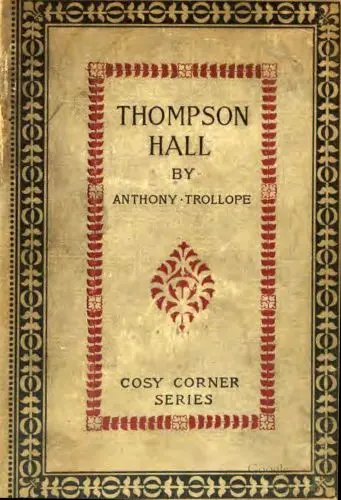
Anthony Trollope

Anthony Trollope
BEHIND THE BOOK
This eBook is for the use of anyone anywhere in the United States and most other parts of the world at no cost and with almost no restrictions whatsoever. You may copy it, give it away or re-use it under the terms of the Project Gutenberg License included with this eBook or online at www.gutenberg.org. If you are not located in the United States, you will have to check the laws of the country where you are located before using this eBook. Read the source licence.
The original source file, including credits and licence, is retained by this library. Request an original-format copy at no charge. Please include the book title and Project Gutenberg identifier #5709.
KEEP YOUR CURIOSITY GOING
Cécile Tormay

Moritz Busch
Coulson Kernahan
John L. Ransom

Maurice Baring
Frances Wright