THE CLASSIC COLLECTION✦South Australia and Western AustraliaCLASSIC FREE BOOKS
South Australia and Western Australia
Anthony Trollope
THE CLASSIC COLLECTION · 1880
"La Vendée" by Anthony Trollope is a historical romance written during the late 19th century. The narrative unfolds during the tumultuous period of the French Revolution, focusing on the experiences of royalist supporters in the Vendée region. It centers upon characters such as M. de Lescure and Henri de Larochejaquelin, who are deeply embroiled in the conflict as they seek to restore the monarchy amidst the chaos of revolutionary fervor. The opening of "La Vendée" presents the dire state of France in 1792, detailing the aftermath of the King’s overthrow and the rising revolutionary sentiments in Paris. We meet a group of royalist youths, known as the Poitevins, who gather in support of their imprisoned King Louis XVI and strive to organize resistance against the republicans. Notably, M. de Lescure is introduced as a compassionate yet brave leader, alongside the impetuous Henri de Larochejaquelin, who is driven by a passionate loyalty to the monarchy. Tensions are palpable as royalists react to increasingly oppressive sentiments, and the chapter culminates in the urgency felt by these young men to act in their King’s defense, setting the stage for the impending civil conflict in the Vendée.
Introduction adapted from the source catalogue; source summaries may be automatically generated.
Free to read · English · 178,960 words · No account needed
MAKE TIME FOR A GOOD BOOK
On by default. Untick to stop anonymous reading totals. Each page counts after 10 seconds in view. How this works.
Anonymous counting is on unless you have switched it off.
Larochejaquelin, however, was always true to him; he knew that he was an orphan, without brother, sister, or relatives, and with the devotion of a real friend, he overlooked all his faults, and greatly magnified his talents. For Henri's sake, M. de Lescure tolerated him, and the three were therefore much together; they came from the same country; they belonged to the same club; they had the same political sympathies; and were looked upon as dear and stedfast friends.
On the 10th of August, the King left the Tuilleries, and took refuge in the National Assembly; during the greater part of the night he remained there with his family. Early on the following morning, he was removed, under a guard, to the Feuillants; and on the 12th it was decided that he should be confined in the prison of the Temple.
It was on the morning of the 12th, that the last meeting of the little club of the Poitevins took place.
They met with throbbing hearts and blank faces; they all felt that evil days had come that the Revolution which had been so petted and caressed by the best and fairest in France, had become a beast of prey, and that war, anarchy, and misrule were at hand.
They sat waiting on the morning of the 12th, till they should learn the decision of the Assembly with regard to the King. De Lescure was there calm and grave, but with much melancholy in his countenance.
Larochejaquelin was there. Hot and eager, whispering plans for rescuing the King, to which the less resolute hardly dared to listen. Charette, the Prince de Talmont, d'Autachamps, Fleuriot, and others, all of whom now detested the Revolution, though they could not but feel the danger of proclaiming themselves royalists.
"Denot will be here directly," said La Rochejaquelin; "he is at the Assembly--they are not apt to be very tedious in their decisions."
"Danton has openly declared," said Fleuriot, "that the armed sections shall remain in revolt, unless the Assembly decree the abolition of the monarchy."
"Lafayette," said the Prince, "is the only man now who could save the country--if Lafayette will move, he might still save the throne."
"He could do nothing," said d'Autachamps, "but add himself to the ruins--the regiments, to a man, would side with the populace."
"I don't know," said Larochejaquelin, "I don't think so. See how our Swiss fought--could any men be more true to their officers or their colours? and do you think there are not thousands in the French army as true, as brave as they? If Lafayette would raise his hand, I for one would join him."
Your reading position is saved on this browser. Take it to another device with a library code. Reading pages adapt to text, rather than matching a printed edition.
Anthony Trollope

Anthony Trollope
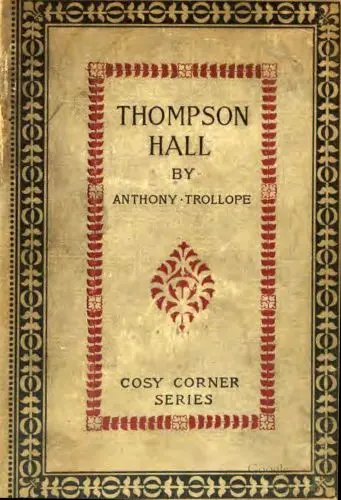
Anthony Trollope

Anthony Trollope
BEHIND THE BOOK
This eBook is for the use of anyone anywhere in the United States and most other parts of the world at no cost and with almost no restrictions whatsoever. You may copy it, give it away or re-use it under the terms of the Project Gutenberg License included with this eBook or online at www.gutenberg.org. If you are not located in the United States, you will have to check the laws of the country where you are located before using this eBook. Read the source licence.
The original source file, including credits and licence, is retained by this library. Request an original-format copy at no charge. Please include the book title and Project Gutenberg identifier #5709.
KEEP YOUR CURIOSITY GOING
Cécile Tormay

Moritz Busch
Coulson Kernahan
John L. Ransom

Maurice Baring
Frances Wright