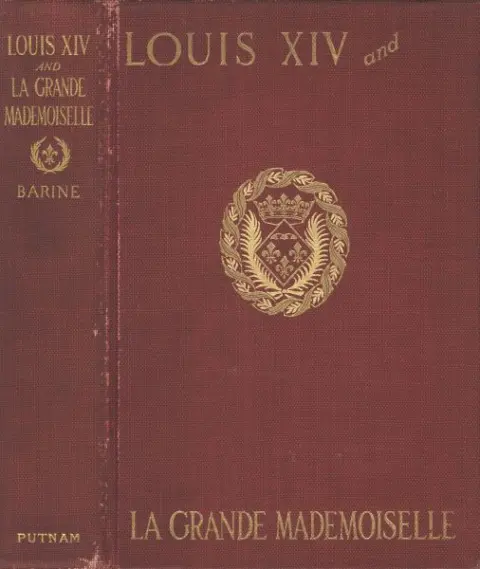
Louis XIV and La Grande Mademoiselle, 1652-1693
Arvède Barine

THE CLASSIC COLLECTION · 1902
"La Grande Mademoiselle, 1627-1652" by Arvède Barine is a historical account written in the late 19th century. The narrative focuses on Anne-Marie-Louise d'Orléans, known as La Grande Mademoiselle, a significant yet underappreciated figure of her time. Through her life experiences, the book illustrates the complex socio-political landscape of 17th-century France, particularly during the reigns of Louis XIII and Louis XIV. The opening of the book introduces La Grande Mademoiselle, daughter of Gaston d'Orléans, and sets the stage for an exploration of her childhood and early influences. The narrative highlights her upbringing amidst the court's intrigues, the contrasting personalities of her parents, and the royal family's dynamics. As Barine delves into La Grande Mademoiselle’s ambitions and the constraints she faced, it becomes evident that her life paralleled the shifting attitudes in France, reflecting broader societal transformations in morality, education, and women's roles at the court. This portion effectively establishes not only the character's background but also hints at her future adventures and the societal challenges she would embody.
Introduction adapted from the source catalogue; source summaries may be automatically generated.
Free to read · English · 118,965 words · No account needed
MAKE TIME FOR A GOOD BOOK
On by default. Untick to stop anonymous reading totals. Each page counts after 10 seconds in view. How this works.
Anonymous counting is on unless you have switched it off.
This orthography did not hinder Mademoiselle when, under the name of "Princess Cassandane" she figured in the Grand Dictionnaire des Précieuses; and according to the distinctions established between the "true précieuse" and the "Savante" by Mademoiselle de Scudéry, she had a right to figure there, as had many of her noble contemporaries, who would have been the shame of the humblest of the schools.
The "true précieuse," she who left comets and the Greek language to the "Savantes," applied herself to the task of penetrating the mysteries of the heart. That was her science, and from certain points of view it was worth as much as any other.
La Grande Mademoiselle devoted her talents and her life to the perfection of her particular art. Keeping well within the limits that she herself had set, she made a special study of the hearts of princesses and of everything concerning them; and she professed that she had established, definitely, the only proper methods by which persons of her quality should, bound in duty to themselves, look upon love, and upon glory.
The wells from which she drew her spiritual draughts were not exclusively her own; she shared their benefits with all honest people, of either sex, engaged in completing the sentimental education by the essential principle of life.
[Footnote 1: Mémoires de Gaston.]
[Footnote 2: Mémoires de Gaston.]
[Footnote 3: Mémoires de Gaston.]
[Footnote 4: Mémoires de Mademoiselle de Montpensier.]
[Footnote 5: Sauval (1620-1670), Histoire et recherches sur les
antiquités de Paris.]
[Footnote 6: The gate of the "Conférence" was built at the time the great improvements were begun, in 1633. It was built after the grand plans of Cardinal de Richelieu and according to his own instructions (Gamboust).]
[Footnote 7: Piganiol de la Force (1673-1753), Description of the City
of Paris, etc.]
[Footnote 8: Estat de la France (Collection Danjou).]
[Footnote 9: Extraits des comptes et dépenses du roi pour l'année
1616 (Collection Danjou).]
[Footnote 10: Mémoires de Mathieu Molé.]
[Footnote 11: Letter written by Pontis.]
[Footnote 12: Richelieu et la monarchie absolue.]
[Footnote 13: Mémoires of Lenet.]
[Footnote 14: See his Mémoires.]
[Footnote 15: A few years before his death, which occurred in 1670.]
[Footnote 16: Beheaded in 1632, aged thirty-seven years.]
[Footnote 17: Tallemant.]
[Footnote 18: The first volume of Le Grand Cyrus appeared in 1649;
the last in 1653.]
[Footnote 19: Mademoiselle de Scudéry uses the word propre, meaning
"elegant," etc.]
[Footnote 20: In Clélie.]
[Footnote 21: Tallemant.]
[Footnote 22: The first number bears date 1605.]
[Footnote 23: The first number appeared May 1, 1631.]
[Footnote 24: Recueil, etc. Discours sur plusieurs points importants de l'état present des affaires de France.]
[Footnote 25: Recueil, etc. Avertissement aux provinces sur les nouveaux mouvements du royaume, by the Sieur de Cléonville (1631).]
Your reading position is saved on this browser. Take it to another device with a library code. Reading pages adapt to text, rather than matching a printed edition.
BEHIND THE BOOK
This eBook is for the use of anyone anywhere in the United States and most other parts of the world at no cost and with almost no restrictions whatsoever. You may copy it, give it away or re-use it under the terms of the Project Gutenberg License included with this eBook or online at www.gutenberg.org. If you are not located in the United States, you will have to check the laws of the country where you are located before using this eBook. Read the source licence.
The original source file, including credits and licence, is retained by this library. Request an original-format copy at no charge. Please include the book title and Project Gutenberg identifier #50717.
KEEP YOUR CURIOSITY GOING
Cécile Tormay

Moritz Busch
John L. Ransom
Frances Wright
Cécile Tormay

Mabel Potter Daggett