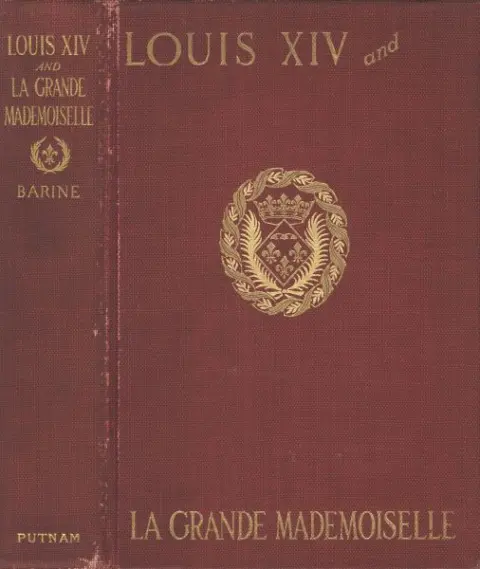
Louis XIV and La Grande Mademoiselle, 1652-1693
Arvède Barine
THE CLASSIC COLLECTION · 1902
"La Grande Mademoiselle, 1627-1652" by Arvède Barine is a historical account written in the late 19th century. The narrative focuses on Anne-Marie-Louise d'Orléans, known as La Grande Mademoiselle, a significant yet underappreciated figure of her time. Through her life experiences, the book illustrates the complex socio-political landscape of 17th-century France, particularly during the reigns of Louis XIII and Louis XIV. The opening of the book introduces La Grande Mademoiselle, daughter of Gaston d'Orléans, and sets the stage for an exploration of her childhood and early influences. The narrative highlights her upbringing amidst the court's intrigues, the contrasting personalities of her parents, and the royal family's dynamics. As Barine delves into La Grande Mademoiselle’s ambitions and the constraints she faced, it becomes evident that her life paralleled the shifting attitudes in France, reflecting broader societal transformations in morality, education, and women's roles at the court. This portion effectively establishes not only the character's background but also hints at her future adventures and the societal challenges she would embody.
Introduction adapted from the source catalogue; source summaries may be automatically generated.
Free to read · English · 118,965 words · No account needed
MAKE TIME FOR A GOOD BOOK
On by default. Untick to stop anonymous reading totals. Each page counts after 10 seconds in view. How this works.
Anonymous counting is on unless you have switched it off.
Mademoiselle wrote of that time: "There never were as many balls as there were that year; and I went to them all."
The final crisis came the thirteenth day of May. Immediately after the King gave up the ghost, the Queen and all the Court retired from the death-chamber and made ready to depart from Saint Germain early in the morning. The moving was like breaking camp. At daybreak long files of baggage wagons laden with furniture and with luggage began to descend the hill of Saint Germain, and soon afterward crowded chariots, drawn by six horses, and groups of cavaliers, joined the lumbering wains. The suppressed droning of many voices accompanied the procession. At eleven o'clock silence fell upon the long, writhing line, and an army corps surrounding the royal mourners passed, escorted by the Marshals of France, dukes and peers, and the gentlemen of the Court,--all mounted.
The last of the battalions filed by the van of the procession, and the chariots and the wains moved on, mingling with the servitors and men of all trades, who in that day followed in the train of all the great.
Saint Germain was vacant. The last errand boy vanished, the murmur of the moving throng died in the distance; the shroud of silence wrapped the new château, and the curtain fell upon the fifth act of the reign of Louis XIII. There remained upon the stage only a corpse, light as a plume, watched by a lieutenant and his guard.
[Footnote 60: Mademoiselle was ten years old at that time.]
[Footnote 61: The Palais-Royal of to-day.]
[Footnote 62: Alex. Hardy et le théâtre français, Eugène Rigal.]
[Footnote 63: Sorel, La maison des jeux. The book was published in 1642, but M. E. Rigal supposes that the disorders and the complaints cited in it date from a previous epoch.]
[Footnote 64: La pratique du théâtre.]
[Footnote 65: Certainly the desire was not lacking.--AUTHOR.]
[Footnote 66: Le théâtre au temps du Corneille, Gustave Reynier. The first representation of the Cid took place either in December, 1636, or in January, 1637.]
[Footnote 67: See dedicatory letter accompanying a comedy played in 1632 and published in 1636. Galanteries du duc d'Ossonne. Mairet.]
[Footnote 68: Aminta was played in 1573, but it was not imprinted until 1581, when it was first known outside of Italy.]
[Footnote 69: Pierre Corneille, Petit de Julleville.]
[Footnote 70: Pierre Corneille, Petit de Julleville.]
[Footnote 71: Jules Lemaître.]
[Footnote 72: Manual de l'histoire de la littérature française. F.
Brunetière.]
[Footnote 73: Corneille, Lanson.]
[Footnote 74: Cyrano de Bergerac, E. Rostand.]
Your reading position is saved on this browser. Take it to another device with a library code. Reading pages adapt to text, rather than matching a printed edition.
BEHIND THE BOOK
This eBook is for the use of anyone anywhere in the United States and most other parts of the world at no cost and with almost no restrictions whatsoever. You may copy it, give it away or re-use it under the terms of the Project Gutenberg License included with this eBook or online at www.gutenberg.org. If you are not located in the United States, you will have to check the laws of the country where you are located before using this eBook. Read the source licence.
The original source file, including credits and licence, is retained by this library. Request an original-format copy at no charge. Please include the book title and Project Gutenberg identifier #50717.
KEEP YOUR CURIOSITY GOING
Cécile Tormay

Moritz Busch
John L. Ransom
Frances Wright
Cécile Tormay

Mabel Potter Daggett