THE CLASSIC COLLECTION✦SalmagundiCLASSIC FREE BOOKS
Salmagundi
William Irving & Washington Irving & James Kirke Paulding
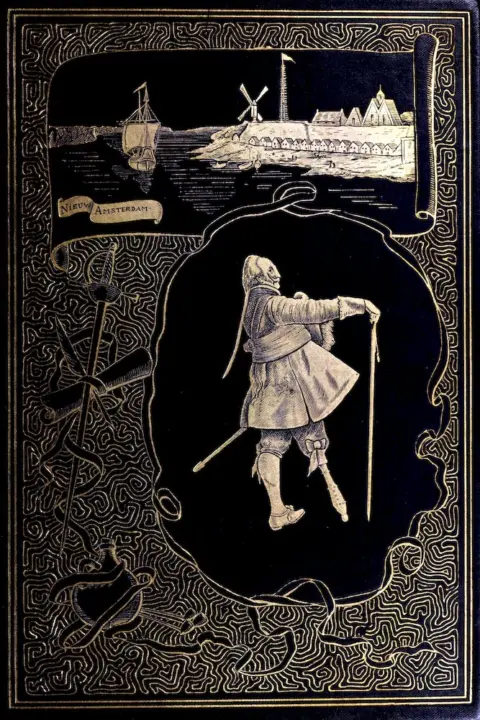
THE CLASSIC COLLECTION · 1893
A History of New York, subtitled From the Beginning of the World to the End of the Dutch Dynasty, is an 1809 literary parody on the early history of New York City by Washington Irving. Originally published under the pseudonym Diedrich Knickerbocker, later editions that acknowledged Irving's authorship were printed as Knickerbocker's History of New York.
The book is significant as early media describing what became modern Christmas traditions in the United States. (This summary is from Wikipedia.)
Introduction adapted from the source catalogue; source summaries may be automatically generated.
Free to read · English · 64,058 words · No account needed
MAKE TIME FOR A GOOD BOOK
On by default. Untick to stop anonymous reading totals. Each page counts after 10 seconds in view. How this works.
Anonymous counting is on unless you have switched it off.
=Chapter I.= HOW PETER STUYVESANT RELIEVED THE SOVEREIGN PEOPLE FROM THE BURDEN OF TAKING CARE OF THE NATION; WITH SUNDRY PARTICULARS OF HIS CONDUCT IN TIME OF PEACE, AND OF THE RISE OF A GREAT DUTCH ARISTOCRACY.
The history of the reign of Peter Stuyvesant furnishes an edifying picture of the cares and vexations inseparable from sovereignty, and a solemn warning to all who are ambitious of attaining the seat of honor. Though returning in triumph and crowned with victory, his exultation was checked on observing the abuses which had sprung up in New Amsterdam during his short absence. His walking-staff, which he had sent home to act as vice-gerent, had, it is true, kept his council-chamber in order,—the counsellors eying it with awe, as it lay in grim repose upon the table, and smoking their pipes in silence,—but its control extended not out of doors.
The populace unfortunately had had too much their own way under the slack though fitful reign of William the Testy; and though upon the accession of Peter Stuyvesant they had felt, with the instinctive perception which mobs as well as cattle possess, that the reins of government had passed into stronger hands, yet could they not help fretting and chafing and champing upon the bit, in restive silence.
Scarcely, therefore, had he departed on his expedition against the Swedes, than the old factions of William Kieft’s reign had again thrust their heads above water. Pot-house meetings were again held to “discuss the state of the nation,” where cobblers, tinkers, and tailors, the self-dubbed “friends of the people,” once more felt themselves inspired with the gift of legislation, and undertook to lecture on every movement of government.
Now, as Peter Stuyvesant had a singular inclination to govern the province by his individual will, his first move, on his return, was to put a stop to this gratuitous legislation. Accordingly, one evening, when an inspired cobbler was holding forth to an assemblage of the kind, the intrepid Peter suddenly made his appearance, with his ominous walking-staff in his hand, and a countenance sufficient to petrify a mill-stone. The whole meeting was thrown into confusion,—the orator stood aghast, with open mouth and trembling knees, while “horror! tyranny! liberty! rights! taxes! death! destruction!” and a host of other patriotic phrases were bolted forth before he had time to close his lips. Peter took no notice of the skulking throng, but strode up to the brawling bully-ruffian, and pulling out a huge silver watch, which might have served in times of yore as a town clock, and which is still retained by his descendants as a family curiosity, requested the orator to mend it, and set it going. The orator humbly confessed it was utterly out of his power, as he was unacquainted with the nature of its construction. “Nay, but,” said Peter, “try your ingenuity, man: you see all the springs and wheels, and how easily the clumsiest hand may stop it, and pull it to pieces; and why should it not be equally easy to regulate as to stop it?” The orator declared that his trade was wholly different,—that he was a poor cobbler, and had never meddled with a watch in his life,—that there were men skilled in the art, whose business it was to attend to those matters; but for his part, he should only mar the workmanship and put the whole in confusion. “Why, harkee, master of mine,” cried Peter,—turning suddenly upon him, with a countenance that almost petrified the patcher of shoes into a perfect lapstone,—“dost thou pretend to meddle with the movements of government,—to regulate, and correct, and patch, and cobble a complicated machine, the principles of which are above thy comprehension, and its simplest operations too subtle for thy understanding, when thou canst not correct a trifling error in a common piece of mechanism, the whole mystery of which is open to thy inspection?—Hence with thee to the leather and stone, which are emblems of thy head; cobble thy shoes, and confine thyself to the vocation for which Heaven has fitted thee. But,” elevating his voice until it made the welkin ring, “if ever I catch thee, or any of thy tribe, meddling again with the affairs of government, by St. Nicholas, but I’ll have every mother’s bastard of ye flayed alive, and your hides stretched for drumheads, that ye may thenceforth make a noise to some purpose!”
Your reading position is saved on this browser. Take it to another device with a library code. Reading pages adapt to text, rather than matching a printed edition.
William Irving & Washington Irving & James Kirke Paulding
Washington Irving
Washington Irving
Washington Irving
BEHIND THE BOOK
This eBook is for the use of anyone anywhere in the United States and most other parts of the world at no cost and with almost no restrictions whatsoever. You may copy it, give it away or re-use it under the terms of the Project Gutenberg License included with this eBook or online at www.gutenberg.org. If you are not located in the United States, you will have to check the laws of the country where you are located before using this eBook. Read the source licence.
The original source file, including credits and licence, is retained by this library. Request an original-format copy at no charge. Please include the book title and Project Gutenberg identifier #78730.
KEEP YOUR CURIOSITY GOING
Cécile Tormay

Moritz Busch
John L. Ransom
Frances Wright
Cécile Tormay

Mabel Potter Daggett