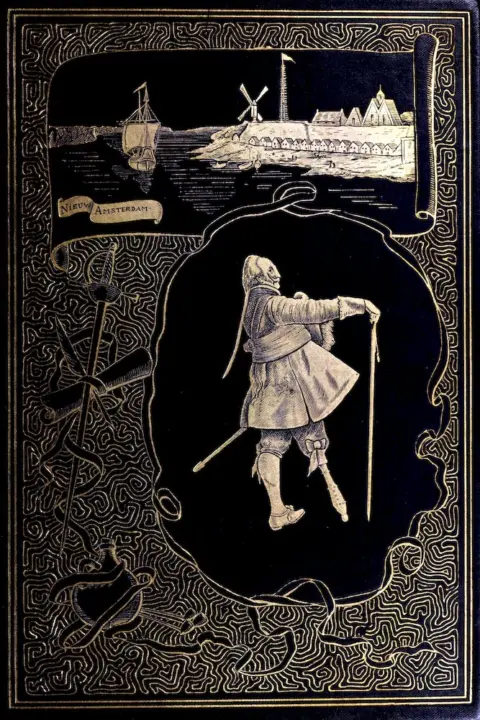
Knickerbocker’s history of New York, vol. 2 (of 2)
Washington Irving
THE CLASSIC COLLECTION · 1893
A History of New York, subtitled From the Beginning of the World to the End of the Dutch Dynasty, is an 1809 literary parody on the early history of New York City by Washington Irving. Originally published under the pseudonym Diedrich Knickerbocker, later editions that acknowledged Irving's authorship were printed as Knickerbocker's History of New York.
The book is significant as early media describing what became modern Christmas traditions in the United States.
(This summary is from Wikipedia.)
Introduction adapted from the source catalogue; source summaries may be automatically generated.
Free to read · English · 62,288 words · No account needed
MAKE TIME FOR A GOOD BOOK
On by default. Untick to stop anonymous reading totals. Each page counts after 10 seconds in view. How this works.
Anonymous counting is on unless you have switched it off.
From the foregoing arguments, therefore, and a variety of others equally conclusive, which I forbear to enumerate, it is clearly evident that this fair quarter of the globe, when first visited by Europeans, was a howling wilderness, inhabited by nothing but wild beasts; and that the transatlantic visitors acquired an incontrovertible property therein by the right of discovery.
This right being fully established, we now come to the next, which is the right acquired by cultivation. “The cultivation of the soil,” we are told, “is an obligation imposed by nature on mankind. The whole world is appointed for the nourishment of its inhabitants; but it would be incapable of doing it, was it uncultivated. Every nation is then obliged by the law of nature to cultivate the ground that has fallen to its share. Those people, like the ancient Germans and modern Tartars, who, having fertile countries, disdain to cultivate the earth, and choose to live by rapine, are wanting to themselves, and deserve to be exterminated as savage and pernicious beasts.”[20]
Now it is notorious that the savages knew nothing of agriculture, when first discovered by the Europeans, but lived a most vagabond, disorderly, unrighteous life,—rambling from place to place, and prodigally rioting upon the spontaneous luxuries of nature, without tasking her generosity to yield them anything more; whereas it has been most unquestionably shown, that Heaven intended the earth should be ploughed and sown, and manured, and laid out into cities, and towns, and farms, and country-seats, and pleasure-grounds, and public gardens; all which the Indians knew nothing about: therefore, they did not improve the talents Providence had bestowed on them: therefore, they were careless stewards: therefore, they had no right to the soil: therefore, they deserved to be exterminated.
It is true, the savages might plead that they drew all the benefits from the land which their simple wants required,—they found plenty of game to hunt, which, together with the roots and uncultivated fruits of the earth, furnished a sufficient variety for their frugal repasts,—and that, as Heaven merely designed the earth to form the abode, and satisfy the wants of man, so long as those purposes were answered, the will of Heaven was accomplished. But this only proves how undeserving they were of the blessings around them: they were so much the more savages, for not having more wants; for knowledge is in some degree an increase of desires; and it is this superiority both in the number and magnitude of his desires, that distinguishes the man from the beast. Therefore the Indians, in not having more wants, were very unreasonable animals; and it was but just that they should make way for the Europeans, who had a thousand wants to their one, and, therefore, would turn the earth to more account, and by cultivating it, more truly fulfil the will of Heaven. Besides—Grotius, and Lauterbach, and Puffendorf, and Titius, and many wise men beside, who have considered the matter properly, have determined that the property of a country cannot be acquired by hunting, cutting wood, or drawing water in it—nothing but precise demarcation of limits, and the intention of cultivation, can establish the possession. Now, as the savages (probably from never having read the authors above quoted) had never complied with any of these necessary forms, it plainly follows that they had no right to the soil, but that it was completely at the disposal of the first comers, who had more knowledge, more wants, and more elegant, that is to say artificial, desires than themselves.
Your reading position is saved on this browser. Take it to another device with a library code. Reading pages adapt to text, rather than matching a printed edition.
Washington Irving
William Irving & Washington Irving & James Kirke Paulding
Washington Irving
Washington Irving
BEHIND THE BOOK
This eBook is for the use of anyone anywhere in the United States and most other parts of the world at no cost and with almost no restrictions whatsoever. You may copy it, give it away or re-use it under the terms of the Project Gutenberg License included with this eBook or online at www.gutenberg.org. If you are not located in the United States, you will have to check the laws of the country where you are located before using this eBook. Read the source licence.
The original source file, including credits and licence, is retained by this library. Request an original-format copy at no charge. Please include the book title and Project Gutenberg identifier #77921.
KEEP YOUR CURIOSITY GOING
Cécile Tormay

Moritz Busch
John L. Ransom
Frances Wright
Cécile Tormay

Mabel Potter Daggett