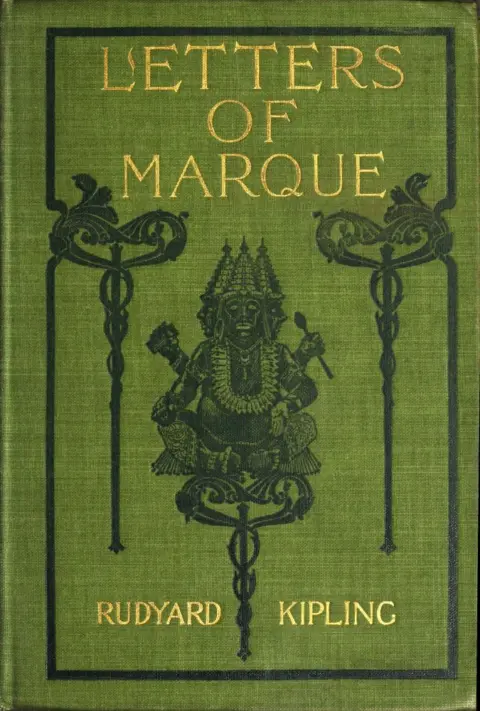
Letters of Marque
Rudyard Kipling
THE CLASSIC COLLECTION · 1901
"Kim" by Rudyard Kipling is a novel first published in 1901. It follows the adventures of an orphaned Irish boy living as a street vagabond in late 19th-century India. Kim befriends a Tibetan lama seeking spiritual enlightenment and becomes his disciple. Their journey along the Grand Trunk Road draws Kim into the dangerous world of British espionage and the Great Game—the covert struggle between Russia and Britain for control of Central Asia. The novel vividly portrays India's cultures, religions, and teeming populations.
Introduction adapted from the source catalogue; source summaries may be automatically generated.
Free to read · English · 106,890 words · No account needed
MAKE TIME FOR A GOOD BOOK
On by default. Untick to stop anonymous reading totals. Each page counts after 10 seconds in view. How this works.
Anonymous counting is on unless you have switched it off.
The man turned helplessly and drifted towards the boys. He was old, and his woollen gaberdine still reeked of the stinking artemisia of the mountain passes.
“O Children, what is that big house?” he said in very fair Urdu.
“The Ajaib-Gher, the Wonder House!” Kim gave him no title—such as Lala or Mian. He could not divine the man’s creed.
“Ah! The Wonder House! Can any enter?”
“It is written above the door—all can enter.”
“Without payment?”
“I go in and out. I am no banker,” laughed Kim.
“Alas! I am an old man. I did not know.” Then, fingering his rosary, he half turned to the Museum.
“What is your caste? Where is your house? Have you come far?” Kim
asked.
“I came by Kulu—from beyond the Kailas—but what know you? From the Hills where”—he sighed—“the air and water are fresh and cool.”
“Aha! Khitai [a Chinaman],” said Abdullah proudly. Fook Shing had once chased him out of his shop for spitting at the joss above the boots.
“Pahari [a hillman],” said little Chota Lal.
“Aye, child—a hillman from hills thou’lt never see. Didst hear of Bhotiyal [Tibet]? I am no Khitai, but a Bhotiya [Tibetan], since you must know—a lama—or, say, a guru in your tongue.”
“A guru from Tibet,” said Kim. “I have not seen such a man. They be Hindus in Tibet, then?”
“We be followers of the Middle Way, living in peace in our lamasseries, and I go to see the Four Holy Places before I die. Now do you, who are children, know as much as I do who am old.” He smiled benignantly on the boys.
“Hast thou eaten?”
He fumbled in his bosom and drew forth a worn, wooden begging-bowl. The boys nodded. All priests of their acquaintance begged.
“I do not wish to eat yet.” He turned his head like an old tortoise in the sunlight. “Is it true that there are many images in the Wonder House of Lahore?” He repeated the last words as one making sure of an address.
“That is true,” said Abdullah. “It is full of heathen būts. Thou also art an idolater.”
“Never mind him,” said. Kim. “That is the Government’s house and there is no idolatry in it, but only a Sahib with a white beard. Come with me and I will show.”
“Strange priests eat boys,” whispered Chota Lal.
“And he is a stranger and a būt-parast (idolater),” said Abdullah,
the Mohammedan.
Kim laughed. “He is new. Run to your mothers’ laps, and be safe. Come!”
Your reading position is saved on this browser. Take it to another device with a library code. Reading pages adapt to text, rather than matching a printed edition.
Rudyard Kipling
Rudyard Kipling
Rudyard Kipling
Rudyard Kipling
BEHIND THE BOOK
This eBook is for the use of anyone anywhere in the United States and most other parts of the world at no cost and with almost no restrictions whatsoever. You may copy it, give it away or re-use it under the terms of the Project Gutenberg License included with this eBook or online at www.gutenberg.org. If you are not located in the United States, you will have to check the laws of the country where you are located before using this eBook. Read the source licence.
The original source file, including credits and licence, is retained by this library. Request an original-format copy at no charge. Please include the book title and Project Gutenberg identifier #2226.
KEEP YOUR CURIOSITY GOING
Cécile Tormay

Moritz Busch
Coulson Kernahan
John L. Ransom

Maurice Baring
Frances Wright