THE CLASSIC COLLECTION✦An outlaw’s diary: the CommuneCLASSIC FREE BOOKS
An outlaw’s diary: the Commune
Cécile Tormay
THE CLASSIC COLLECTION · 1843
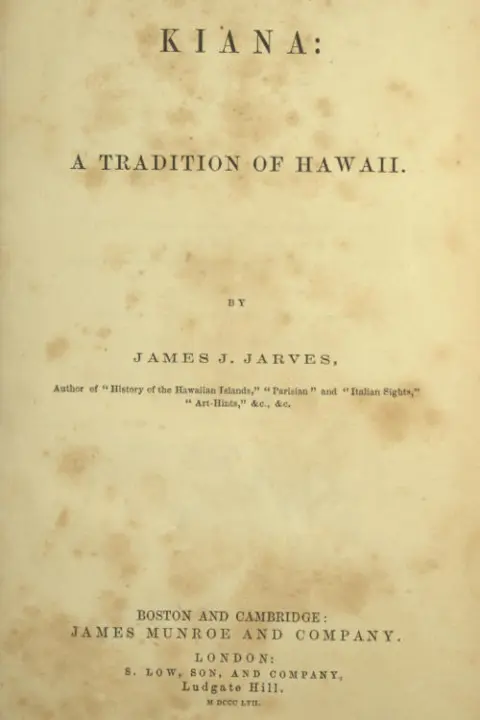
"Kiana: A Tradition of Hawaii" by James Jackson Jarves is a historical novel written in the mid-19th century. The book explores the intermingling of cultures through the arrival of a shipwrecked crew on the Hawaiian Islands, focusing on the influence of a Spanish priest and his companions on the native Hawaiian people, particularly the character Kiana, who is a descendant of a revered chief and significant figure in the island's lore. The opening of the novel sets a contemplative mood aboard a caravel drifting in the vastness of the Pacific Ocean during the early 16th century. The crew, led by Juan Alvirez and accompanied by his sister Beatriz, faces dire circumstances as they are stranded without provisions and plagued by despair. As they drift towards an unknown fate, the characters exhibit a mixture of hope and weariness. Beatriz emerges as a compassionate figure, focusing on nurturing her brother and the crew, while a priest named Olmedo offers spiritual strength. This scene of desperation foreshadows their eventual shipwreck, landing them on a mysterious and seemingly deserted Hawaiian island where they encounter the reigning chief, Kiana. The blend of tragedy and adventure sets the stage for a rich tale of resilience and cultural exchange.
Introduction adapted from the source catalogue; source summaries may be automatically generated.
Free to read · English · 68,377 words · No account needed
MAKE TIME FOR A GOOD BOOK
On by default. Untick to stop anonymous reading totals. Each page counts after 10 seconds in view. How this works.
Anonymous counting is on unless you have switched it off.
Often Kiana came in, and sat gazing at her until the big tears followed one another down his cheeks. Seemingly unconscious of them, he would remain without uttering a word for hours, striving only to give some order which he thought might promote her comfort. To him the fading away of the maiden was like the loss of sunlight to the landscape. The earth was all there, but its joy and glory were alike gone.
How was Olmedo? Calm. Never had Beatriz appeared to him so lovely as now. He had seen too many death-beds not to know that she was shortly to pass away. Every change in her aspect was closely watched, and all that his experience could suggest done to postpone, if it could not avert, her death. But he neither sought to deceive himself nor her. If Juan felt himself alone, how much more must he whose soul was so interwoven with the dying woman’s! Tenderly and truly had their love and faith kept pace in all the eventful scenes they had passed through. Tempted, they had conquered. Their hearts had recognized their inalienable birthright—to love—yet they had not sinned. Now the spiritual was triumphing over the material. As the body grew more helpless, the spirit became indeed stronger. This he saw. How could he then sorrow; when, with the eye of faith, he beheld infinite joy expanding in her soul? Mourn for himself, left so solitary in his earthly pilgrimage, he must, and did, but he rejoiced for her. At no time had he been more earnest in his religious duties than during her illness. A solemn responsibility rested upon him to be even more faithful to her pure aspirations and gentle faith. He was with her also more than ever. As she drew nigh her departure, every trace of the harsher doctrines of her church passed from her mind, as the dead leaves of autumn give way to the living growth of spring. Fed by the vital currents of faith and love that flowed into her soul from that world her spirit was now piercing, his mind grew likewise, and he perceived how that separation in body could prove union in spirit. Thus he was comforted and sustained. He now felt that divine wisdom and love were given in some degree to all men; that all nature was imbued with their principles; that both nature and man were working out the great problem of happiness, through a slow and laborious progress, governed by universal laws existing from a beneficent and impartial deity. Polemical creeds were the shackles of intellect and the graves of the soul. There was but one creed, viz., that God made all men, and none had a right to arrogate to themselves the way of salvation. Of him to whom much was given, it was true that much would be required. God was always revealing himself to the inquiring soul. No age or race had a right to claim a final revelation or a monopoly of inspiration. Truth was as free as the air to all who could or would receive it, but it was like gold in the mine, dark and hidden until labor brought it to the sunlight, stamped it with the die of reason, and put it into circulation. All new coin was looked on with suspicion, but when made familiar became as current as the old. All truth was partial, because its degree depended upon the quality and capacity of the individual mind. Perfect truth is the divine atmosphere. No man can breathe that now, but might hope to attain it through infinite progress. Hence among men universal toleration of opinions should prevail. The best minds here were but infants in knowledge. Striving there should be, but it should consist in mutual charity and forbearance; the patient waiting of each soul, and patient working out of its duties in faith, for individual and general life were linked together for a harmonious end. If disappointment to him were needful for another’s good, he was ready to bid it welcome, and from out of self-sacrifice to rise the stronger man. He saw in Beatriz’s death her spiritual promotion. In strengthening her to meet it, he was best preparing himself for those consolations which as necessarily result from moral laws as does gravitation from the physical. Therefore Olmedo looked upon the present trial as the beautiful working out of the final happiness of Beatriz and himself. To him she was the divine messenger through whom life and light had come. Talk not of the power of passionate love! Its selfish flame burns itself out, leaving nothing but ashes. Olmedo loved Beatriz, but it was now with a love in which passion was sublimated into purity; strengthened by self-sacrifice and made immortal by faith. What, then, were a few years of time to him who already saw into eternity!
Your reading position is saved on this browser. Take it to another device with a library code. Reading pages adapt to text, rather than matching a printed edition.
BEHIND THE BOOK
This eBook is for the use of anyone anywhere in the United States and most other parts of the world at no cost and with almost no restrictions whatsoever. You may copy it, give it away or re-use it under the terms of the Project Gutenberg License included with this eBook or online at www.gutenberg.org. If you are not located in the United States, you will have to check the laws of the country where you are located before using this eBook. Read the source licence.
The original source file, including credits and licence, is retained by this library. Request an original-format copy at no charge. Please include the book title and Project Gutenberg identifier #60066.
KEEP YOUR CURIOSITY GOING
Cécile Tormay

Moritz Busch
Coulson Kernahan
John L. Ransom

Maurice Baring
Frances Wright