THE CLASSIC COLLECTION✦An outlaw’s diary: the CommuneCLASSIC FREE BOOKS
An outlaw’s diary: the Commune
Cécile Tormay
THE CLASSIC COLLECTION · 1843
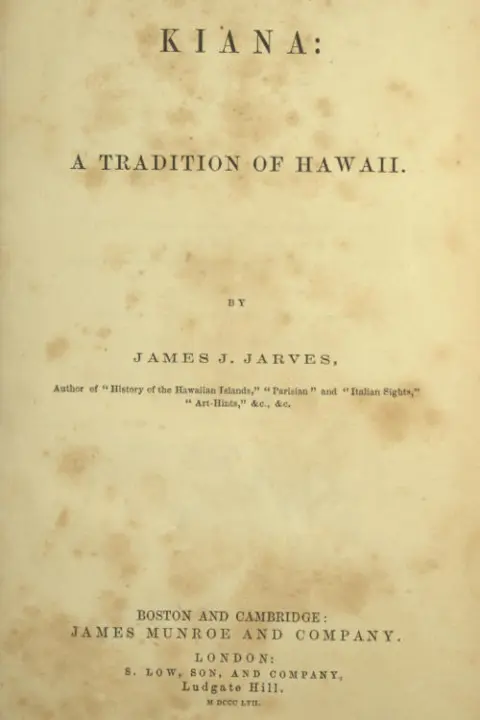
"Kiana: A Tradition of Hawaii" by James Jackson Jarves is a historical novel written in the mid-19th century. The book explores the intermingling of cultures through the arrival of a shipwrecked crew on the Hawaiian Islands, focusing on the influence of a Spanish priest and his companions on the native Hawaiian people, particularly the character Kiana, who is a descendant of a revered chief and significant figure in the island's lore. The opening of the novel sets a contemplative mood aboard a caravel drifting in the vastness of the Pacific Ocean during the early 16th century. The crew, led by Juan Alvirez and accompanied by his sister Beatriz, faces dire circumstances as they are stranded without provisions and plagued by despair. As they drift towards an unknown fate, the characters exhibit a mixture of hope and weariness. Beatriz emerges as a compassionate figure, focusing on nurturing her brother and the crew, while a priest named Olmedo offers spiritual strength. This scene of desperation foreshadows their eventual shipwreck, landing them on a mysterious and seemingly deserted Hawaiian island where they encounter the reigning chief, Kiana. The blend of tragedy and adventure sets the stage for a rich tale of resilience and cultural exchange.
Introduction adapted from the source catalogue; source summaries may be automatically generated.
Free to read · English · 68,377 words · No account needed
MAKE TIME FOR A GOOD BOOK
On by default. Untick to stop anonymous reading totals. Each page counts after 10 seconds in view. How this works.
Anonymous counting is on unless you have switched it off.
Juan, irritated at Kiana’s prudence, demanded that they should attack Tolta at once, and drive his men into the river. But that chief would not waver from his surer policy, for he had also sent to summon his warriors to join him. By keeping his foes in their present situation, they would, before long, be enabled to assault them, certain of success; whereas now, a defeat or even a repulse would endanger the lives of those they had just rescued. Until Beatriz and Olmedo were within the Pahonua, it would be risking too much. Juan acquiesced in these measures, but swore he would not lose sight of Tolta while he lived.
Pohaku, as we know, had pursued Tolta, deceived by the report of Hewahewa. But few of his warriors had been able to keep up with him. The messenger that Tolta had sent, and who might have explained their position, had missed him. The enraged chief came in sight on the main road, soon after the hostile parties had assumed their present positions. Perceiving Kiana and his warriors, he was still more confirmed in his belief of Tolta’s treachery; believing that he had fled to rejoin that chief and surprise him. Without stopping to parley or to ascertain the truth, he roared out to Tolta’s men to make way, and sprang forward with a ferocious look towards the Mexican. The warriors, surprised and confused, for they had supposed he had come to their assistance, parted before him like water before a strong swimmer. Straight on towards Tolta he came foaming and cursing, and bidding him await his fate. The Mexican, at a loss to account for his sudden hate, supposed him gone mad and ordered his men to seize him, but they would have sooner, unarmed, crossed the tusks of the fiercest wild boar of the mountains, than have now put themselves in his path. With his spear poised, he stopped a few feet from Tolta, glaring upon him with blood-shot eyes. In another second he would have driven it clean through him, but Tolta’s instinct of life was quicker than even his rage. Seeing his hopeless position, he sprang aside and the spear glanced on the turf, tearing up the ground, and finally burying itself deep into it, remained with its haft quivering in the air. Pohaku, uttering a fearful howl of disappointed rage, ran towards him, intending to seize him with his naked arms, and to twist his spine. The Mexican, whose movements were quick and subtle, again dodged him, and sprang upon the cliff. As Pohaku rushed after, he aimed a stroke at him with his dagger, which would have reached his heart had it not struck upon an ivory ornament, which he wore upon his breast. The steel broke, and Tolta was left defenceless. The river was now his only chance. A precipice ninety feet high lay between him and it. With one bound he cleared its edge. So sudden was this movement and so desperate the leap, that all for the moment supposed him dashed to pieces on the rocks beneath. Striking the water, however, with his feet pointed like a wedge, and his arms clinging to his sides, he disappeared, but soon rose and struck out towards the Pahonua. The rapid current bore him towards the shallower waters. Here his feet touching the sand, he was obliged to walk now and then, sinking as the water deepened and compelled him again to swim. Suddenly he was seen to throw his arms wildly in the air, and to shriek for help to the priests who were watching him from the walls of the Pahonua. They ran hastily towards the water’s edge to rescue him, but perceiving his position they dared not trust themselves on the treacherous sands. His exertions to reach them were desperate, but every struggle sank him deeper. He had touched a quicksand, and its vortex was slowly sucking him down. Inch by inch he disappeared, each moment to him an eternity. His entire life of baffled ambition and revenge, with all the deeds of horror he had witnessed or participated in; all the better desires he had cherished and affections he had indulged; all of his dark and troublous career became legible in letters of fire to his quickened memory, and mingling with an obscure and despairing future, the terrible mythology of his earliest belief conflicting with the hated creed of the Spaniard, harrowed his soul. Fiercely he struggled for a while with his fate. The water became discolored by the sand his frantic exertions to release himself stirred up. But nothing could now save him. Conscious of this he became more quiet. As the waters covered his face its latest look was towards a group of females just landing at no great distance above him. One among them had seen the leap and after struggle. Shuddering she covered her head with her mantle, and was then praying for the soul of her enemy, whose hands, even after his head had sunk out of sight, were seen for an instant turned imploringly towards her.
Your reading position is saved on this browser. Take it to another device with a library code. Reading pages adapt to text, rather than matching a printed edition.
BEHIND THE BOOK
This eBook is for the use of anyone anywhere in the United States and most other parts of the world at no cost and with almost no restrictions whatsoever. You may copy it, give it away or re-use it under the terms of the Project Gutenberg License included with this eBook or online at www.gutenberg.org. If you are not located in the United States, you will have to check the laws of the country where you are located before using this eBook. Read the source licence.
The original source file, including credits and licence, is retained by this library. Request an original-format copy at no charge. Please include the book title and Project Gutenberg identifier #60066.
KEEP YOUR CURIOSITY GOING
Cécile Tormay

Moritz Busch
Coulson Kernahan
John L. Ransom

Maurice Baring
Frances Wright