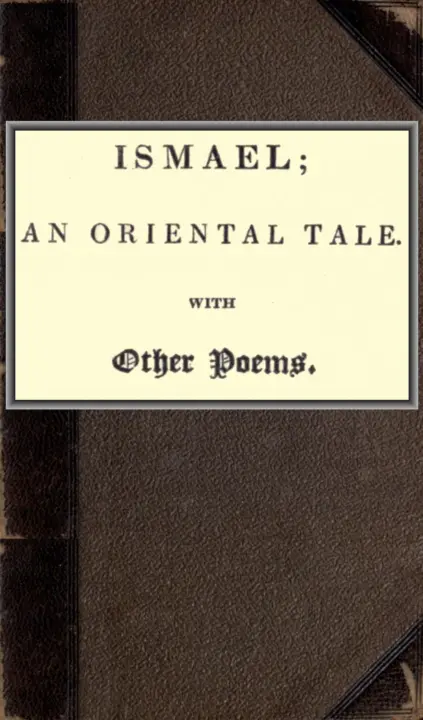
Ismael; an oriental tale. With other poems
Edward Bulwer Lytton, Baron Lytton
THE CLASSIC COLLECTION · 1873
"Kenelm Chillingly — Complete" by Edward Bulwer Lytton is a novel written during the mid-19th century. The story revolves around the life and philosophical musings of its titular character, Kenelm Chillingly, and explores themes of identity, existence, and the expectations placed upon individuals by society and family. The narrative opens with a rich introduction to Kenelm's family background, primarily focusing on his father, Sir Peter Chillingly, and the unique dynamics of a family grappling with the unanticipated arrival of the long-awaited heir. The opening of the novel begins by introducing Sir Peter Chillingly and his marriage to Lady Caroline Brotherton, as well as their struggles with childlessness. Eventually, they welcome Kenelm into the world, but the moment is marked not by joy, but by The father's peculiar reaction to his son's serious demeanor at birth. The narrative then shifts to family dynamics and characters who will influence Kenelm's life such as his cousin Gordon, who harbors expectations regarding inheritance, and the various relatives at a family council deciding on the baby's name. Kenelm grows into a thoughtful and introspective boy with an inclination towards philosophy and metaphysics, marked early on by a desire to make sense of his identity amid familial and societal expectations. The beginning sets the stage for Kenelm’s adventures and opinions, hinting at a journey filled with contrasting characters and illustrious discussions that will shape his understanding of the world.
Introduction adapted from the source catalogue; source summaries may be automatically generated.
Free to read · English · 192,766 words · No account needed
MAKE TIME FOR A GOOD BOOK
On by default. Untick to stop anonymous reading totals. Each page counts after 10 seconds in view. How this works.
Anonymous counting is on unless you have switched it off.
While he was thus thinking, the lady had drawn her chair close to the minstrel, and was speaking to him with evident earnestness, but in tones too low for Kenelm to hear. Still it seemed to him, by her manner and by the man’s look, as if she were speaking in some sort of reproach, which he sought to deprecate. Then he spoke, also in a whisper, and she averted her face for a moment; then she held out her hand, and the minstrel kissed it. Certainly, thus seen, the two might well be taken for lovers; and the soft night, the fragrance of the flowers, silence and solitude, stars and moon light, all girt them as with an atmosphere of love. Presently the man rose and leaned over the balcony, propping his cheek on his hand, and gazing on the river. The lady rose too, and also leaned over the balustrade, her dark hair almost touching the auburn locks of her companion.
Kenelm sighed. Was it from envy, from pity, from fear? I know not; but
he sighed.
After a brief pause, the lady said, still in low tones, but not too low this time to escape Kenelm’s fine sense of hearing,--
“Tell me those verses again. I must remember every word of them when you
are gone.”
The man shook his head gently, and answered, but inaudibly.
“Do,” said the lady; “set them to music later; and the next time you come I will sing them. I have thought of a title for them.”
“What?” asked the minstrel.
“Love’s quarrel.”
The minstrel turned his head, and their eyes met, and, in meeting, lingered long. Then he moved away, and with face turned from her and towards the river, gave the melody of his wondrous voice to the following lines:--
“Standing by the river, gazing on the river, See it paved with starbeams,--heaven is at our feet; Now the wave is troubled, now the rushes quiver; Vanished is the starlight: it was a deceit.
“Comes a little cloudlet ‘twixt ourselves and heaven, And from all the river fades the silver track; Put thine arms around me, whisper low, ‘Forgiven!’ See how on the river starlight settles back.”
When he had finished, still with face turned aside, the lady did not, indeed, whisper “Forgiven,” nor put her arms around him; but, as if by irresistible impulse, she laid her hand lightly on his shoulder.
The minstrel started.
There came to his ear,--he knew not from whence, from whom,--
“Mischief! mischief! Remember the little child!”
“Hush!” he said, staring round. “Did you not hear a voice?”
Your reading position is saved on this browser. Take it to another device with a library code. Reading pages adapt to text, rather than matching a printed edition.
Edward Bulwer Lytton, Baron Lytton
Rebecca Harding Davis & Thomas De Quincey & Charles Dickens & Nathaniel Hawthorne & Edward Bulwer Lytton, Baron Lytton & Edgar Allan Poe & Harriet Elizabeth Prescott Spofford
Edward Bulwer Lytton, Baron Lytton
Edward Bulwer Lytton, Baron Lytton
BEHIND THE BOOK
This eBook is for the use of anyone anywhere in the United States and most other parts of the world at no cost and with almost no restrictions whatsoever. You may copy it, give it away or re-use it under the terms of the Project Gutenberg License included with this eBook or online at www.gutenberg.org. If you are not located in the United States, you will have to check the laws of the country where you are located before using this eBook. Read the source licence.
The original source file, including credits and licence, is retained by this library. Request an original-format copy at no charge. Please include the book title and Project Gutenberg identifier #7658.
KEEP YOUR CURIOSITY GOING
Coulson Kernahan

Maurice Baring
Frances Wright
Cécile Tormay

Frederic Jesup Stimson

W. H. P. (William Henry Pope) Jarvis