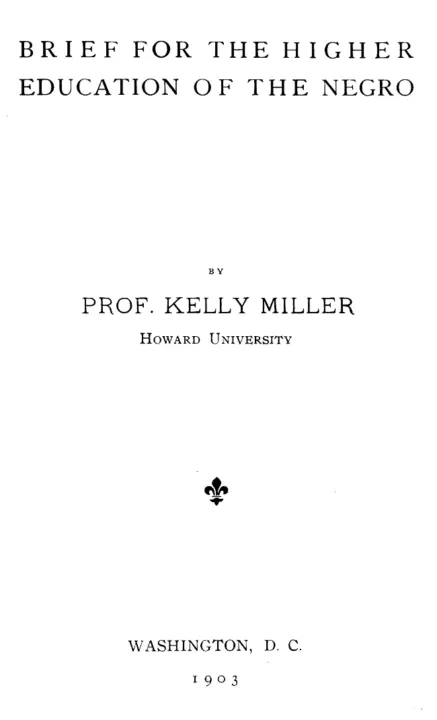
Brief for the higher education of the negro
Kelly Miller
THE CLASSIC COLLECTION · 1919
"Kelly Miller's History of the World War for Human Rights" by Kelly Miller is a historical account written in the early 20th century. This work provides a detailed exploration of World War I with a particular focus on the contributions of Black soldiers in the conflict and the broader implications for human rights and democracy. The book aims to highlight the pivotal roles played by African American troops and the significance of their service in the context of fighting against autocracy and for freedom. The opening of the book sets the tone for an extensive examination of the war and its impact, discussing the far-reaching changes it wrought on civilization. It introduces the main theme of the Negro's involvement in the war, particularly asserting their loyalty and bravery throughout the conflict. Miller plans to present a logical and passionate analysis of the Black contribution to the war, suggesting that their actions during this pivotal historical moment would influence future discussions surrounding civil rights and citizenship in America. By outlining the historical context and highlighting the valor of Black soldiers, the text immediately frames the significance of their contributions against the backdrop of a global struggle for democracy and human rights.
Introduction adapted from the source catalogue; source summaries may be automatically generated.
Free to read · English · 194,149 words · No account needed
MAKE TIME FOR A GOOD BOOK
On by default. Untick to stop anonymous reading totals. Each page counts after 10 seconds in view. How this works.
Anonymous counting is on unless you have switched it off.
Feb. 16--Germany's reply stating "war zone" act is an act of self-defense against illegal methods employed by Great Britain in preventing commerce between Germany and neutral countries.
Feb. 18--German official "blockade" of Great Britain commenced. German submarines begin campaign of "piracy and pillage."
Feb. 19--Anglo-French squadron bombards Dardanelles.
Feb. 20--United States sends identic note to Great Britain and Germany suggesting an agreement between these two powers respecting the conduct of naval warfare.
Feb. 28--Germany's reply to identic note.
Mar. 1--Announcement of British "blockade": "Orders in Council" issued to prevent commodities of any kind from reaching or leaving Germany.
Mar. 10--British capture Neuve Chapelle.
Mar. 17--Russians captured Przemysl and strengthened their hold on the
greater part of Galicia.
Mar. 28--British steamship "Falaba" attacked by submarine and sunk (111
lives lost; 1 American).
Apr. 2--Russians fighting in the Carpathians.
Apr. 8--Steamer "Harpalyce," in service of American commission for aid of Belgium, torpedoed; 15 lives lost.
Apr. 17-May 17--Second Battle of Ypres. British captured Hill 60 (April 19); (April 23); Germans advanced toward Yser Canal. Asphyxiating gas employed by the Germans. Failure of Germany to break through the British lines.
Apr. 22--German embassy sends out a warning against embarkation on vessels belonging to Great Britain.
Apr. 26--Allied troops land on the Gallipoli Peninsula.
Apr. 28--American vessel "Cushing" attacked by German aeroplane.
Apr. 30--Germans invade the Baltic Provinces of Russia.
May 1--American steamship "Gulflight" sunk by German submarine; two Americans lost. Warning of German embassy published in daily papers.
May 2--Russians forced by the combined Germans and Austrians to retire from their positions in the Carpathians (Battle of the Dunajec).
May 7--Cunard line steamship "Lusitania" sunk by German submarine (1,154 lives lost, 114 being Americans).
May 8--Germans occupy Libau, Russian port on the Baltic.
May 9-June--Battle of Artois, or Festubert (near La Bassee).
May 10--Message of sympathy from Germany on loss of American lives by
sinking of "Lusitania."
May 12--South African troops under Gen. Botha occupy capital of German
Southwest Africa.
May 13--American note protests against submarine policy culminating in the sinking of the "Lusitania."
May 23--Italy declared war on Austria-Hungary.
May 25--Coalition cabinet formed in Great Britain; Asquith continues to
be Prime Minister.
May 25--American steamship "Nebraskan" attacked by submarine.
May 28--Germany's answer to American note of May 13.
June 1--Supplementary note from Germany in regard to the "Gulflight" and
"Cushing."
June 3--Przemysl retaken by Germans and Austrians.
June 8--Resignation of William J. Bryan, Secretary of State.
June 9--Monfalcone occupied by Italians, severing one of two railway
lines to Trieste.
June 9--United States sends second note on "Lusitania" case.
June 22--The Austro-Germans recapture Lemberg.
July 2--Naval action between Russian and German warships in the Baltic.
Your reading position is saved on this browser. Take it to another device with a library code. Reading pages adapt to text, rather than matching a printed edition.
Kelly Miller
Kelly Miller
BEHIND THE BOOK
This eBook is for the use of anyone anywhere in the United States and most other parts of the world at no cost and with almost no restrictions whatsoever. You may copy it, give it away or re-use it under the terms of the Project Gutenberg License included with this eBook or online at www.gutenberg.org. If you are not located in the United States, you will have to check the laws of the country where you are located before using this eBook. Read the source licence.
The original source file, including credits and licence, is retained by this library. Request an original-format copy at no charge. Please include the book title and Project Gutenberg identifier #19179.
KEEP YOUR CURIOSITY GOING
Cécile Tormay

Moritz Busch
John L. Ransom
Frances Wright
Cécile Tormay

Mabel Potter Daggett