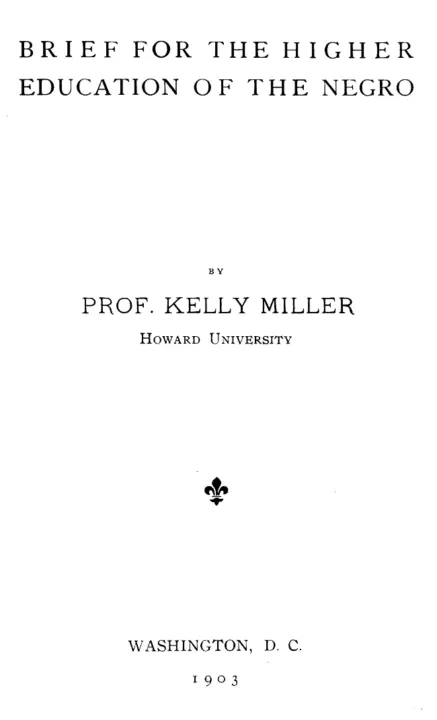
Brief for the higher education of the negro
Kelly Miller
THE CLASSIC COLLECTION · 1919
"Kelly Miller's History of the World War for Human Rights" by Kelly Miller is a historical account written in the early 20th century. This work provides a detailed exploration of World War I with a particular focus on the contributions of Black soldiers in the conflict and the broader implications for human rights and democracy. The book aims to highlight the pivotal roles played by African American troops and the significance of their service in the context of fighting against autocracy and for freedom. The opening of the book sets the tone for an extensive examination of the war and its impact, discussing the far-reaching changes it wrought on civilization. It introduces the main theme of the Negro's involvement in the war, particularly asserting their loyalty and bravery throughout the conflict. Miller plans to present a logical and passionate analysis of the Black contribution to the war, suggesting that their actions during this pivotal historical moment would influence future discussions surrounding civil rights and citizenship in America. By outlining the historical context and highlighting the valor of Black soldiers, the text immediately frames the significance of their contributions against the backdrop of a global struggle for democracy and human rights.
Introduction adapted from the source catalogue; source summaries may be automatically generated.
Free to read · English · 194,149 words · No account needed
MAKE TIME FOR A GOOD BOOK
On by default. Untick to stop anonymous reading totals. Each page counts after 10 seconds in view. How this works.
Anonymous counting is on unless you have switched it off.
Austria sought a separate peace, but Germany, seeing the handwriting on the wall, asked for an armistice through Prince Maximilian of Baden, who had succeeded Count Von Hertling as Chancellor. But while agreeing to accept as a basis of peace the points established by President Wilson as necessary to an agreement, Germany's military forces continued their ruthless and barbaric warfare.
President Wilson submitted a set of questions to the German Government to ascertain the sincerity and purpose of the request and finally brought the matter to an issue by declaring that nothing short of a complete surrender would suffice and that further negotiations must be taken up with the Allied command.
Meantime King Boris of Bulgaria abdicated and the Government was taken over by the people. This was followed by the surrender of Austria on November 8 and the abdication of the Emperor Charles.
Austria in her surrender agreed to the immediate suspension of hostilities, the demobilization of the army of Austro-Hungary and the withdrawal of all forces from the North Sea to Switzerland, the evacuation of all territories invaded, the evacuation of all German troops from Austro-Hungarian territory and the Italian and Balkan fronts, as well as the surrender of fifteen submarines and all German submarines in Austro-Hungarian territorial waters, together with thirty-four warships, and also the repatriation of all prisoners of war.
With her forces demoralized and Bulgaria, Turkey and Austria out of the war and her power broken in Russia, Germany was driven to the necessity of accepting terms submitted by the Allies as the basis of peace as outlined by President Wilson.
Thus came peace after fifty-two continuous months of fighting, in which it is estimated that nearly 10,000,000 were killed and that there were about 27,000,000 casualties, while $200,000,000 were expended by the combined nations.
America's casualties were 236,117, divided as follows: Killed and died of wounds, 36,154; died of disease, 14,811; died from unassigned causes, 2,204; wounded, 179,625; missing, 1,160, and prisoners, 2,163.
England by contrast had 658,665 killed, 2,032,122 wounded and 359,145 missing and prisoners during the four years, while Italy had about 1,600,000 casualties; France, 3,500,000; Belgium, 400,000; Rumania, 200,000, and Russia, 6,000,000. All told, twenty-eight nations, with a total population of approximately 1,600,000,000, or nearly eleven-twelfths of the human race, were involved in the world struggle at the close.
Your reading position is saved on this browser. Take it to another device with a library code. Reading pages adapt to text, rather than matching a printed edition.
Kelly Miller
Kelly Miller
BEHIND THE BOOK
This eBook is for the use of anyone anywhere in the United States and most other parts of the world at no cost and with almost no restrictions whatsoever. You may copy it, give it away or re-use it under the terms of the Project Gutenberg License included with this eBook or online at www.gutenberg.org. If you are not located in the United States, you will have to check the laws of the country where you are located before using this eBook. Read the source licence.
The original source file, including credits and licence, is retained by this library. Request an original-format copy at no charge. Please include the book title and Project Gutenberg identifier #19179.
KEEP YOUR CURIOSITY GOING
Cécile Tormay

Moritz Busch
John L. Ransom
Frances Wright
Cécile Tormay

Mabel Potter Daggett