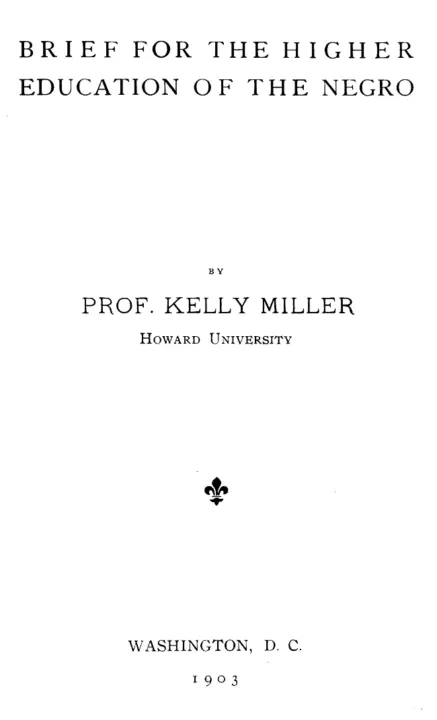
Brief for the higher education of the negro
Kelly Miller
THE CLASSIC COLLECTION · 1919
"Kelly Miller's History of the World War for Human Rights" by Kelly Miller is a historical account written in the early 20th century. This work provides a detailed exploration of World War I with a particular focus on the contributions of Black soldiers in the conflict and the broader implications for human rights and democracy. The book aims to highlight the pivotal roles played by African American troops and the significance of their service in the context of fighting against autocracy and for freedom. The opening of the book sets the tone for an extensive examination of the war and its impact, discussing the far-reaching changes it wrought on civilization. It introduces the main theme of the Negro's involvement in the war, particularly asserting their loyalty and bravery throughout the conflict. Miller plans to present a logical and passionate analysis of the Black contribution to the war, suggesting that their actions during this pivotal historical moment would influence future discussions surrounding civil rights and citizenship in America. By outlining the historical context and highlighting the valor of Black soldiers, the text immediately frames the significance of their contributions against the backdrop of a global struggle for democracy and human rights.
Introduction adapted from the source catalogue; source summaries may be automatically generated.
Free to read · English · 194,149 words · No account needed
MAKE TIME FOR A GOOD BOOK
On by default. Untick to stop anonymous reading totals. Each page counts after 10 seconds in view. How this works.
Anonymous counting is on unless you have switched it off.
Some idea of what all this financing means to a country may be judged by the statement of the Chancellor of the Exchequer, who in October, 1916, replying to questions regarding the English loans in the House of Commons, declared that England was paying at that time about $10,000,000 a day in the United States, for every working day in the year.
When the English mission visited the United States in May, 1917, after the country had entered the war, there was handed to Arthur James Balfour, ex-Premier of England, a check for $200,000,000, said to have been one of the largest single checks ever paid in this country. It was a loan for war purposes. In the month of June it was stated that the total advance made to the Allies was $923,000,000, among the loans made then was one of $75,000,000 to Great Britain, and $3,000,000 to Servia. The Servian loan, the first made by the United States to that country, was mainly for the improvement of railway lines. A small portion was used for the relief of the distressed population, and Red Cross work.
It was stated that the allied countries would spend in America, in the neighborhood of $200,000,000 a month for the year; which brings attention to the resources which America turned in against Germany when she joined the allied forces. To meet the demands made upon it the Government borrowed at once $3,000,000,000 by popular subscription--a matter of history of which the nation is proud.
From its funds the country loaned Russia $100,000,000, which was the first loan made by the United States to that Government. A credit of $45,000,000 to Belgium was also established by the Secretary of the Treasury. This also was Belgium's first participation in the loan of the Allies.
Aside from the financial resources of the United States, the country is undoubtedly the richest in agricultural, mineral and other natural resources. It annually produces more than 3,500,000,000 bushels of corn, wheat touching the high point of 1,500,000,000 bushels; 1,600,000,000 bushels of oats; 250,000,000 bushels of barley; 40,000,000 bushels of rye; 22,000,000 bushels of buckwheat; 425,000,000 bushels of potatoes; 77,000,000 tons of hay; 30,000,000 bushels of flaxseed; 7,000,000,000 pounds of cotton; more than 1,000,000,000 pounds of tobacco; 2,000,000 long tons of sugar and 275,000,000 pounds of wool.
There are nearly 70,000,000 swine, and as many cattle, more than 25,000,000 head of horses and mules, and 62,000,000 sheep. Coal is mined at the rate of more than 500,000,000 tons yearly, and the copper mines yield 1,250,000,000 pounds of metal. Petroleum wells yield 225,500,000 barrels yearly. There are 270,000 manufacturing plants with a yearly output of more than $25,000,000,000. The products of the farm total more than $11,000,000,000 annually.
Your reading position is saved on this browser. Take it to another device with a library code. Reading pages adapt to text, rather than matching a printed edition.
Kelly Miller
Kelly Miller
BEHIND THE BOOK
This eBook is for the use of anyone anywhere in the United States and most other parts of the world at no cost and with almost no restrictions whatsoever. You may copy it, give it away or re-use it under the terms of the Project Gutenberg License included with this eBook or online at www.gutenberg.org. If you are not located in the United States, you will have to check the laws of the country where you are located before using this eBook. Read the source licence.
The original source file, including credits and licence, is retained by this library. Request an original-format copy at no charge. Please include the book title and Project Gutenberg identifier #19179.
KEEP YOUR CURIOSITY GOING
Cécile Tormay

Moritz Busch
John L. Ransom
Frances Wright
Cécile Tormay

Mabel Potter Daggett