THE CLASSIC COLLECTION✦Salve Venetia, gleanings from Venetian history; vol. IICLASSIC FREE BOOKS
Salve Venetia, gleanings from Venetian history; vol. II
F. Marion (Francis Marion) Crawford
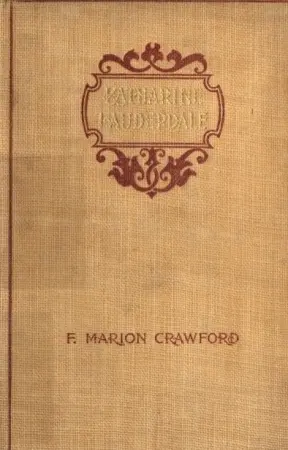
THE CLASSIC COLLECTION · 1893
"Katharine Lauderdale, Vol. 2 of 2" by F. Marion Crawford is a novel written in the late 19th century. The story revolves around the titular character, Katharine Lauderdale, as she navigates the complexities of marriage, family expectations, and societal pressures, particularly concerning her relationship with Jack Ralston, her husband. The narrative delves into themes of independence, love, and the clash between personal desires and familial duty. At the start of this second volume, the tension is palpable as Katharine meets with her wealthy uncle, Robert Lauderdale, to discuss her recent secret marriage to Jack Ralston. Expecting support, she finds herself facing unexpected hurdles as her uncle questions both her and Jack's decisions, highlighting the familial expectations and societal norms that impact their lives. Meanwhile, Jack experiences his own emotional turmoil, feeling the weight of their union and grappling with his identity as a man in a world that has long deemed him a failure. This opening sets the stage for a complex exploration of love, pride, and the struggle between personal happiness and familial obligations.
Introduction adapted from the source catalogue; source summaries may be automatically generated.
Free to read · English · 79,909 words · No account needed
MAKE TIME FOR A GOOD BOOK
On by default. Untick to stop anonymous reading totals. Each page counts after 10 seconds in view. How this works.
Anonymous counting is on unless you have switched it off.
Some one had sat down at the piano. The keyboard was away from them, so that they could not see who it was, but as Katharine spoke a chord was struck, then two or three more followed, and the first bars of a waltz rang through the room. It was the same which the orchestra had been playing on the previous evening, just when Katharine had left the Assembly rooms with Hester Crowdie.
“They were playing that last night,” she said, leaning toward him once more in the shadow of the piano. “I was so unhappy--last night--”
No one was looking at them in their corner. John Ralston caught her hand in his, pressed it almost sharply, and then held it a moment.
“I love you with all my heart,” he said.
The deep grey eyes melted as they met his, and the beautiful mouth
quivered.
“I want to kiss you, dear,” said Katharine. “Then I shall know. Do you think anybody will see?”
That is the story of those five days, from Monday afternoon to Friday evening, in reality little more than four times twenty-four hours. It has been a long story, and if it has not been well told, the fault lies with him who has told it, and may or may not be pardoned, according to the kindness of those whose patience has brought them thus far. And if there be any whose patience will carry them further, they shall be satisfied before long, unless the writer be meanwhile gathered among those who tell no tales.
For there is much more to be said about John Ralston and Katharine, and about all the other people who have entered into their lives. For instance, it may occur to some one to wonder whether, after this last evening, John and Katharine declared their marriage at once, or whether they were obliged to keep the secret much longer, and some may ask whether John Ralston’s resolution held good against more of such temptations as he had resisted on Wednesday night at the Thirlwalls’ dance. Some may like to know whether old Robert Lauderdale lived many years longer, and, if he died, what became of the vast Lauderdale fortune; whether it turned out to be true that Alexander Junior was rich, or, at least, not nearly so poor as he represented himself to be; whether Walter Crowdie had another of those strange attacks which had so terrified his wife on Monday night; whether he and Paul Griggs, the veteran man of letters, were really bound by some common tie of a former history or not, and, finally, perhaps, whether Charlotte Slayback got divorced from Benjamin Slayback of Nevada, or not. There is also a pretty little tale to be told about the three Misses Miner, Frank’s old-maid sisters. And some few there may be who will care to know what Katharine’s convictions ultimately became and remained, when, after passing through this five days’ storm, she found time once more for thought and meditation. All these things may interest a few patient readers, but the main question here raised and not yet answered is whether that hasty, secret marriage between Katharine and John turned out to have been really such a piece of folly as it seemed, or whether the lovers were ultimately glad that they had done as they did. It is assuredly very rash to be married secretly, and some of the reasons given by Katharine when she persuaded John to take the step were not very valid ones, as he, at least, was well aware at the time. But, on the other hand, such true love as they really bore one another is good, and a rare thing in the world, and when men and women feel such love, having felt it long, and knowing it, they may be right to do such things to make sure of not being parted; and they may live to look each into the other’s eyes and say, long afterwards, ‘Thank God that we were not afraid.’ But this must not be asserted of them positively by others without proof.
Your reading position is saved on this browser. Take it to another device with a library code. Reading pages adapt to text, rather than matching a printed edition.
F. Marion (Francis Marion) Crawford
F. Marion (Francis Marion) Crawford

F. Marion (Francis Marion) Crawford

F. Marion (Francis Marion) Crawford
BEHIND THE BOOK
This eBook is for the use of anyone anywhere in the United States and most other parts of the world at no cost and with almost no restrictions whatsoever. You may copy it, give it away or re-use it under the terms of the Project Gutenberg License included with this eBook or online at www.gutenberg.org. If you are not located in the United States, you will have to check the laws of the country where you are located before using this eBook. Read the source licence.
The original source file, including credits and licence, is retained by this library. Request an original-format copy at no charge. Please include the book title and Project Gutenberg identifier #50886.
KEEP YOUR CURIOSITY GOING
Coulson Kernahan

Maurice Baring
Frances Wright
Cécile Tormay

Frederic Jesup Stimson

W. H. P. (William Henry Pope) Jarvis