THE CLASSIC COLLECTION✦Salve Venetia, gleanings from Venetian history; vol. IICLASSIC FREE BOOKS
Salve Venetia, gleanings from Venetian history; vol. II
F. Marion (Francis Marion) Crawford
THE CLASSIC COLLECTION · 1893
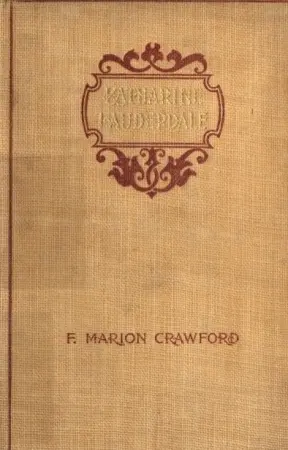
"Katharine Lauderdale, Vol. 2 of 2" by F. Marion Crawford is a novel written in the late 19th century. The story revolves around the titular character, Katharine Lauderdale, as she navigates the complexities of marriage, family expectations, and societal pressures, particularly concerning her relationship with Jack Ralston, her husband. The narrative delves into themes of independence, love, and the clash between personal desires and familial duty. At the start of this second volume, the tension is palpable as Katharine meets with her wealthy uncle, Robert Lauderdale, to discuss her recent secret marriage to Jack Ralston. Expecting support, she finds herself facing unexpected hurdles as her uncle questions both her and Jack's decisions, highlighting the familial expectations and societal norms that impact their lives. Meanwhile, Jack experiences his own emotional turmoil, feeling the weight of their union and grappling with his identity as a man in a world that has long deemed him a failure. This opening sets the stage for a complex exploration of love, pride, and the struggle between personal happiness and familial obligations.
Introduction adapted from the source catalogue; source summaries may be automatically generated.
Free to read · English · 79,909 words · No account needed
MAKE TIME FOR A GOOD BOOK
On by default. Untick to stop anonymous reading totals. Each page counts after 10 seconds in view. How this works.
Anonymous counting is on unless you have switched it off.
“Is it true? Do you really hate music?” asked Katharine, turning and beginning to descend again.
“Quite true,” answered Griggs, quietly. “I detest it. Crowdie’s a nuisance with his perpetual yapping.”
Crowdie laughed good naturedly, and Katharine said nothing. As they reached the lower landing she turned and paused an instant, so that Griggs came beside her.
“Did you always hate music?” she asked, looking up into his weather-beaten face with some curiosity.
“Hm!” Griggs uttered a doubtful sound. “It’s a long time since I heard any that pleased me, at all events.”
“There are certain subjects, Miss Lauderdale, upon which Griggs is unapproachable, because he won’t say anything. And there are others upon which it is dangerous to approach him, because he is likely to say too much. Hester! Where are you?”
He disappeared into the little room at the front of the house in search of his wife, and Katharine stood alone with Griggs in the entry. Again she looked at him with curiosity.
“You’re a very good-humoured person, Mr. Griggs,” she said, with a
smile.
“You mean about Crowdie? Oh, I can stand a lot of his chaff--and he has
to stand mine, too.”
“That was a very interesting answer you gave to my question about dreams,” said Katharine, leaning against the pillar of the banister.
“Was it? Let me see--what did I say?” He seemed to be absent-minded
again.
“Come to luncheon!” cried Crowdie, reappearing with Hester at that moment. “You can talk metaphysics over the oysters.”
“Metaphysics!” exclaimed Griggs, with a smile.
“Oh, I know,” answered Crowdie. “I can’t tell the difference between metaphysics and psychics, and geography and Totem. It is all precisely the same to me--and it is to Griggs, if he’d only acknowledge it. Come along, Miss Lauderdale--to oysters and culture!”
Hester laughed at Crowdie’s good spirits, and Griggs smiled. He had large, sharp teeth, and Katharine thought of the wolf and the rabbit again. It was strange that they should be on such good terms.
They sat down to luncheon. The dining-room, like every other part of the small house, had been beautified as much as its position and dimensions would allow. It had originally been small, but an extension of glass had been built out into the yard, which Hester had turned into a fernery. There were a great number of plants of many varieties, some of which had been obtained with great difficulty from immense distances. Hester had been told that it would be impossible to make them grow in an inhabited room, but she had succeeded, and the result was something altogether out of the common.
Your reading position is saved on this browser. Take it to another device with a library code. Reading pages adapt to text, rather than matching a printed edition.
F. Marion (Francis Marion) Crawford
F. Marion (Francis Marion) Crawford

F. Marion (Francis Marion) Crawford

F. Marion (Francis Marion) Crawford
BEHIND THE BOOK
This eBook is for the use of anyone anywhere in the United States and most other parts of the world at no cost and with almost no restrictions whatsoever. You may copy it, give it away or re-use it under the terms of the Project Gutenberg License included with this eBook or online at www.gutenberg.org. If you are not located in the United States, you will have to check the laws of the country where you are located before using this eBook. Read the source licence.
The original source file, including credits and licence, is retained by this library. Request an original-format copy at no charge. Please include the book title and Project Gutenberg identifier #50886.
KEEP YOUR CURIOSITY GOING
Coulson Kernahan

Maurice Baring
Frances Wright
Cécile Tormay

Frederic Jesup Stimson

W. H. P. (William Henry Pope) Jarvis