THE CLASSIC COLLECTION✦Salve Venetia, gleanings from Venetian history; vol. IICLASSIC FREE BOOKS
Salve Venetia, gleanings from Venetian history; vol. II
F. Marion (Francis Marion) Crawford
THE CLASSIC COLLECTION · 1893
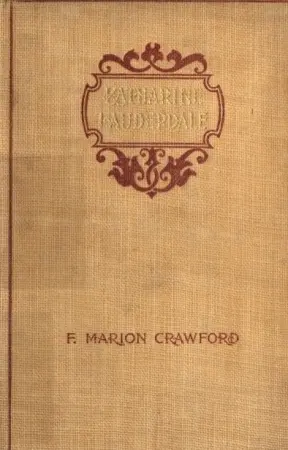
"Katharine Lauderdale, Vol. 2 of 2" by F. Marion Crawford is a novel written in the late 19th century. The story revolves around the titular character, Katharine Lauderdale, as she navigates the complexities of marriage, family expectations, and societal pressures, particularly concerning her relationship with Jack Ralston, her husband. The narrative delves into themes of independence, love, and the clash between personal desires and familial duty. At the start of this second volume, the tension is palpable as Katharine meets with her wealthy uncle, Robert Lauderdale, to discuss her recent secret marriage to Jack Ralston. Expecting support, she finds herself facing unexpected hurdles as her uncle questions both her and Jack's decisions, highlighting the familial expectations and societal norms that impact their lives. Meanwhile, Jack experiences his own emotional turmoil, feeling the weight of their union and grappling with his identity as a man in a world that has long deemed him a failure. This opening sets the stage for a complex exploration of love, pride, and the struggle between personal happiness and familial obligations.
Introduction adapted from the source catalogue; source summaries may be automatically generated.
Free to read · English · 79,909 words · No account needed
MAKE TIME FOR A GOOD BOOK
On by default. Untick to stop anonymous reading totals. Each page counts after 10 seconds in view. How this works.
Anonymous counting is on unless you have switched it off.
“Oh--I don’t know!” Griggs rose abruptly from his seat and began to pace the room. “It’s lots of things, I suppose. Things we don’t understand and never shall--in this world.”
“But in the other world, perhaps,” suggested Crowdie, with a smile which Katharine did not like.
“The other world is the inside of this one,” said Griggs, coming up to the easel and looking at the painting. “That’s good, Crowdie,” he said, thoughtfully. “It’s distinctly good. I mean that it’s like, that’s all. Of course, I don’t know anything about painting--that’s your business.”
“Of course it is,” answered Crowdie; “I didn’t ask you to criticise. But I’m glad if you think it’s like.”
“Yes. Don’t mind my telling you, Crowdie--Miss Lauderdale, I hope you’ll forgive me--there’s a slight irregularity in the pupil of Miss Lauderdale’s right eye--it isn’t exactly round. It affects the expression. Do you see?”
“I never noticed it,” said Katharine in surprise.
“By Jove--you’re right!” exclaimed Crowdie. “What eyes you have,
Griggs!”
“It doesn’t affect your sight in the least,” said Griggs, “and nobody would notice it, but it affects the expression all the same.”
“You saw it at once,” remarked Katharine.
“Oh--Griggs sees everything,” answered Crowdie. “He probably observed the fact last night when he was introduced to you, and has been thinking about it ever since.”
“Now you’ve interrupted him again,” said Katharine. “Do sit down again, Mr. Griggs, and go on with what you were saying--about the other side of the question.”
“The question of success?”
“Yes--and difficulties--and all that.”
“Delightfully vague--‘all that’! I can only give you an idea of what I mean. The question of success involves its own value, and the ultimate happiness of mankind. Do you see how big it is? It goes through everything, and it has no end. What is success? Getting ahead of other people, I suppose. But in what direction? In the direction of one’s own happiness, presumably. Every one has a prime and innate right to be happy. Ideas about happiness differ. With most people it’s a matter of taste and inherited proclivities. All schemes for making all mankind happy in one direction must fail. A man is happy when he feels that he has succeeded--the sportsman when he has killed his game, the parson when he believes he has saved a soul. We can’t all be parsons, nor all good shots. There must be variety. Happiness is success, in each variety, and nothing else. I mean, of course, belief in one’s own success, with a reasonable amount of acknowledgment. It’s of much less consequence to Crowdie, for instance, what you think, or I think, or Mrs. Crowdie thinks about that picture, than it is to himself. But our opinion has a certain value for him. With an amateur, public opinion is everything, or nearly everything. With a good professional it is quite secondary, because he knows much better than the public can, whether his work is good or bad. He himself is his world--the public is only his weather, fine one day and rainy the next. He prefers his world in fine weather, but even when it rains he would not exchange it for any other. He’s his own king, kingdom and court. He’s his own enemy, his own conqueror, and his own captive--slave is a better word. In the course of time he may even become perfectly indifferent to the weather in his world--that is, to the public. And if he can believe that he is doing a good work, and if he can keep inside his own world, he will probably be happy.”
Your reading position is saved on this browser. Take it to another device with a library code. Reading pages adapt to text, rather than matching a printed edition.
F. Marion (Francis Marion) Crawford
F. Marion (Francis Marion) Crawford

F. Marion (Francis Marion) Crawford

F. Marion (Francis Marion) Crawford
BEHIND THE BOOK
This eBook is for the use of anyone anywhere in the United States and most other parts of the world at no cost and with almost no restrictions whatsoever. You may copy it, give it away or re-use it under the terms of the Project Gutenberg License included with this eBook or online at www.gutenberg.org. If you are not located in the United States, you will have to check the laws of the country where you are located before using this eBook. Read the source licence.
The original source file, including credits and licence, is retained by this library. Request an original-format copy at no charge. Please include the book title and Project Gutenberg identifier #50886.
KEEP YOUR CURIOSITY GOING
Coulson Kernahan

Maurice Baring
Frances Wright
Cécile Tormay

Frederic Jesup Stimson

W. H. P. (William Henry Pope) Jarvis