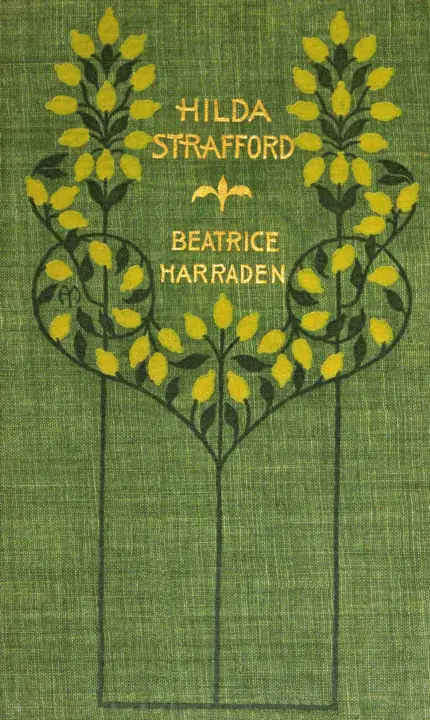
Hilda Strafford: A California Story
Beatrice Harraden

THE CLASSIC COLLECTION · 1903
"Katharine Frensham: A Novel" by Beatrice Harraden is a late 19th-century novel that explores complex family dynamics, love, and personal identity. The story primarily revolves around the characters of Clifford and Marianne Thornton, along with their son Alan, as they navigate the turbulent waters of their faltering marriage. As tensions rise and tragedy strikes, the book delves into themes of regret and the consequences of unfulfilled aspirations. At the start of the novel, we are introduced to Clifford and Alan, who discuss the unhappy state of Clifford's marriage with Marianne. The emotional weight of their confrontation reveals the strains within the family, culminating in the abrupt and tragic death of Marianne after a heated exchange. Following this devastating loss, the focus shifts to both father and son grappling with their grief and guilt. Alongside this, we see the tender moments of their companionship, the interventions of their old Danish governess, Knutty, and the emotional void left by Marianne's passing, setting the stage for potential change and healing in their lives as they embark on a journey to Japan.
Introduction adapted from the source catalogue; source summaries may be automatically generated.
Free to read · English · 94,486 words · No account needed
MAKE TIME FOR A GOOD BOOK
On by default. Untick to stop anonymous reading totals. Each page counts after 10 seconds in view. How this works.
Anonymous counting is on unless you have switched it off.
They passed out of hearing. Clifford took leave of the old saeter-woman, and went to join his companions.
"Alas!" he thought, "she was able to find the right weapon with which to
wound me."
Meantime Katharine and Alan were waiting for him. The boy had thrown himself down on the ground, and seemed lost in his own thoughts. Suddenly he said to her:
"How did you know it was her voice? You have never seen her--have you?"
"Yes," Katharine answered. "I have seen her once before, Alan, when she said cruel and slanderous things against your father. Every one was shocked. No one believed."
"No one believed," Alan repeated to himself.
"No one could believe such things of a man like your father," Katharine answered without looking at him. "Even I, a stranger to him, knew they must be untrue. I thought to myself at the time what a curse it must be to be born with a tongue and a mind like Mrs Stanhope's. Much better to be a sweet old saeter-woman like the old woman up there."
"What was it she said about father?" the boy asked with painful
eagerness.
"I think you know," Katharine replied gently.
And just then Clifford came towards them. Alan got up and ran to meet
him.
"Father," he cried, "I want to tell you everything she said to me. I've tried dozens of times, but----"
"I know, Alan," Clifford said tenderly. "You are even as I have been all my life--a prisoner of silence. We will have a long talk when we get home."
It was a glorious day: with bright warm sunshine, cold, crisp air, and a sky of unbroken blue. And all around stretched the great and wonderful distances, less mysterious in the frankness of the morning, but always possessed of mystic influence and eloquent bidding. But the harmony of the day was gone for Clifford, Katharine, and Alan; the gladness of the expedition was over for them. Still, they took their part with the others, and did their best to hide their own sad feelings. The returning pilgrims passed over the wild heathland, through the low and luxuriant growth of brush, juniper, and stunted willow, through the birch-woods and pine-forests, and so downwards, downwards, their faces set towards the Rondane mountains and their backs to the great Jutenheim range. Gerda sang, Ejnar was rescued from swamps, the French artist sketched, and the little Swedish lady flirted with him, for a "changeling," so she told Katharine! The Mathematiker sulked, Katharine comforted him, and Alan kept close to her, whilst Clifford strolled along, sometimes with them, sometimes alone, and sometimes with Gerda, who loved to get him to herself. The Sorenskriver had left his geniality behind at the Saeter. He became quieter and quieter, until he reached his normal condition of surliness. Jens, however, remained in a state of mountain-exhilaration all the way home, and, encouraged by sympathetic listeners, told stories of frightful Trolds living in the mountains, and of the occasions when he himself had seen apparitions of men, women, and horses fading into nothing on near approach.
Your reading position is saved on this browser. Take it to another device with a library code. Reading pages adapt to text, rather than matching a printed edition.
Beatrice Harraden
Beatrice Harraden
Beatrice Harraden
BEHIND THE BOOK
This eBook is for the use of anyone anywhere in the United States and most other parts of the world at no cost and with almost no restrictions whatsoever. You may copy it, give it away or re-use it under the terms of the Project Gutenberg License included with this eBook or online at www.gutenberg.org. If you are not located in the United States, you will have to check the laws of the country where you are located before using this eBook. Read the source licence.
The original source file, including credits and licence, is retained by this library. Request an original-format copy at no charge. Please include the book title and Project Gutenberg identifier #42812.
KEEP YOUR CURIOSITY GOING
Coulson Kernahan

Maurice Baring
Frances Wright
Cécile Tormay

Frederic Jesup Stimson

W. H. P. (William Henry Pope) Jarvis