
Last letters from the living dead man
David Patterson (Spirit) Hatch
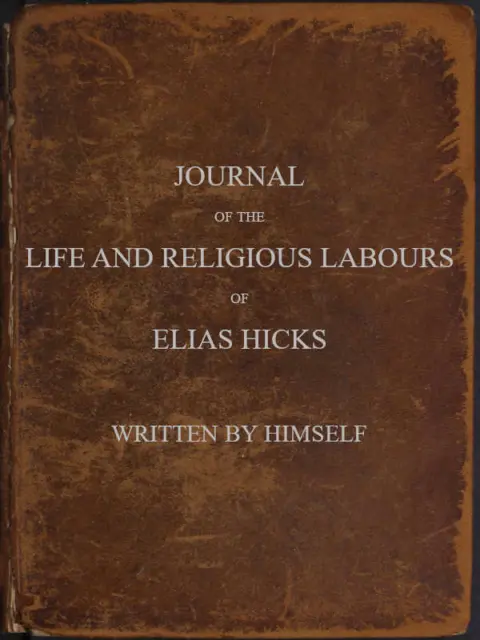
THE CLASSIC COLLECTION · 1832
"Journal of the Life and Religious Labours of Elias Hicks" by Elias Hicks is a personal memoir written in the early 19th century. The work chronicles the life, spiritual journey, and ministry of Elias Hicks, a prominent figure in the Religious Society of Friends (Quakers). It reflects on his experiences, trials, and insights gained through his commitment to his faith and community. At the start of the memoir, Hicks introduces his life, beginning with his birth in 1748 and describing his early influences and spiritual experiences that shaped his character. He shares formative moments, including the challenges he faced during his apprenticeship and the temptations that arose from various influences around him. His narrative reveals not only his struggles with vanity and social distractions but also his eventual commitment to a life of service and religious dedication, which is marked by his later travels and speaking engagements within the Quaker community and beyond. The opening portion sets a reflective and contemplative tone, indicating that the memoir will delve deeply into Hicks's spiritual convictions and his efforts to promote peace and righteousness throughout his life.
Introduction adapted from the source catalogue; source summaries may be automatically generated.
Free to read · English · 168,105 words · No account needed
MAKE TIME FOR A GOOD BOOK
On by default. Untick to stop anonymous reading totals. Each page counts after 10 seconds in view. How this works.
Anonymous counting is on unless you have switched it off.
It was in the latter part of this journey, between Mamaroneck and Westchester, that we met with the interruption, which I before alluded to, from some of those robbers, who frequented the country between the two armies. I was a little ahead of my companion and some other Friends, and was met, and accosted by two of those persons in a very rough manner. I did not see them until they spoke, and one of them demanded very rudely to know where we were going. I looked calmly upon him, and informed him, without the least interruption of mind, where we were intending to go. He then interrogated me further, as to where we had been, what our business was, and where we were from, to all of which I gave true and suitable answers in a mild and pleasant tone. They seemed thereby to be entirely disarmed of their rage and violence, although they had just before robbed and beat a man; and the one, who had hitherto stood silent, being the most overcome, said to his fellow, “Come, let us go, the Quakers go where they please;” and, then turning away, they left us to pursue our journey without further interruption. I considered this as a merciful preservation through the interference of divine providence, who, by his power, not only sets bounds to the sea, and saith, “Hitherto shalt thou come, but no further; and here shall thy proud waves be stayed,” but also limits the rage and will of wicked men, and turns them from their purpose; and thereby delivers, from their power and cruelty, those that put their trust in him.
In the fall of the year 1781, I was taken sick with a fever, which lasted for several months, in the course of which my strength became very much exhausted, and some of my friends were ready to conclude, that I should not continue long with them; yet, through the whole of my indisposition, I had to believe that I should recover. But through the exercise and distress both of body and mind which I experienced, it proved a very humbling dispensation to me. One circumstance in particular made it peculiarly exercising to my mind, although it was that on which I principally grounded my belief of recovery. When I was reduced nearly to the lowest state of bodily weakness, a prospect opened on my mind to pay a religious visit to some parts of our island where no Friends lived, and among a people, who, from the acquaintance I had with them, were more likely to mock, than to receive me, seeing that I considered myself but a child in such a service. But when the prospect first presented, it was very impressive on my mind, and an injunction seemed to attend requiring my assent thereto; and although I pleaded as an excuse my weakness and inability of body, as well as my unfitness, even if I was well, for such a service, yet with all my reasonings and pleadings I could feel no excuse granted me, and the requisition lay heavy upon me both day and night. By my thus standing out, I was brought very low both in body and mind; and finding that I could get no peace in this state of refusal, and that if I did not yield, my life must be taken for my stubbornness without any prospect of peace hereafter, I at length yielded to the heavenly call, which brought immediate peace and comfort to my afflicted soul; and the Lord was very gracious, opening many things for my encouragement. In the forepart of the next summer, having fully recovered my health, and apprehending the right time had arrived to perform this service, I opened it to the monthly meeting, and obtained its unity and concurrence, and two Friends agreed to bear me company. We set out about the middle of the 8th month, 1782, and had a very favoured meeting at Jamaica, with a considerable number of the inhabitants. After this we had a meeting at Samuel Doughty’s, on the south side of the island, and then passed on to a Dutch settlement called Flatlands, where we had some difficulty to obtain a meeting, in consequence of the priest of the place being opposed thereto. The people seemed generally afraid to offend him, but said that if he would consent, they should be very willing to attend. However his assent could not be obtained, for he appeared very jealous lest his interest in the people should be affected. But there was one man, who seemed so much master of his own house, that he said we were welcome to have a meeting in it, let others say what they might. A meeting was accordingly appointed, which, although small, was a satisfactory opportunity. The master of the house and his wife, in an especial manner, seemed much affected therewith, and pressed us to come and see them again. From thence we passed on, and had meetings at Gravesend, New-Utrecht, and Springfield, all to good satisfaction. From the latter we proceeded home, feeling the comfortable reward of peace for this service, and very thankful to the Lord, my gracious helper, for his countenance and support therein. May his name be praised for ever.
Your reading position is saved on this browser. Take it to another device with a library code. Reading pages adapt to text, rather than matching a printed edition.
BEHIND THE BOOK
This eBook is for the use of anyone anywhere in the United States and most other parts of the world at no cost and with almost no restrictions whatsoever. You may copy it, give it away or re-use it under the terms of the Project Gutenberg License included with this eBook or online at www.gutenberg.org. If you are not located in the United States, you will have to check the laws of the country where you are located before using this eBook. Read the source licence.
The original source file, including credits and licence, is retained by this library. Request an original-format copy at no charge. Please include the book title and Project Gutenberg identifier #61777.
KEEP YOUR CURIOSITY GOING
David Patterson (Spirit) Hatch

David Patterson (Spirit) Hatch

David Patterson (Spirit) Hatch
Cécile Tormay

Moritz Busch
John L. Ransom