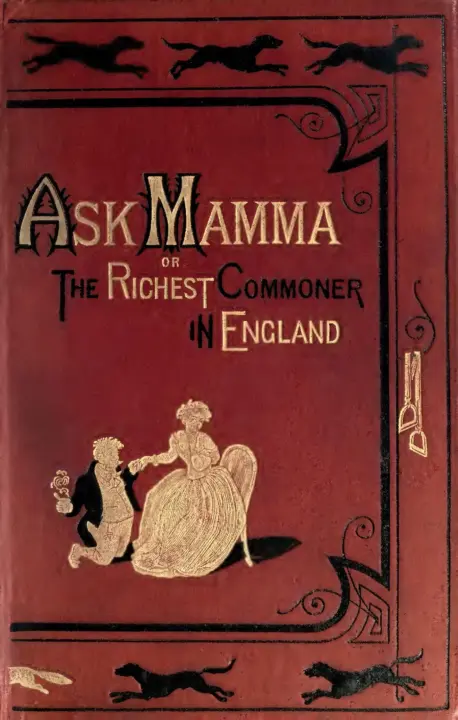
“Ask Mamma”; or, The Richest Commoner In England
Robert Smith Surtees
THE CLASSIC COLLECTION · 1843
"Jorrocks' Jaunts and Jollities" by Robert Smith Surtees is a humorous novel written in the mid-19th century. This book follows the eccentric and boisterous exploits of Mr. Jorrocks, a city grocer and enthusiastic fox hunter, as he navigates the colorful world of hunting and the sportsman lifestyle in Surrey, England. The narrative is characterized by its rich, playful language and satirical observations of the society surrounding the hunt. The opening of the novel sets the stage for the whimsical adventures that await Mr. Jorrocks. It introduces readers to the vibrant atmosphere of fox hunting in Surrey, marked by the camaraderie of the sportsmen and the unique charm of their gatherings. As Mr. Jorrocks prepares for a day of hunting, he reflects on the thrill of the chase while showcasing his personality through humorous anecdotes and lively interactions with fellow hunters. Their antics, coupled with engaging descriptions of the hunting scene, strike a balance between sporting excitement and comedic misadventures, effectively drawing readers into the lively world of the Surrey hunt.
Introduction adapted from the source catalogue; source summaries may be automatically generated.
Free to read · English · 89,620 words · No account needed
MAKE TIME FOR A GOOD BOOK
On by default. Untick to stop anonymous reading totals. Each page counts after 10 seconds in view. How this works.
Anonymous counting is on unless you have switched it off.
The day was fine, and the hearts of all seemed light and gay. The coach, though slow, was clean and smart, the harness bright and well-polished, while the sleek brown horses poked their heads about at ease, without the torture of the bearing-rein. The coachman, like his vehicle, was heavy, and had he been set on all fours, a party of six might have eat off his back. Thus they proceeded at a good steady substantial sort of pace; trotting on level ground, walking up hills, and dragging down inclines. Nor among the whole party was there a murmur of discontent at the pace. Most of the passengers seemed careless which way they went, so long as they did but move, and they rolled through the Garden of England with the most stoical indifference. We know not whether it has ever struck the reader, but the travellers by Dover coaches are less captious about pace than those on most others.
And now let us fancy our friends up, and down, Shooter's Hill, through Dartford, Northfleet, and Gravesend--at which latter place, the first foreign symptom appears, in words, "Poste aux Chevaux," on the door-post of the inn; and let us imagine them bowling down Rochester Hill at a somewhat amended pace, with the old castle, by the river Medway, the towns of Chatham, Strood and Rochester full before them, and the finely wooded country extending round in pleasing variety of hill and dale. As they reach the foot of the hill, the guard commences a solo on his bugle, to give notice to the innkeeper to have the coach dinner on the table. All huddled together, inside and out, long passengers and short ones, they cut across the bridge, rattle along the narrow street, sparking the mud from the newly-watered streets on the shop windows and passengers on each side, and pull up at the "Pig and Crossbow," with a jerk and a dash as though they had been travelling at the rate of twelve miles an hour. Two other coaches are "dining," while some few passengers, whose "hour is not yet come," sit patiently on the roof, or pace up and down the street with short and hurried turns, anxious to see the horses brought out that are to forward them on their journey. And what a commotion this new arrival creates! From the arched doorway of the inn issue two chamber-maids, one in curls the other in a cap; Boots, with both curls and a cap, and a ladder in his hand; a knock-kneed waiter, with a dirty duster, to count noses, while the neat landlady, in a spruce black silk gown and clean white apron, stands smirking, smiling, and rubbing her hands down her sides, inveigling the passengers into the house, where she will turn them over to the waiters to take their chance the instant she gets them in. About the door the usual idlers are assembled.--A coachman out of place, a beggar out at the elbows, a sergeant in uniform, and three recruits with ribbons in their hats; a captain with his boots cut for corns, the coachman that is to drive to Dover, a youth in a straw hat and a rowing shirt, the little inquisitive old man of the place--who sees all the midday coaches change horses, speculates on the passengers and sees who the parcels are for--and, though last but not least, Mr. Bangup, the "varmint" man, the height of whose ambition is to be taken for a coachman. As the coach pulled up, he was in the bar taking a glass of cold sherry "without" and a cigar, which latter he brings out lighted in his mouth, with his shaved white hat stuck knowingly on one side, and the thumbs of his brown hands thrust into the arm-holes of his waistcoat, throwing back his single breasted fancy buttoned green coat, and showing a cream coloured cravat, fastened with a gold coach-and-four pin, which, with a buff waistcoat and tight drab trousers buttoning over the boot, complete his "toggery," as he would call it. His whiskers are large and riotous in the extreme, while his hair is clipped as close as a charity schoolboy's. The coachman and he are on the best of terms, as the outward twist of their elbows and jerks of the head on meeting testify. His conversation is short and slangy, accompanied with the correct nasal twang. After standing and blowing a few puffs, during which time the passengers have all alighted, and the coachman has got through the thick of his business, he takes the cigar out of his mouth, and, spitting on the flags, addresses his friend with, "Y've got the old near-side leader back from Joe, I see." "Yes, Mr. Bangup, yes," replies his friend, "but I had some work first--our gov'rnor was all for the change--at last, says I to our 'osskeeper, says I, it arn't no use your harnessing that 'ere roan for me any more, for as how I von't drive him, so it's not to no use harnessing of him, for I von't be gammon'd out of my team not by none on them, therefore it arn't to never no use harnessing of him again for me." "So you did 'em," observes Mr. Bangup. "Lord bless ye, yes! it warn't to no use aggravising about it, for says I, I von't stand it, so it warn't to no manner of use harnessing of him again for me." "Come, Smith, what are you chaffing there about?" inquires the landlord, coming out with the wide-spread way-bill in his hands, "have you two insides?" "No, gov'rnor, I has but von, and that's precious empty, haw! haw! haw!" "Well, but now get Brown to blow his horn early, and you help to hurry the passengers away from my grub, and may be I'll give you your dinner for your trouble," replies the landlord, reckoning he would save both his meat and his horses by the experiment. "Ay, there goes the dinner!" added he, just as Mr. Jorrocks's voice was heard inside the "Pig and Crossbow," giving a most tremendous roar for his food.--"Pork at the top, and pork at the bottom," the host observes to the waiter in passing, "and mind, put the joints before the women--they are slow carvers."
Your reading position is saved on this browser. Take it to another device with a library code. Reading pages adapt to text, rather than matching a printed edition.
BEHIND THE BOOK
This eBook is for the use of anyone anywhere in the United States and most other parts of the world at no cost and with almost no restrictions whatsoever. You may copy it, give it away or re-use it under the terms of the Project Gutenberg License included with this eBook or online at www.gutenberg.org. If you are not located in the United States, you will have to check the laws of the country where you are located before using this eBook. Read the source licence.
The original source file, including credits and licence, is retained by this library. Request an original-format copy at no charge. Please include the book title and Project Gutenberg identifier #15387.
KEEP YOUR CURIOSITY GOING
Coulson Kernahan

Maurice Baring
Frances Wright
Cécile Tormay

Frederic Jesup Stimson

W. H. P. (William Henry Pope) Jarvis