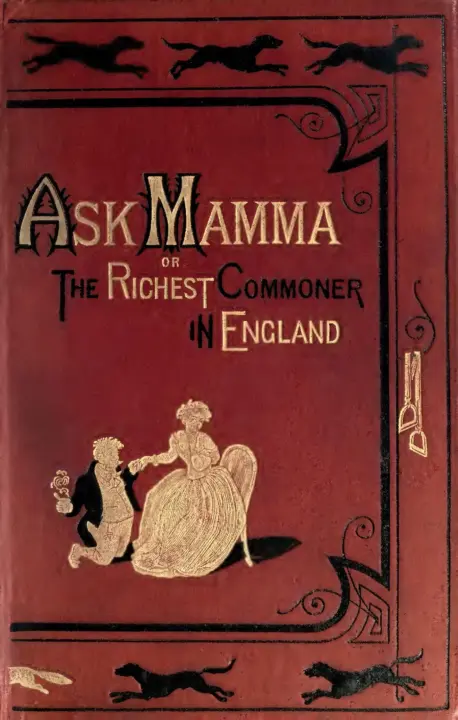
“Ask Mamma”; or, The Richest Commoner In England
Robert Smith Surtees
THE CLASSIC COLLECTION · 1843
"Jorrocks' Jaunts and Jollities" by Robert Smith Surtees is a humorous novel written in the mid-19th century. This book follows the eccentric and boisterous exploits of Mr. Jorrocks, a city grocer and enthusiastic fox hunter, as he navigates the colorful world of hunting and the sportsman lifestyle in Surrey, England. The narrative is characterized by its rich, playful language and satirical observations of the society surrounding the hunt. The opening of the novel sets the stage for the whimsical adventures that await Mr. Jorrocks. It introduces readers to the vibrant atmosphere of fox hunting in Surrey, marked by the camaraderie of the sportsmen and the unique charm of their gatherings. As Mr. Jorrocks prepares for a day of hunting, he reflects on the thrill of the chase while showcasing his personality through humorous anecdotes and lively interactions with fellow hunters. Their antics, coupled with engaging descriptions of the hunting scene, strike a balance between sporting excitement and comedic misadventures, effectively drawing readers into the lively world of the Surrey hunt.
Introduction adapted from the source catalogue; source summaries may be automatically generated.
Free to read · English · 89,620 words · No account needed
MAKE TIME FOR A GOOD BOOK
On by default. Untick to stop anonymous reading totals. Each page counts after 10 seconds in view. How this works.
Anonymous counting is on unless you have switched it off.
"Pray, are your clocks here by London time?" he asked of a respectable elderly-looking man whom he saw turn out of the entry leading to the Kingston rooms, and take the usual survey first up the town and then down it, and afterwards compose his hands in his breeches-pockets, there to stand to see the "world." [17] "Come now, old 'un--none o' your tricks here--you've got a match on against time, I suppose," was all the answer he could get after the man (old R--n the ex-flagellator) had surveyed him from head to foot.
[Footnote 17: Newmarket or London--it's all the same--"The world" is but composed of one's own acquaintance.]
We need hardly say after all these rebuffs that when Mr. Jorrocks met the Yorkshireman, he was not in the best possible humour; indeed, to say nothing of the extreme sharpness and suspicion of the people, we know of no place where a man, not fond of racing, is so completely out of his element as at Newmarket, for with the exception of a little "elbow shaking" in the evening, there is literally and truly nothing else to do. It is "Heath," "Ditch in," "Abingdon mile," "T.Y.C. Stakes," "Sweepstakes," "Handicaps," "Bet," "Lay," "Take," "Odds," "Evens," morning, noon and night.
Mr. Jorrocks made bitter complaints during the breakfast, and some invidious comparisons between racing men and fox-hunters, which, however, became softer towards the close, as he got deeper in the delicacy of a fine Cambridge brawn. Nature being at length appeased, he again thought of turning out, to have a look, as he said, at the shows on the course, but the appearance of his friend the Baron opposite the window, put it out of his head, and he sallied forth to join him. The Baron was evidently incog.: for he had on the same short dirty-white waistcoat, Chinese boots, and conical hat, that he travelled down in, and being a stranger in the land, of course he was uncommonly glad to pick up Jorrocks, so after he had hugged him a little, called him a "bon garcon," and a few other endearing terms, he run his great long arm through his, and walked him down street, the whole peregrinations of Newmarket being comprised in the words "up street" and "down." He then communicated in most unrepresentable language, that he was on his way to buy "an 'oss," and Jorrocks informing him that he was a perfect connoisseur in the article, the Baron again assured him of his distinguished consideration. They were met by Joe Rogers the trainer with a ring-key in his hand, who led the way to the stable, and having unlocked a box in which was a fine slapping four-year old, according to etiquette he put his hat in a corner, took a switch in one hand, laid hold of the horse's head with the other, while the lad in attendance stripped off its clothes. The Baron then turned up his wrists, and making a curious noise in his throat, proceeded to pass his hand down each leg, and along its back, after which he gave it a thump in the belly and squeezed its throat, when, being as wise as he was at starting, he stuck his thumb in his side, and took a mental survey of the whole.--"Ah," said he at length--"foin 'oss,--foin 'oss; vot ears he has?" "Oh," said Rogers, "they show breeding." "Non, non, I say vot ears he has?" "Well, but he carries them well," was the answer. "Non, non," stamping, "I say vot ears (years) he has?" "Oh, hang it, I twig--four years old." Then the Baron took another long look at him. At length he resumed, "I vill my wet." "What's that?" inquired Rogers of Jorrocks. "His wet--why, a drink to be sure," and thereupon Rogers went to the pump and brought a glass of pure water, which the Baron refused with becoming indignation. "Non, non," said he stamping, "I vill my wet." Rogers looked at Jorrocks, and Jorrocks looked at Rogers, but neither Rogers nor Jorrocks understood him. "I vill my wet," repeated the Baron with vehemence. "He must want some brandy in it," observed Mr. Jorrocks, judging of the Baron by himself, and thereupon the lad was sent for three-penn'orth. When it arrived, the Baron dashed it out of his hand with a prolonged sacre-e-e-e--! adding "I vill von wet-tin-nin-na-ary surgeon." The boy was dispatched for one, and on his arrival the veterinary surgeon went through the process that the Baron had attempted, and not being a man of many words, he just gave the Baron a nod at the end. "How moch?" inquked the Baron of Rogers. "Five hundred," was the answer. "Vot, five hundred livre?" "Oh d----n it, you may take or leave him, just as you like, but you won't get him for less." The "vet" explained that the Baron wished to know whether it was five hundred francs (French ten-pences), or five hundred guineas English money, and being informed that it was the latter, he gave his conical hat a thrust on his brow, and bolted out of the box.
Your reading position is saved on this browser. Take it to another device with a library code. Reading pages adapt to text, rather than matching a printed edition.
BEHIND THE BOOK
This eBook is for the use of anyone anywhere in the United States and most other parts of the world at no cost and with almost no restrictions whatsoever. You may copy it, give it away or re-use it under the terms of the Project Gutenberg License included with this eBook or online at www.gutenberg.org. If you are not located in the United States, you will have to check the laws of the country where you are located before using this eBook. Read the source licence.
The original source file, including credits and licence, is retained by this library. Request an original-format copy at no charge. Please include the book title and Project Gutenberg identifier #15387.
KEEP YOUR CURIOSITY GOING
Coulson Kernahan

Maurice Baring
Frances Wright
Cécile Tormay

Frederic Jesup Stimson

W. H. P. (William Henry Pope) Jarvis