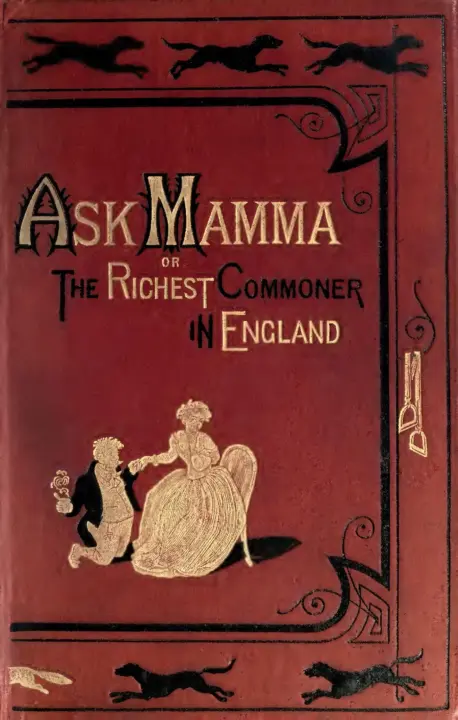
“Ask Mamma”; or, The Richest Commoner In England
Robert Smith Surtees
THE CLASSIC COLLECTION · 1843
"Jorrocks' Jaunts and Jollities" by Robert Smith Surtees is a humorous novel written in the mid-19th century. This book follows the eccentric and boisterous exploits of Mr. Jorrocks, a city grocer and enthusiastic fox hunter, as he navigates the colorful world of hunting and the sportsman lifestyle in Surrey, England. The narrative is characterized by its rich, playful language and satirical observations of the society surrounding the hunt. The opening of the novel sets the stage for the whimsical adventures that await Mr. Jorrocks. It introduces readers to the vibrant atmosphere of fox hunting in Surrey, marked by the camaraderie of the sportsmen and the unique charm of their gatherings. As Mr. Jorrocks prepares for a day of hunting, he reflects on the thrill of the chase while showcasing his personality through humorous anecdotes and lively interactions with fellow hunters. Their antics, coupled with engaging descriptions of the hunting scene, strike a balance between sporting excitement and comedic misadventures, effectively drawing readers into the lively world of the Surrey hunt.
Introduction adapted from the source catalogue; source summaries may be automatically generated.
Free to read · English · 89,620 words · No account needed
MAKE TIME FOR A GOOD BOOK
On by default. Untick to stop anonymous reading totals. Each page counts after 10 seconds in view. How this works.
Anonymous counting is on unless you have switched it off.
"Bravo!" exclaimed Jorrocks, throwing his paper cap in the air as the Yorkshireman concluded.--"Bravo!--werry good indeed! You speak like ten Lord Mayors--never heard nothing better. Dash my vig, if I won't go. By Jove, you've done it. Tell me one thing--is there a good place to feed at?"
"Capital!" replied the Yorkshireman, "beef, mutton, cheese, ham, all the delicacies of the season, as the sailor said"; and thereupon the Yorkshireman and Jorrocks shook hands upon the bargain.
Sunday night arrived, and with it arrived, at the "Belle Sauvage," in Ludgate Hill, Mr. Jorrocks's boy "Binjimin," with Mr. Jorrocks's carpet-bag; and shortly after Mr. Jorrocks, on his chestnut hunter, and the Yorkshireman, in a hack cab, entered the yard. Having consigned his horse to Binjimin; after giving him a very instructive lesson relative to the manner in which he would chastise him if he heard of his trotting or playing any tricks with the horse on his way home, Mr. Jorrocks proceeded to pay the remainder of his fare in the coach office. The mail was full inside and out, indeed the book-keeper assured him he could have filled a dozen more, so anxious ware all London to see the Riddlesworth run. "Inside," said he, "are you and your friend, and if it wern't that the night air might give you cold, Mr. Jorrocks" (for all the book-keepers in London know him), "I should have liked to have got you outsides, and I tried to make an exchange with two black-legs, but they would hear of nothing less than two guineas a head, which wouldn't do, you know. Here comes another of your passengers--a great foreign nobleman, they say--Baron something--though he looks as much like a foreign pickpocket as anything else."
"Vich be de voiture?" inquired a tall, gaunt-looking foreigner, with immense moustache, a high conical hat with a bright buckle, long, loose, blueish-blackish frock-coat, very short white waistcoat, baggy brownish striped trousers, and long-footed Wellington boots, with a sort of Chinese turn up at the toe. "Vich be de Newmarket Voiture?" said he, repeating the query, as he entered the office and deposited a silk umbrella, a camlet cloak, and a Swiss knapsack on the counter. The porter, without any attempt at an answer, took his goods and walked off to the mail, followed closely by the Baron, and after depositing the cloak inside, so that the Baron might ride with his "face to the horses," as the saying is, he turned the knapsack into the hind boot, and swung himself into the office till it was time to ask for something for his exertions. Meanwhile the Baron made a tour of the yard, taking a lesson in English from the lettering on the various coaches, when, on the hind boot of one, he deciphered the word Cheapside.--"Ah, Cheapside!" said he, pulling out his dictionary and turning to the letter C. "Chaste, chat, chaw,--cheap, dat be it. Cheap,--to be had at a low price--small value. Ah! I hev (have) it," said he, stamping and knitting his brows, "sacre-e-e-e-e nom de Dieu," and the first word being drawn out to its usual longitude, three strides brought him and the conclusion of the oath into the office together. He then opened out upon the book-keeper, in a tremendous volley of French, English and Hanoverian oaths, for he was a cross between the first and last named countries, the purport of which was "dat he had paid de best price, and he be dem if he vod ride on de Cheapside of de coach." In vain the clerks and book-keepers tried to convince him he was wrong in his interpretation. With the full conviction of a foreigner that he was about to be cheated, he had his cloak shifted to the opposite side of the coach, and the knapsack placed on the roof. The fourth inside having cast up, the outside passengers mounted, the insides took their places, three-pences and sixpences were pulled out for the porters, the guard twanged his horn, the coachman turned out his elbow, flourished his whip, caught the point, cried "All right! sit tight!" and trotted out of the yard.
Your reading position is saved on this browser. Take it to another device with a library code. Reading pages adapt to text, rather than matching a printed edition.
BEHIND THE BOOK
This eBook is for the use of anyone anywhere in the United States and most other parts of the world at no cost and with almost no restrictions whatsoever. You may copy it, give it away or re-use it under the terms of the Project Gutenberg License included with this eBook or online at www.gutenberg.org. If you are not located in the United States, you will have to check the laws of the country where you are located before using this eBook. Read the source licence.
The original source file, including credits and licence, is retained by this library. Request an original-format copy at no charge. Please include the book title and Project Gutenberg identifier #15387.
KEEP YOUR CURIOSITY GOING
Coulson Kernahan

Maurice Baring
Frances Wright
Cécile Tormay

Frederic Jesup Stimson

W. H. P. (William Henry Pope) Jarvis