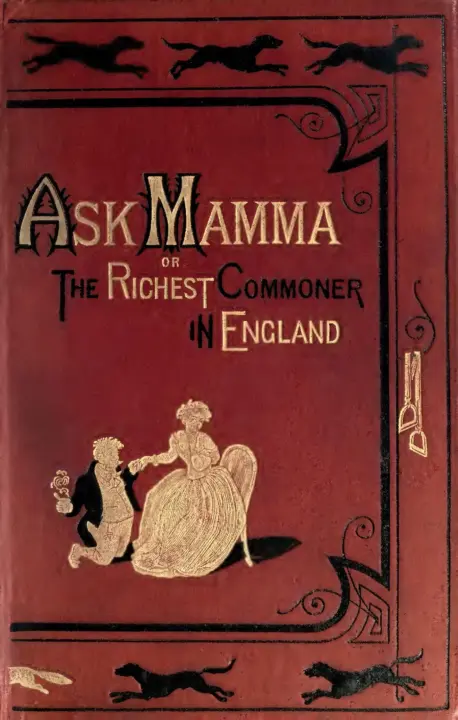
“Ask Mamma”; or, The Richest Commoner In England
Robert Smith Surtees
THE CLASSIC COLLECTION · 1843
"Jorrocks' Jaunts and Jollities" by Robert Smith Surtees is a humorous novel written in the mid-19th century. This book follows the eccentric and boisterous exploits of Mr. Jorrocks, a city grocer and enthusiastic fox hunter, as he navigates the colorful world of hunting and the sportsman lifestyle in Surrey, England. The narrative is characterized by its rich, playful language and satirical observations of the society surrounding the hunt. The opening of the novel sets the stage for the whimsical adventures that await Mr. Jorrocks. It introduces readers to the vibrant atmosphere of fox hunting in Surrey, marked by the camaraderie of the sportsmen and the unique charm of their gatherings. As Mr. Jorrocks prepares for a day of hunting, he reflects on the thrill of the chase while showcasing his personality through humorous anecdotes and lively interactions with fellow hunters. Their antics, coupled with engaging descriptions of the hunting scene, strike a balance between sporting excitement and comedic misadventures, effectively drawing readers into the lively world of the Surrey hunt.
Introduction adapted from the source catalogue; source summaries may be automatically generated.
Free to read · English · 89,620 words · No account needed
MAKE TIME FOR A GOOD BOOK
On by default. Untick to stop anonymous reading totals. Each page counts after 10 seconds in view. How this works.
Anonymous counting is on unless you have switched it off.
[Footnote 16: Poor Jonathan, one of the hardest riders and drinkers of his day, exists, like his pack, but in the recollection of mankind. He was long huntsman to the late Lord Derby, who, when he gave up his staghounds, made Jonathan a present of them, and for two or three seasons he scratched on in an indifferent sort of way, until the hounds were sold to go abroad--to Hungary, we believe.]
On hearing this, a gentleman off with his glove and began collecting, or capping, prior to turning out--it being the rule of the hunt to make sure of the money before starting, for fear of accidents. "Half a crown, if you please, sir." "Now I'll take your half a crown." "Mr. Jorrocks, shall I trouble you for half a crown?" "Oh, surely," said Jorrocks, pulling out a handful of great five-shilling pieces; "here's for this gentleman and myself," handing one of them over, "and I shan't even ask you for discount for ready money." The capping went round, and a goodly sum was collected. Meanwhile the deer-cart was drawn to the far side of a thick fence, and the door being opened, a lubberly-looking animal, as big as a donkey, blobbed out, and began feeding very composedly. "That won't do," said Jonathan Griffin, eyeing him--"ride on, Tom, and whip him away." Off went the whip, followed by a score of sportsmen whose shouts, aided by the cracking of their whips, would have frightened the devil himself; and these worthies, knowing the hounds would catch them up in due time, resolved themselves into a hunt for the present, and pursued the animal themselves. Ten minutes having expired and the hounds seeming likely to break away, Jonathan thought it advisable to let them have their wicked will, and accordingly they rushed off in full cry to the spot where the deer had been uncarted. Of course, there was no trouble in casting for the scent; indeed they were very honest, and did not pretend to any mystery; the hounds knew within an inch where it would be, and the start was pretty much like that for a hunter's plate in four-mile heats. A few dashing blades rode before the hounds at starting, but otherwise the field was tolerably quiet, and was considerably diminished after the three first leaps. The scent improved, as did the pace, and presently they got into a lane along which they rattled for five miles as hard as ever they could lay legs to the ground, throwing the mud into each other's faces, until each man looked as if he was roughcast. A Kentish wagon, drawn by six oxen, taking up the whole of the lane, had obliged the dear animal to take to the fields again, where, at the first fence, most of our high-mettled racers stood still. In truth, it was rather a nasty place, a yawning ditch, with a mud bank and a rotten landing. "Now, who's for it? Go it, Jorrocks, you're a fox-hunter," said one, who, erecting himself in his stirrups, was ogling the opposite side. "I don't like it," said Jorrocks; "is never a gate near?" "Oh yes, at the bottom of the field," and away they all tore for it. The hounds now had got out of sight, but were heard running in cover at the bottom of the turnip-field into which they had just passed, and also the clattering of horses' hoofs on the highway. The hounds came out several times on to the road, evidently carrying the scent, but as often threw up and returned into the cover. The huntsman was puzzled at last; and quite convinced that the deer was not in the wood, he called them out, and proceeded to make a cast, followed by the majority of the field. They trotted about at a brisk pace, first to the right, then to the left, afterwards to the north, and then to the south, over grass, fallow, turnips, potatoes, and flints, through three farmyards, round two horse-ponds, and at the back of a small village or hamlet, without a note, save those of a few babblers. Everyone seemed to consider it a desperate job. They were all puzzled; at last they heard a terrible holloaing about a quarter of a mile to the south, and immediately after was espied a group of horsemen, galloping along the road at full speed, in the centre of which was Jorrocks; his green coat wide open, with the tails flying a long way behind that of his horse, his right leg was thrust out, down the side of which he kept applying his ponderous hunting whip, making a most terrible clatter. As they approached, he singled himself out from the group, and was the first to reach the field. He immediately burst out into one of his usual hunting energetic strains. "Oh Jonathan Griffin! Jonathan Griffin!" said he, "here's a lamentable occurrence--a terrible disaster! Oh dear, oh dear--we shall never get to Tunbridge--that unfortunate deer has escaped us, and we shall never see nothing more of him--rely upon it, he's killed before this." "Why, how's that?" inquired Griffin, evidently in a terrible perturbation. "Why," said Jorrocks, slapping the whip down his leg again, "there's a little girl tells me, that as she was getting water at the well just at the end of the wood, where we lost him, she saw what she took to be a donkey jump into a return post-chaise from the 'Bell', at Seven Oaks, that was passing along the road with the door swinging wide open! and you may rely upon it, it was the deer. The landlord of the 'Bell' will have cut his throat before this, for, you know, he vowed wengeance against us last year, because his wife's pony-chaise was upset, and he swore that we did it." "Oh, but that's a bad job", said the huntsman; "what shall we do?" "Here, Tom," calling to the whipper-in, "jump on to the Hastings coach" (which just came up), "and try if you can't overtake him, and bring him back, chaise and all, and I'll follow slowly with the hounds." Tom was soon up, the coach bowled on, and Jonathan and the hounds trotted gently forward till they came to a public-house. Here, as they stopped lamenting over their unhappy fate, and consoling themselves with some cold sherry negus, the post-chaise appeared in sight, with the deer's head sticking out of the side window with all the dignity of a Lord Mayor. "Huzza! huzza! huzza!" exclaimed Jorrocks, taking off his hat, "here's old Tunbridge come back again, huzza! huzza!" "But who's to pay me for the po-chay," said the driver, pulling up; "I must be paid before I let him out." "How much?" says Jonathan. "Why, eighteen-pence a mile, to be sure, and three-pence a mile to the driver." "No," says Jorrocks, "that won't do, yours is a return chay; however, here's five shillings for you, and now, Jonathan, turn him out again--he's quite fresh after his ride--and see, he's got some straw in the bottom."
Your reading position is saved on this browser. Take it to another device with a library code. Reading pages adapt to text, rather than matching a printed edition.
BEHIND THE BOOK
This eBook is for the use of anyone anywhere in the United States and most other parts of the world at no cost and with almost no restrictions whatsoever. You may copy it, give it away or re-use it under the terms of the Project Gutenberg License included with this eBook or online at www.gutenberg.org. If you are not located in the United States, you will have to check the laws of the country where you are located before using this eBook. Read the source licence.
The original source file, including credits and licence, is retained by this library. Request an original-format copy at no charge. Please include the book title and Project Gutenberg identifier #15387.
KEEP YOUR CURIOSITY GOING
Coulson Kernahan

Maurice Baring
Frances Wright
Cécile Tormay

Frederic Jesup Stimson

W. H. P. (William Henry Pope) Jarvis