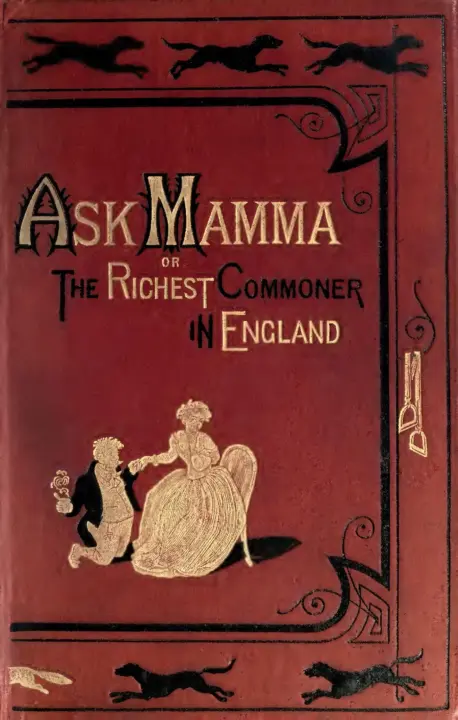
“Ask Mamma”; or, The Richest Commoner In England
Robert Smith Surtees
THE CLASSIC COLLECTION · 1843
"Jorrocks' Jaunts and Jollities" by Robert Smith Surtees is a humorous novel written in the mid-19th century. This book follows the eccentric and boisterous exploits of Mr. Jorrocks, a city grocer and enthusiastic fox hunter, as he navigates the colorful world of hunting and the sportsman lifestyle in Surrey, England. The narrative is characterized by its rich, playful language and satirical observations of the society surrounding the hunt. The opening of the novel sets the stage for the whimsical adventures that await Mr. Jorrocks. It introduces readers to the vibrant atmosphere of fox hunting in Surrey, marked by the camaraderie of the sportsmen and the unique charm of their gatherings. As Mr. Jorrocks prepares for a day of hunting, he reflects on the thrill of the chase while showcasing his personality through humorous anecdotes and lively interactions with fellow hunters. Their antics, coupled with engaging descriptions of the hunting scene, strike a balance between sporting excitement and comedic misadventures, effectively drawing readers into the lively world of the Surrey hunt.
Introduction adapted from the source catalogue; source summaries may be automatically generated.
Free to read · English · 89,620 words · No account needed
MAKE TIME FOR A GOOD BOOK
On by default. Untick to stop anonymous reading totals. Each page counts after 10 seconds in view. How this works.
Anonymous counting is on unless you have switched it off.
"Hold!" roared the Colonel, half smothered in the embrace, and disengaging himself he drew back a few paces, putting his hand on the hilt of his sword, when in the training groom of Paris he recognised his friend the Baron of Newmarket. The abruptness of the incident disarmed Mr. Jorrocks of reflection, and being a man of impulse and warm affections, he at once forgave the novelty of the embrace, and most cordially joined hands with those of his friend. They then struck up a mixture of broken English and equally broken French, in mutual inquiries after each other's healths and movements, and presuming that Mr. Jorrocks was following up the sporting trade in Paris, the Baron most considerately gave him his best recommendations which horse to back, kindly betting with him himself, but, unfortunately, at each time assigning Mr. Jorrocks the losing horse. At length, being completely cleaned out, he declined any further transactions, and having got the Countess into the cab, was in the act of climbing in himself, when someone took him by the sword as he was hoisting himself up by the wooden apron, and drew him back to the ground. "Holloa, Stubbs, my boy!" cried he, "I'm werry 'appy to see ye," holding out his hand, and thereupon Mr. Stubbs took off his hat to the Countess. "Well now, the deuce be in these French," observed Mr. Jorrocks, confidentially, in an undertone as, resigning the reins to Agamemnon, he put his arm through the Yorkshireman's and drew out of hearing of the Countess behind the cab--"the deuce be in them. I say. There's that beggarly Baron as we met at Newmarket has just diddled me out of four Naps and a half, by getting me to back 'osses that he said were certain to win, and I really don't know how we are to make 'tongue and buckle' meet, as the coachmen say. Somehow or other they are far too sharp for me. Cards, dominoes, dice, backgammon, and racing, all one--they inwariably beat me, and I declare I haven't as much pewter as will coach me to Calais." The Yorkshireman, as may be supposed, was not in a condition of any great pecuniary assistance, but after a turn or two along the mound, he felt it would be a reproach on his country if he suffered his friend to be done by a Frenchman, and on consideration he thought of a trick that Monsieur would not be up to. Accordingly, desiring Mr. Jorrocks to take him to the Baron, and behave with great cordiality, and agree to the proposal he should make, they set off in search of that worthy, who, after some trouble, they discovered in the "Cottage of Content," entertaining John Jones and his comrades with an account of the manner in which he had fleeced Monsieur Shorrock. The Yorkshireman met him with the greatest delight, shook hands with him over and over again, and then began talking about racing, pigeon-shooting, and Newmarket, pretended to be full of money, and very anxious for the Baron's advice in laying it out. On hearing this, the Baron beckoned him to retire, and joining him in the avenue, walked him up and down, while he recommended his backing a horse that was notoriously amiss. The Yorkshireman consented, lost a Nap with great good humour, and banteringly told the Baron he thought he could beat the horse on foot. This led them to talk of foot-racing and at last the Yorkshireman offered to bet that Mr. Jorrocks would run fifty yards with him on his back, before the Baron would run a hundred. Upon this the Baron scratched his head and looked very knowing, pretended to make a calculation, when the Yorkshireman affected fear, and professed his readiness to withdraw the offer. The Baron then plucked up his courage, and after some haggling, the match was made for six Naps, the Yorkshireman reckoning the Baron might have ten francs in addition to what he had won of Mr. Jorrocks and himself. The money was then deposited in the hands of the Countess Benvolio, and away went the trio to the "Cottage of Content," to get men and ropes to measure and keep the ground. The English jockeys and lads, though ready enough to pigeon a countryman themselves, have no notion of assisting a foreigner to do so, unless they share in the spoil, and the Baron being a notorious screw, they all seemed heartily glad to find him in a trap. Out then they all sallied, amid cheers and shouts, while John Jones, with a yard-wand in his hand, proceeded to measure a hundred yards along the low side of the mound. This species of amusement being far more in accordance with the taste of the French than anything in which horses are concerned, an immense mob flocked to the scene, and the Baron having explained how it was, and being considered a safe man to follow, numerous offers were made to bet against the performance of the match. The Yorkshireman being a youth of discretion and accustomed to bet among strangers, got on five Naps more with different parties, who to "prevent accidents" submitted to deposit the money with the Countess, and all things being adjusted, and the course cleared by a picket of infantry, Mr. Jorrocks ungirded his sword, and depositing it with his frock-coat in the cab, walked up to the fifty yards he was to have for start. "Now, Colonel," said the Yorkshireman, backing him to the mound, so that he might leap on without shaking him, "put your best leg first, and it's a hollow thing; if you don't fall, you must win,"--and thereupon taking Mr. Jorrocks's cocked hat and feather from his head, he put it sideways on his own, so that he might not be recognised, and mounted his man. Mr. Jorrocks then took his place as directed by John Jones, and at a signal from him--the dropping of a blue cotton handkerchief--away they started amid the shouts, the clapping of hands, and applause of the spectators, who covered the mound and lined the course on either side. Mr. Jorrocks's action was not very capital, his jack-boots and leathers rather impeding his limbs, while the Baron had as little on him as decency would allow. The Yorkshireman feeling his man rather roll at the start, again cautioned him to take it easy, and after a dozen yards he got into a capital run, and though the lanky Baron came tearing along like an ill-fed greyhound, Mr. Jorrocks had full two yards to spare, and ran past the soldier, who stood with his cap on his bayonet as a winning-post, amid the applause of his backers, the yells of his opponents, and the general acclamation of the spectators.
Your reading position is saved on this browser. Take it to another device with a library code. Reading pages adapt to text, rather than matching a printed edition.
BEHIND THE BOOK
This eBook is for the use of anyone anywhere in the United States and most other parts of the world at no cost and with almost no restrictions whatsoever. You may copy it, give it away or re-use it under the terms of the Project Gutenberg License included with this eBook or online at www.gutenberg.org. If you are not located in the United States, you will have to check the laws of the country where you are located before using this eBook. Read the source licence.
The original source file, including credits and licence, is retained by this library. Request an original-format copy at no charge. Please include the book title and Project Gutenberg identifier #15387.
KEEP YOUR CURIOSITY GOING
Coulson Kernahan

Maurice Baring
Frances Wright
Cécile Tormay

Frederic Jesup Stimson

W. H. P. (William Henry Pope) Jarvis