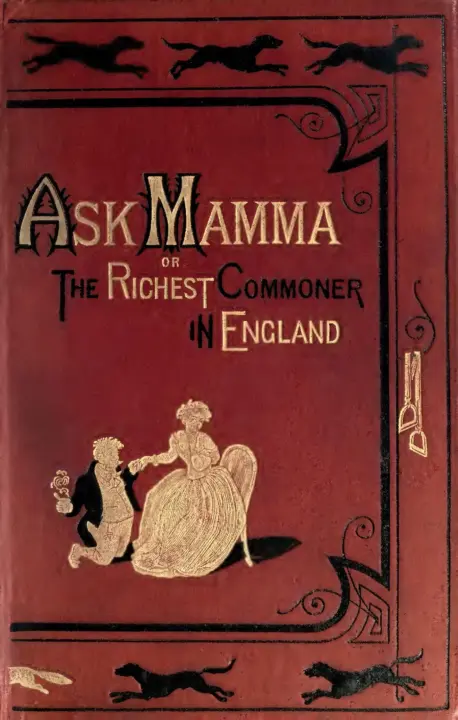
“Ask Mamma”; or, The Richest Commoner In England
Robert Smith Surtees
THE CLASSIC COLLECTION · 1843
"Jorrocks' Jaunts and Jollities" by Robert Smith Surtees is a humorous novel written in the mid-19th century. This book follows the eccentric and boisterous exploits of Mr. Jorrocks, a city grocer and enthusiastic fox hunter, as he navigates the colorful world of hunting and the sportsman lifestyle in Surrey, England. The narrative is characterized by its rich, playful language and satirical observations of the society surrounding the hunt. The opening of the novel sets the stage for the whimsical adventures that await Mr. Jorrocks. It introduces readers to the vibrant atmosphere of fox hunting in Surrey, marked by the camaraderie of the sportsmen and the unique charm of their gatherings. As Mr. Jorrocks prepares for a day of hunting, he reflects on the thrill of the chase while showcasing his personality through humorous anecdotes and lively interactions with fellow hunters. Their antics, coupled with engaging descriptions of the hunting scene, strike a balance between sporting excitement and comedic misadventures, effectively drawing readers into the lively world of the Surrey hunt.
Introduction adapted from the source catalogue; source summaries may be automatically generated.
Free to read · English · 89,620 words · No account needed
MAKE TIME FOR A GOOD BOOK
On by default. Untick to stop anonymous reading totals. Each page counts after 10 seconds in view. How this works.
Anonymous counting is on unless you have switched it off.
[Footnote 23: Co-cous are nondescript vehicles that ply in the environs of Paris. They are a sort of cross between a cab and a young Diligence.]
I, John Jorrocks, of Great Coram Street, in the County of Middlesex, Member of the Surrey Hunt, in England, and Colonel of the Army when I'm in France, having been grossly insulted by Charles Adolphe Eugene of No. 15 bis, Rue Poupee, confectioner, this day repaired to Passy, with the intention of sarving him out with my fists; but, neither he nor any one for him having come to the scratch, I, John Jorrocks, do hereby proclaim the said Charles Adolphe Eugene to be a shabby fellow and no soldier, and totally unworthy the notice of a fox-hunter and a gentleman sportsman.
(Signed) JOHN JORROCKS.
(Countersigned) STUBBS.
This being completed, and the bill paid, they returned leisurely on foot to Paris, looking first at one object, then at another, so that the Countess Benvolio's dinner-hour was passed ere they reached the Tuileries Gardens, where after resting themselves until it began to get dusk, and their appetites returned, they repaired to the Cafe de Paris to destroy them again.--The lofty well-gilded salon was just lighted up, and the numberless lamps reflected in costly mirrors in almost every partition of the wall, aided by the graceful figures and elegant dresses of the ladies, interspersed among the sombre-coated gentry, with here and there the gay uniforms of the military, imparted a fairy air to the scene, which was not a little heightened by the contrast produced by Mr. Jorrocks's substantial figure, stumping through the centre with his hat on his head, his hands behind his back, and the dust of the day hanging about his Hessians.
"Garsoon," said he, hanging up his hat, and taking his place at a vacant table laid for two, "ge wouderai some wittles," and, accordingly, the spruce-jacketed, white-aproned garcon brought him the usual red-backed book with gilt edges, cut and lettered at the side, like the index to a ledger, and, as Mr. Jorrocks said, "containing reading enough for a month." "Quelle potage voulez vous, monsieur?" inquired the garcon at last, tired of waiting while he studied the carte and looked the words out in the dictionary. "Avez-vous any potted lobster?" "Non," said the garcon, "potage au vermicelle, au riz, a la Julienne, consomme, et potage aux choux." "Old shoe! who the devil do you think eats old shoes here? Have you any mock turtle or gravy soup?" "Non, monsieur," said the garcon with a shrug of the shoulders. "Then avez-vous any roast beef?" "Non, monsieur; nous avons boeuf au naturel--boeuf a la sauce piquante--boeuf aux cornichons--boeuf a la mode--boeuf aux choux--boeuf a la sauce tomate--bifteck aux pommes de terre." "Hold hard," said Jorrocks; "I've often heard that you can dress an egg a thousand ways, and I want to hear no more about it; bring me a beef-steak and pommes de terre for three." "Stop!" cried Mr. Stubbs, with dismay--"I see you don't understand ordering a dinner in France --let me teach you. Where's the carte?" "Here," said Mr. Jorrocks, "is 'the bill of lading,'" handing over the book.--"Garcon, apportez une douzaine des huitres, un citron, et du beurre frais," said the Yorkshireman, and while they were discussing the propriety of eating them before or after the soup, a beautiful dish of little green oysters made their appearance, which were encored before the first supply was finished. "Now, Colonel," said the Yorkshireman, "take a bumper of Chablis," lifting a pint bottle out of the cooler. "It has had one plunge in the ice-pail and no more--see what a delicate rind it leaves on the glass!" eyeing it as he spoke. "Ay, but I'd rayther it should leave something in the mouth than on the side of the glass," replied Mr. Jorrocks; "I loves a good strong generous wine--military port, in fact--but here comes fish and soup--wot are they?" "Filet de sole au gratin, et potage au macaroni avec fromage de Parmesan. I'll take fish first, because the soup will keep hot longest." "So will I," said Mr. Jorrocks, "for I think you understand the thing--but they seem to give werry small penn'orths--it really looks like trifling with one's appetite--I likes the old joint--the cut-and-come-again system, such as we used to have at Sugden's in Cornhill--joint, wegitables, and cheese all for two shillings." "Don't talk of your joints here," rejoined the Yorkshireman--"I told you before, you don't understand the art of eating--the dexterity of the thing consists in titivating the appetite with delicate morsels so as to prolong the pleasure. A well-regulated French dinner lasts two hours, whereas you go off at score, and take the shine out of yourself before you turn the Tattenham Corner of your appetite. But come, take another glass of Chablis, for your voice is husky as though your throat was full of dust.--Will you eat some of this boulli-vert?" "No, not no bouleward for me thank ye." "Well, then, we will have the 'entree de boeuf--beef with sauce tomate--and there is a cotelette de veau en papillotte;--which will you take?" "I'll trouble the beef, I think; I don't like that 'ere pantaloon cutlet much, the skin is so tough." "Oh, but you don't eat the paper, man; that is only put on to keep this nice layer of fat ham from melting; take some, if it is only that you may enjoy a glass of champagne after it. There is no meat like veal for paving the way for a glass of champagne." "Well, I don't care if I do, now you have explained how to eat it, for I've really been troubled with indigestion all day from eating one wholesale yesterday; but don't you stand potatoes--pommes de terre, as we say in France?" "Oh yes, fried, and a la maitre d'hotel; here they come, smoking hot. Now, J---- for a glass of champagne--take it out of the pail--nay, man! not with both hands round the middle, unless you like it warm--by the neck, so," showing him how to do it and pouring him a glass of still champagne. "This won't do," said Jorrocks, holding it up to the candle; "garsoon! garsoon!--no good--no bon--no fizzay, no fizzay," giving the bottom of the bottle a slap with his hand to rouse it. "Oh, but this is still champagne," explained the Yorkshireman, "and far the best." "I don't think so," retorted Mr. Jorrocks, emptying the glass into his water-stand. "Well, then, have a bottle of the other," rejoined the Yorkshireman, ordering one. "And who's to pay for it?" inquired Mr. Jorrocks. "Oh, never mind that--care killed the cat--give a loose to pleasure for once, for it's a poor heart that never rejoices. Here it comes, and 'may you never know what it is to want,' as the beggar boys say.--Now, let's see you treat it like a philosopher--the wire is off, so you've nothing to do but cut the string, and press the cork on one side with your thumb.--Nay! you've cut both sides!" Fizz, pop, bang, and away went the cork close past the ear of an old deaf general, and bounded against the wall.--"Come, there's no mischief done, so pour out the wine.--Your good health, old boy, may you live for a thousand years, and I be there to count them! --Now, that's what I call good," observed the Yorkshireman, holding up his glass, "see how it dulls the glass, even to the rim--champagne isn't worth a copper unless it's iced--is it, Colonel?" "Vy, I don't know--carn't say I like it so werry cold; it makes my teeth chatter, and cools my courage as it gets below--champagne certainly gives one werry gentlemanly ideas, but for a continuance, I don't know but I should prefer mild hale." "You're right, old boy, it does give one very gentlemanly ideas, so take another glass, and you'll fancy yourself an emperor.--Your good health again." "The same to you, sir. And now wot do you call this chap?" "That is a quail, the other a snipe--which will you take?" "Vy, a bit of both, I think; and do you eat these chaps with them?" "Yes, nothing nicer--artichokes a la sauce blanche; you get the real eating part, you see, by having them sent up this way, instead of like haystacks, as they come in England, diving and burning your fingers amid an infinity of leaves." "They are werry pretty eating, I must confess; and this upper Binjamin of ham the birds are cooked in is delicious. I'll trouble you for another plateful." "That's right, Colonel, you are yourself again. I always thought you would come back into the right course; and now you are good for a glass of claret of light Hermitage. Come, buck up, and give a loose to pleasure for once." "For once, ay, that's what you always say; but your once comes so werry often." "Say no more.--Garcon! un demi-bouteille de St. Julien; and here, J----, is a dish upon which I will stake my credit as an experienced caterer--a Charlotte de pommes--upon my reputation it is a fine one, the crust is browned to a turn, and the rich apricot sweet-meat lies ensconced in the middle, like a sleeping babe in its cradle. If ever man deserved a peerage and a pension it is this cook." "It's werry delicious--order another." "Oh, your eyes are bigger than your stomach, Mr. J----. According to all mathematical calculations, this will more than suffice. Ay, I thought so--you are regularly at a stand-still. Take a glass of whatever you like. Good--I'll drink Chablis to your champagne. And now, that there may be no mistake as to our country, we will have some cheese--fromage de Roquefort, Gruyere, Neufchatel, or whatever you like--and a beaker of Burgundy after, and then remove the cloth, for I hate dabbling in dowlas after dinner is done." "Rum beggars these French," said Mr. Jorrocks to himself, laying down the newspaper, and taking a sip of Churchman's chocolate, as on the Sunday morning he sat with the Countess Benvolio, discussing rolls and butter, with Galignani's Messenger, for breakfast.
Your reading position is saved on this browser. Take it to another device with a library code. Reading pages adapt to text, rather than matching a printed edition.
BEHIND THE BOOK
This eBook is for the use of anyone anywhere in the United States and most other parts of the world at no cost and with almost no restrictions whatsoever. You may copy it, give it away or re-use it under the terms of the Project Gutenberg License included with this eBook or online at www.gutenberg.org. If you are not located in the United States, you will have to check the laws of the country where you are located before using this eBook. Read the source licence.
The original source file, including credits and licence, is retained by this library. Request an original-format copy at no charge. Please include the book title and Project Gutenberg identifier #15387.
KEEP YOUR CURIOSITY GOING
Coulson Kernahan

Maurice Baring
Frances Wright
Cécile Tormay

Frederic Jesup Stimson

W. H. P. (William Henry Pope) Jarvis