READ · DISCOVER · ENJOYClassic literature · Always free
THE CLASSIC COLLECTION✦Jorrocks’ Jaunts and JollitiesRobert Smith SurteesCLASSIC FREE BOOKS

THE CLASSIC COLLECTION · 1843

Jorrocks’ Jaunts and Jollities

"Jorrocks' Jaunts and Jollities" by Robert Smith Surtees is a humorous novel written in the mid-19th century. This book follows the eccentric and boisterous exploits of Mr. Jorrocks, a city grocer and enthusiastic fox hunter, as he navigates the colorful world of hunting and the sportsman lifestyle in Surrey, England. The narrative is characterized by its rich, playful language and satirical observations of the society surrounding the hunt. The opening of the novel sets the stage for the whimsical adventures that await Mr. Jorrocks. It introduces readers to the vibrant atmosphere of fox hunting in Surrey, marked by the camaraderie of the sportsmen and the unique charm of their gatherings. As Mr. Jorrocks prepares for a day of hunting, he reflects on the thrill of the chase while showcasing his personality through humorous anecdotes and lively interactions with fellow hunters. Their antics, coupled with engaging descriptions of the hunting scene, strike a balance between sporting excitement and comedic misadventures, effectively drawing readers into the lively world of the Surrey hunt.

Introduction adapted from the source catalogue; source summaries may be automatically generated.

Start reading ↓

Free to read · English · 89,620 words · No account needed

MAKE TIME FOR A GOOD BOOK

Jorrocks’ Jaunts and Jollities

On by default. Untick to stop anonymous reading totals. Each page counts after 10 seconds in view. How this works.

Anonymous counting is on unless you have switched it off.

Jorrocks’ Jaunts and Jollities

Everyone who has done a little "voyaging," as they call it in France, knows that a few miles to the south of Samer rises a very steep hill, across which the route lies, and that diligence travellers are generally invited to walk up it. A path which strikes off near the foot of the hill, across the open, cuts off the angle, and--diligences being anything but what the name would imply,--the passengers, by availing themselves of the short cut, have ample time for striking up confabs, and inquiring into the comforts of the occupiers of the various compartments. Our friends of the "interior" were all busy jabbering and talking--some with their tongues, others with their hands and tongues--with the exception of the monster in the cloak, who sat like a sack in the corner, until the horses, having reached the well-known breathing place, made a dead halt, and the conducteur proceeded to invite the party to descend and "promenade" up the hill. "What's happened now?" cried the monster, jumping up as the door opened; "surely, they don't expect us to walk up this mountain! I've travelled three hundred thousand miles, and was never asked to do such a thing in all my life before. I won't do it; I paid for riding, and ride I will. You are all a set of infamous cheats," said he to the conducteur in good plain English; but the conducteur, not understanding the language, shut the door as soon as all the rest were out, and let him roll on by himself. Jorrocks stuck to his woman, who had a negro boy in the rotonde, dressed in baggy slate-coloured trousers, with a green waistcoat and a blue coat, with a coronet on the button, who came to hand her out, and was addressed by the heroic name of "Agamemnon." Jorrocks got a glimpse of the button, but, not understanding foreign coronets, thought it was a crest; nevertheless, he thought he might as well inquire who his friend was, so, slinking back as they reached the foot of the hill he got hold of the nigger, and asked what they called his missis. Massa did not understand, and Mr. Jorrocks, sorely puzzled how to explain, again had recourse to the Manuel du Voyageur; but Madame de Genlis had not anticipated such an occurrence, and there was no dialogue adapted to his situation. There was a conversation with a lacquey, however, commencing with--"Are you disposed to enter into my service?" and, in the hopes of hitting upon something that would convey his wishes, he "hark'd forward," and passing by--"Are you married?" arrived at--"What is your wife's occupation?" "Que fait votre femme?" said he, suiting the action to the word, and pointing to Madame. Agamemnon showed his ivories, as he laughed at the idea of Jorrocks calling his mistress his wife, and by signs and words conveyed to him some idea of the importance of the personage to whom he alluded. This he did most completely, for before the diligence came up, Jorrocks pulled the Yorkshireman aside, and asked if he was aware that they were travelling with a real live Countess; "Madame la Countess Benwolio, the nigger informs me," said he; "a werry grande femme, though what that means I don't know." "Oh, Countesses are common enough here," replied the Yorkshireman. "I dare say she's a stay-maker. I remember a paint-maker who had a German Baron for a colour-grinder once." "Oh," said Jorrocks, "you are jealous--you always try to run down my friends; but that won't do, I'm wide awake to your tricks"; so saying, he shuffled off, and getting hold of the Countess, helped Agamemnon to hoist her into the diligence. He was most insinuating for the next two hours, and jabbered about love and fox-hunting, admiring the fine, flat, open country, and the absence of hedges and flints; but as neither youth nor age can subsist on love alone, his confounded appetite began to trouble him, and got quite the better of him before they reached Abbeville. Every mile seemed a league, and he had his head out of the window at least twenty times before they came in sight of the town. At length the diligence got its slow length dragged not only to Abbeville, but to the sign of the "Fidele Berger"--or "Fiddle Burgur," as Mr. Jorrocks pronounced it--where they were to dine. The door being opened, out he jumped, and with his Manuel du Voyageur in one hand, and the Countess Benvolio in the other, he pushed his way through the crowd of "pauvres miserables" congregated under the gateway, who exhibited every species of disease and infirmity that poor human nature is liable or heir to, and entered the hotel. The "Sally manger," as he called it, was a long brick-floored room on the basement, with a white stove at one end, and the walls plentifully decorated with a panoramic view of the Grand Nation wallopping the Spaniards at the siege of Saragossa. The diligence being a leetle behind time as usual, the soup was on the table when they entered. The passengers quickly ranged themselves round, and, with his mouth watering as the female garcon lifted the cover from the tureen, Mr. Jorrocks sat in the expectation of seeing the rich contents ladled into the plates. His countenance fell fifty per cent as the first spoonful passed before his eyes.--"My vig, why it's water!" exclaimed he--"water, I do declare, with worms[21] in it--I can't eat such stuff as that--it's not man's meat--oh dear, oh dear, I fear I've made a terrible mistake in coming to France! Never saw such stuff as this at Bleaden's or Birch's, or anywhere in the city." "I've travelled three hundred thousand miles," said the fat man, sending his plate from him in disgust, "and never tasted such a mess as this before." "I'll show them up in The Times," cried Mr. Jorrocks; "and, look, what stuff is here--beef boiled to rags!--well, I never, no never, saw anything like this before. Oh, I wish I was in Great Coram Street again!--I'm sure I can't live here--I wonder if I could get a return chaise--waiter--garsoon--cuss! Oh dear! I see Madame de Genlis is of no use in a pinch--and yet what a dialogue here is! Oh heavens! grant your poor Jorrocks but one request, and that is the contents of a single sentence. 'I want a roasted or boiled leg of mutton, beef, hung beef, a quarter of mutton, mutton chops, veal cutlets, stuffed tongue, dried tongue, hog's pudding, white sausage, meat sausage, chicken with rice, a nice fat roast fowl, roast chicken with cressy, roast or boiled pigeon, a fricassee of chicken, sweet-bread, goose, lamb, calf's cheek, calf's head, fresh pork, salt pork, cold meat, hash.'--But where's the use of titivating one's appetite with reading of such luxteries? Oh, what a wife Madame de Genlis would have made for me! Oh dear, oh dear, I shall die of hunger, I see --I shall die of absolute famine--my stomach thinks my throat's cut already!" In the height of his distress in came two turkeys and a couple of fowls, and his countenance shone forth like an April sun after a shower. "Come, this is better," said he; "I'll trouble you, sir, for a leg and a wing, and a bit of the breast, for I'm really famished--oh hang! the fellow's a Frenchman, and I shall lose half the day in looking it out in my dictionary. Oh dear, oh dear, where's the dinner dialogue!--well, here's something to that purpose. 'I will send you a bit of this fowl.' 'A little bit of the fowl cannot hurt you.'--No, nor a great bit either.--'Which do you like best, leg or wing?' 'Qu'aimez-vous le mieux, la cuisse ou l'aile?'" Here the Countess Benvolio, who had been playing a good knife and fork herself, pricked up her ears, and guessing at Jorrocks's wants, interceded with her countryman and got him a plateful of fowl. It was soon disposed of, however, and half a dish of hashed hare or cat, that was placed within reach of him shortly after, was quickly transferred into his plate. A French dinner is admirably calculated for leading the appetite on by easy stages to the grand consummation of satiety. It begins meagrely, as we have shown, and proceeds gradually through the various gradations of lights, savories, solids, and substantiate. Presently there was a large dish of stewed eels put on. "What's that?" asked Jorrocks of the man.--"Poisson," was the reply. "Poison! why, you infidel, have you no conscience?" "Fishe," said the Countess. "Oh, ay, I smell--eels--just like what we have at the Eel-pie-house at Twickenham--your ladyship, I am thirsty--'ge soif,' in fact." "Ah, bon!" said the Countess, laughing, and giving him a tumbler of claret. "I've travelled three hundred thousand miles," said the fat man, "and never saw claret drunk in that way before." "It's not werry good, I think," said Mr. Jorrocks, smacking his lips; "if it was not claret I would sooner drink port." Some wild ducks and fricandeau de veau which followed, were cut up and handed round, Jorrocks helping himself plentifully to both, as also to pommes de terre a la maitre d'hotel, and bread at discretion. "Faith, but this is not a bad dinner, after all's said and done, when one gets fairly into it." "Fear it will be very expensive," observed the fat man. Just when Jorrocks began to think he had satisfied nature, in came a roast leg of mutton, a beef-steak, "a la G--d-dam", [22] and a dish of larks and snipes.

Your reading position is saved on this browser. Take it to another device with a library code. Reading pages adapt to text, rather than matching a printed edition.

More from this author

BEHIND THE WORDS

About Robert Smith Surtees

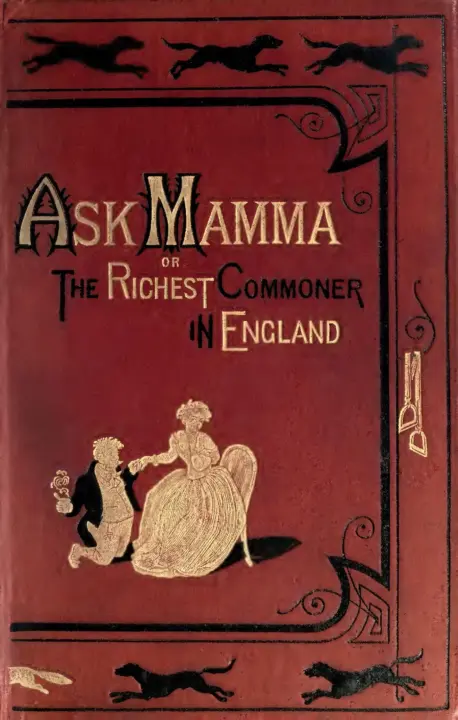
Robert Smith Surtees (1805–1864). Explore “Ask Mamma”; or, The Richest Commoner In England, Mr. Sponge’s Sporting Tour, Jorrocks’ Jaunts and Jollities in this collection. These books span classic fiction, romance.

Explore this author’s books →

THE READERS’ VERDICT

How did this story stay with you?

Not rated yet
Your rating for Jorrocks’ Jaunts and Jollities

Be the first to share your verdict.

One rating per browser, which you can change or remove. A necessary browser identifier remembers your vote. How ratings work

A GOOD STORY DESERVES COMPANY

Pass this book along.

A great read is even better when it’s shared.

SEND A LITTLE INSPIRATION

Share this book

BEHIND THE BOOK

Edition & source details.

Title
Jorrocks’ Jaunts and Jollities
Author
Robert Smith Surtees
First publication (Open Library catalogue match)
1843
Digital edition publisher
Project Gutenberg
Gutenberg release date
2005-03-16
Language
English
Source edition imprint
Not stated in source catalogue
Source identifier
Project Gutenberg #15387
Contributors
No additional named contributors in source metadata

Public-domain source & licence

This eBook is for the use of anyone anywhere in the United States and most other parts of the world at no cost and with almost no restrictions whatsoever. You may copy it, give it away or re-use it under the terms of the Project Gutenberg License included with this eBook or online at www.gutenberg.org. If you are not located in the United States, you will have to check the laws of the country where you are located before using this eBook. Read the source licence.

Full source licence and obtaining an original copy

The original source file, including credits and licence, is retained by this library. Request an original-format copy at no charge. Please include the book title and Project Gutenberg identifier #15387.

the full Project Gutenberg License must appear
prominently whenever any copy of a Project Gutenberg work (any work
on which the phrase “Project Gutenberg” appears, or with which the
phrase “Project Gutenberg” is associated) is accessed, displayed,
performed, viewed, copied or distributed:

This eBook is for the use of anyone anywhere in the United States and most
other parts of the world at no cost and with almost no restrictions
whatsoever. You may copy it, give it away or re-use it under the terms
of the Project Gutenberg™ License included with this eBook or online
at www.gutenberg.org. If you
are not located in the United States, you will have to check the laws
of the country where you are located before using this eBook.

1.E.2. If an individual Project Gutenberg electronic work is
derived from texts not protected by U.S. copyright law (does not
contain a notice indicating that it is posted with permission of the
copyright holder), the work can be copied and distributed to anyone in
the United States without paying any fees or charges. If you are
redistributing or providing access to a work with the phrase “Project
Gutenberg” associated with or appearing on the work, you must comply
either with the requirements of paragraphs 1.E.1 through 1.E.7 or
obtain permission for the use of the work and the Project Gutenberg
trademark as set forth in paragraphs 1.E.8 or 1.E.9.

1.E.3. If an individual Project Gutenberg electronic work is posted
with the permission of the copyright holder, your use and distribution
must comply with both paragraphs 1.E.1 through 1.E.7 and any
additional terms imposed by the copyright holder. Additional terms
will be linked to the Project Gutenberg License for all works
posted with the permission of the copyright holder found at the
beginning of this work.

1.E.4. Do not unlink or detach or remove the full Project Gutenberg
License terms from this work, or any files containing a part of this
work or any other work associated with Project Gutenberg.

1.E.5. Do not copy, display, perform, distribute or redistribute this
electronic work, or any part of this electronic work, without
prominently displaying the sentence set forth in paragraph 1.E.1 with
active links or immediate access to the full terms of the Project
Gutenberg License.

1.E.6. You may convert to and distribute this work in any binary,
compressed, marked up, nonproprietary or proprietary form, including
any word processing or hypertext form. However, if you provide access
to or distribute copies of a Project Gutenberg work in a format
other than “Plain Vanilla ASCII” or other format used in the official
version posted on the official Project Gutenberg website
(www.gutenberg.org), you must, at no additional cost, fee or expense
to the user, provide a copy, a means of exporting a copy, or a means
of obtaining a copy upon request, of the work in its original “Plain
Vanilla ASCII” or other form. Any alternate format must include the
full Project Gutenberg License as specified in paragraph 1.E.1.

1.E.7. Do not charge a fee for access to, viewing, displaying,
performing, copying or distributing any Project Gutenberg works
unless you comply with paragraph 1.E.8 or 1.E.9.

1.E.8. You may charge a reasonable fee for copies of or providing
access to or distributing Project Gutenberg electronic works
provided that:

• You pay a royalty fee of 20% of the gross profits you derive from
the use of Project Gutenberg works calculated using the method
you already use to calculate your applicable taxes. The fee is owed
to the owner of the Project Gutenberg trademark, but he has
agreed to donate royalties under this paragraph to the Project
Gutenberg Literary Archive Foundation. Royalty payments must be paid
within 60 days following each date on which you prepare (or are
legally required to prepare) your periodic tax returns. Royalty
payments should be clearly marked as such and sent to the Project
Gutenberg Literary Archive Foundation at the address specified in
Section 4, “Information about donations to the Project Gutenberg
Literary Archive Foundation.”

• You provide a full refund of any money paid by a user who notifies
you in writing (or by e-mail) within 30 days of receipt that s/he
does not agree to the terms of the full Project Gutenberg™
License. You must require such a user to return or destroy all
copies of the works possessed in a physical medium and discontinue
all use of and all access to other copies of Project Gutenberg™
works.

• You provide, in accordance with paragraph 1.F.3, a full refund of
any money paid for a work or a replacement copy, if a defect in the
electronic work is discovered and reported to you within 90 days of
receipt of the work.

• You comply with all other terms of this agreement for free
distribution of Project Gutenberg™ works.


1.E.9. If you wish to charge a fee or distribute a Project
Gutenberg™ electronic work or group of works on different terms than
are set forth in this agreement, you must obtain permission in writing
from the Project Gutenberg Literary Archive Foundation, the manager of
the Project Gutenberg™ trademark. Contact the Foundation as set
forth in Section 3 below.

1.F.

1.F.1. Project Gutenberg volunteers and employees expend considerable
effort to identify, do copyright research on, transcribe and proofread
works not protected by U.S. copyright law in creating the Project
Gutenberg™ collection. Despite these efforts, Project Gutenberg™
electronic works, and the medium on which they may be stored, may
contain “Defects,” such as, but not limited to, incomplete, inaccurate
or corrupt data, transcription errors, a copyright or other
intellectual property infringement, a defective or damaged disk or
other medium, a computer virus, or computer codes that damage or
cannot be read by your equipment.

1.F.2. LIMITED WARRANTY, DISCLAIMER OF DAMAGES - Except for the “Right
of Replacement or Refund” described in paragraph 1.F.3, the Project
Gutenberg Literary Archive Foundation, the owner of the Project
Gutenberg™ trademark, and any other party distributing a Project
Gutenberg™ electronic work under this agreement, disclaim all
liability to you for damages, costs and expenses, including legal
fees. YOU AGREE THAT YOU HAVE NO REMEDIES FOR NEGLIGENCE, STRICT
LIABILITY, BREACH OF WARRANTY OR BREACH OF CONTRACT EXCEPT THOSE
PROVIDED IN PARAGRAPH 1.F.3. YOU AGREE THAT THE FOUNDATION, THE
TRADEMARK OWNER, AND ANY DISTRIBUTOR UNDER THIS AGREEMENT WILL NOT BE
LIABLE TO YOU FOR ACTUAL, DIRECT, INDIRECT, CONSEQUENTIAL, PUNITIVE OR
INCIDENTAL DAMAGES EVEN IF YOU GIVE NOTICE OF THE POSSIBILITY OF SUCH
DAMAGE.

1.F.3. LIMITED RIGHT OF REPLACEMENT OR REFUND - If you discover a
defect in this electronic work within 90 days of receiving it, you can
receive a refund of the money (if any) you paid for it by sending a
written explanation to the person you received the work from. If you
received the work on a physical medium, you must return the medium
with your written explanation. The person or entity that provided you
with the defective work may elect to provide a replacement copy in
lieu of a refund. If you received the work electronically, the person
or entity providing it to you may choose to give you a second
opportunity to receive the work electronically in lieu of a refund. If
the second copy is also defective, you may demand a refund in writing
without further opportunities to fix the problem.

1.F.4. Except for the limited right of replacement or refund set forth
in paragraph 1.F.3, this work is provided to you ‘AS-IS’, WITH NO
OTHER WARRANTIES OF ANY KIND, EXPRESS OR IMPLIED, INCLUDING BUT NOT
LIMITED TO WARRANTIES OF MERCHANTABILITY OR FITNESS FOR ANY PURPOSE.

1.F.5. Some states do not allow disclaimers of certain implied
warranties or the exclusion or limitation of certain types of
damages. If any disclaimer or limitation set forth in this agreement
violates the law of the state applicable to this agreement, the
agreement shall be interpreted to make the maximum disclaimer or
limitation permitted by the applicable state law. The invalidity or
unenforceability of any provision of this agreement shall not void the
remaining provisions.

1.F.6. INDEMNITY - You agree to indemnify and hold the Foundation, the
trademark owner, any agent or employee of the Foundation, anyone
providing copies of Project Gutenberg™ electronic works in
accordance with this agreement, and any volunteers associated with the
production, promotion and distribution of Project Gutenberg™
electronic works, harmless from all liability, costs and expenses,
including legal fees, that arise directly or indirectly from any of
the following which you do or cause to occur: (a) distribution of this
or any Project Gutenberg work, (b) alteration, modification, or
additions or deletions to any Project Gutenberg work, and (c) any
Defect you cause.

Section 2. Information about the Mission of Project Gutenberg

Project Gutenberg is synonymous with the free distribution of
electronic works in formats readable by the widest variety of
computers including obsolete, old, middle-aged and new computers. It
exists because of the efforts of hundreds of volunteers and donations
from people in all walks of life.

Volunteers and financial support to provide volunteers with the
assistance they need are critical to reaching Project Gutenberg’s
goals and ensuring that the Project Gutenberg collection will
remain freely available for generations to come. In 2001, the Project
Gutenberg Literary Archive Foundation was created to provide a secure
and permanent future for Project Gutenberg and future
generations. To learn more about the Project Gutenberg Literary
Archive Foundation and how your efforts and donations can help, see
Sections 3 and 4 and the Foundation information page at www.gutenberg.org.

Section 3. Information about the Project Gutenberg Literary Archive Foundation

The Project Gutenberg Literary Archive Foundation is a non-profit
501(c)(3) educational corporation organized under the laws of the
state of Mississippi and granted tax exempt status by the Internal
Revenue Service. The Foundation’s EIN or federal tax identification
number is 64-6221541. Contributions to the Project Gutenberg Literary
Archive Foundation are tax deductible to the full extent permitted by
U.S. federal laws and your state’s laws.

The Foundation’s business office is located at 41 Watchung Plaza #516,
Montclair NJ 07042, USA, +1 (862) 621-9288. Email contact links and up
to date contact information can be found at the Foundation’s website
and official page at www.gutenberg.org/contact

Section 4. Information about Donations to the Project Gutenberg
Literary Archive Foundation

Project Gutenberg™ depends upon and cannot survive without widespread
public support and donations to carry out its mission of
increasing the number of public domain and licensed works that can be
freely distributed in machine-readable form accessible by the widest
array of equipment including outdated equipment. Many small donations
($1 to $5,000) are particularly important to maintaining tax exempt
status with the IRS.

The Foundation is committed to complying with the laws regulating
charities and charitable donations in all 50 states of the United
States. Compliance requirements are not uniform and it takes a
considerable effort, much paperwork and many fees to meet and keep up
with these requirements. We do not solicit donations in locations
where we have not received written confirmation of compliance. To SEND
DONATIONS or determine the status of compliance for any particular state
visit www.gutenberg.org/donate.

While we cannot and do not solicit contributions from states where we
have not met the solicitation requirements, we know of no prohibition
against accepting unsolicited donations from donors in such states who
approach us with offers to donate.

International donations are gratefully accepted, but we cannot make
any statements concerning tax treatment of donations received from
outside the United States. U.S. laws alone swamp our small staff.

Please check the Project Gutenberg web pages for current donation
methods and addresses. Donations are accepted in a number of other
ways including checks, online payments and credit card donations. To
donate, please visit: www.gutenberg.org/donate.

Section 5. General Information About Project Gutenberg electronic works

Professor Michael S. Hart was the originator of the Project
Gutenberg concept of a library of electronic works that could be
freely shared with anyone. For forty years, he produced and
distributed Project Gutenberg eBooks with only a loose network of
volunteer support.

Project Gutenberg eBooks are often created from several printed
editions, all of which are confirmed as not protected by copyright in
the U.S. unless a copyright notice is included. Thus, we do not
necessarily keep eBooks in compliance with any particular paper
edition.

Most people start at our website which has the main PG search
facility: www.gutenberg.org.

This website includes information about Project Gutenberg,
including how to make donations to the Project Gutenberg Literary
Archive Foundation, how to help produce our new eBooks, and how to
subscribe to our email newsletter to hear about new eBooks.


KEEP YOUR CURIOSITY GOING

Your next chapter awaits.


