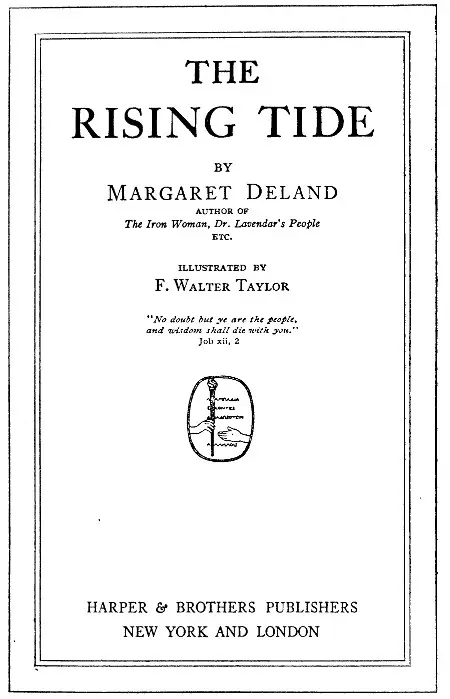
The Rising Tide
Margaret Wade Campbell Deland
THE CLASSIC COLLECTION · 1888
"John Ward, Preacher" by Margaret Wade Campbell Deland is a novel written in the late 19th century. The story revolves around John Ward, a passionate and earnest preacher, and his engagement to Helen Jeffrey, set against the backdrop of a sleepy village called Ashurst. The book explores themes of duty, faith, and the complexities of love, particularly the differences in belief between John and Helen, which pose challenges to their relationship. At the start of the novel, the setting is established on the eve of Helen’s wedding day. The characters are introduced, including Dr. Howe, the local rector, and the Misses Woodhouse, who contribute to the delightful but complex atmosphere of Ashurst. The chapter reveals the anticipation of the wedding, underlying tensions in John Ward's earnestness regarding spiritual matters, and his concern about Helen's beliefs regarding faith and the Bible. As the narrative unfolds, it becomes clear that John is not only focused on their love but also deeply troubled by Helen's differing views on faith and her spiritual condition. The opening sets up a conflict between personal happiness and theological duty, hinting at the thematic exploration that will follow.
Introduction adapted from the source catalogue; source summaries may be automatically generated.
Free to read · English · 121,744 words · No account needed
MAKE TIME FOR A GOOD BOOK
On by default. Untick to stop anonymous reading totals. Each page counts after 10 seconds in view. How this works.
Anonymous counting is on unless you have switched it off.
"Doesn't that go without saying?" said Helen, laughing. "From the letters I've had, I fancy he is a good deal at the rectory."
"Yes," Gifford admitted. "But he is one of those people who make you feel that though they may have good manners, their grandfathers did not, don't you know?"
"But what difference does that make," John asked, "if he is a good man?"
"Oh, of course, no difference," Gifford replied with an impatient laugh.
"But what is the attraction in Ashurst, Giff?" Helen said. "How can he stay there all summer? I should not think he could leave his business."
"Oh, he is rich."
"Why, you don't like him!" said Helen, surprised at his tone.
"I don't know anything about the fellow," the young man answered. "I haven't seen enough of him to have an opinion one way or the other. Judging from aunt Ruth's letters, though, I should say Lois liked him, so I don't think he will be anxious for my approval, or anybody else's."
Helen looked at him with sudden questioning in her eyes, but they had reached his house, and John began to speak to him of his plans and of Lockhaven.
"I'm afraid you will have only too much to do," he said. "There is a great deal of quarreling among the mill-owners, and constant disagreements between the hands."
"Well," Gifford answered, smiling, and straightening his broad shoulders, "if there is work to do, I am glad I am here to do it. But I'm not hopeless for the life it indicates, when you say there's much to be done. The struggle for personal rights and advantages is really, you know, the desire for the best, and a factor in civilization. A generation or two hence, the children of these pushing, aggressive fathers will be fine men."
John shook his head sadly. "Ah, but the present evil?"
But Gifford answered cheerfully, "Oh, well, the present evil is one stage of development; to live up to the best one knows is morality, and the preservation of self is the best some of these people know; we can only wait hopefully for the future."
"Morality is not enough," John said gently. "Morality never saved a soul,
Mr. Woodhouse."
But Helen laughed gayly: "John, dear, Gifford doesn't understand your awful Presbyterian doctrines, and there is no use trying to convert him."
Gifford smiled, and owned good-naturedly that he was a heathen. "But I think," he said, "the thing which keeps the town back most is liquor."
"It is, indeed," John answered, eagerly. "If it could be banished!"
"High license is the only practical remedy," said Gifford, his face full of interest; but John's fell.
Your reading position is saved on this browser. Take it to another device with a library code. Reading pages adapt to text, rather than matching a printed edition.
Margaret Wade Campbell Deland
Margaret Wade Campbell Deland
Margaret Wade Campbell Deland

Margaret Wade Campbell Deland
BEHIND THE BOOK
This eBook is for the use of anyone anywhere in the United States and most other parts of the world at no cost and with almost no restrictions whatsoever. You may copy it, give it away or re-use it under the terms of the Project Gutenberg License included with this eBook or online at www.gutenberg.org. If you are not located in the United States, you will have to check the laws of the country where you are located before using this eBook. Read the source licence.
The original source file, including credits and licence, is retained by this library. Request an original-format copy at no charge. Please include the book title and Project Gutenberg identifier #18478.
KEEP YOUR CURIOSITY GOING
Coulson Kernahan

Maurice Baring
Frances Wright
Cécile Tormay

Frederic Jesup Stimson

W. H. P. (William Henry Pope) Jarvis