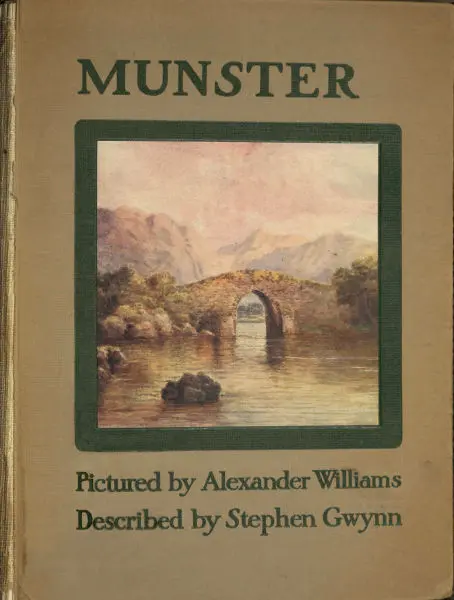
Munster
Stephen Lucius Gwynn
THE CLASSIC COLLECTION · 1919
"John Redmond's Last Years" by Stephen Lucius Gwynn is a historical account written in the early 20th century, specifically published in 1919. The book focuses on the final years of John Redmond, a prominent Irish nationalist leader, detailing his political efforts during a tumultuous period that included World War I and its effects on Ireland. Redmond's story is intertwined with the struggles for Home Rule and the broader aspirations for Irish independence. The opening of the work introduces John Redmond's pivotal role in Irish politics, rooted in his long-standing involvement with the Irish Parliamentary Party. It emphasizes his loyalty to his cause and highlights the complexities faced by political leaders as they navigated shifting alliances amidst the backdrop of the war. The text notes Redmond's upbringing, familial legacy, and the influence of historical events on his outlook, setting the tone for an exploration of his contributions and the challenges he encountered during his last years. The introductory chapter stresses the need to understand Redmond's policies in the context of the political landscape of his time, making it evident that the author intends to delve into the factors that shaped Redmond's aspirations for a unified Ireland.
Introduction adapted from the source catalogue; source summaries may be automatically generated.
Free to read · English · 113,514 words · No account needed
MAKE TIME FOR A GOOD BOOK
On by default. Untick to stop anonymous reading totals. Each page counts after 10 seconds in view. How this works.
Anonymous counting is on unless you have switched it off.
He disclaimed all imputation upon the Prime Minister or the Under-Secretary, Mr. Tennant--exceptions which pointed the reference to Lord Kitchener.
"The fact remains that when we were faced with that difficult and formidable task, practically every suggestion that we made, based on the strength of our own knowledge of what was suitable for Ireland and the conditions there, was put upon one side. The gentlemen who were responsible for that evidently believed that they knew what was suited to the necessities of Ireland far better than we did. A score of times, at least, I put upon paper and sent to the Government and the War Office my suggestions and my remonstrances, but all in vain. Often, almost in despair, I was tempted to rise in this House and publicly tell the House of Commons the way in which we were hampered and thwarted in our work in Ireland. I refrained from doing so from fear of doing mischief and from fear of doing harm. To-day I am very glad that I so refrained, because in spite of these discouragements, in spite of this thwarting and embarrassing, and in spite of the utterly faulty and ridiculous system of recruiting that was set on foot, we have succeeded, and have raised in Ireland a body of men whose numbers Lord Kitchener, in his letter to the Irish conference, declared were magnificent."
He quoted the Unionist Birmingham Post for the saying that what had happened in Ireland was "a miracle." From the National Volunteers 27,054 men had joined the colours; from the Ulster Volunteers 27,412. In both forces there must be many left who could not leave Ireland, yet might be utilized in Ireland.
"It may be remembered that the very day the war broke out I rose in my place in this House and offered the Volunteers to the Government for Home Defence. I only spoke, of course, of the National Volunteers. I was not entitled to speak for the Ulster Volunteers, but I suggested that they and we might work shoulder to shoulder. From that day to this the War Office have persistently refused to have anything to say to these Volunteers. The Prime Minister, a few days after I spoke, in answer to a question told me that the Government were considering at that moment how best to utilize these Volunteers. They have never been utilized since. A few days after I made my speech I went myself to the War Office, and as a result of my interviews there I submitted to the Government a scheme which would have provided them at once with 25,000 men. If that offer had been accepted, not 25,000, not 50,000, but 100,000 men would have been enlisted for Home Defence within the month. But no, it was obstinately refused. I hear that an hon. member below me is now apparently inclined to take the point that the War Office took. The War Office said that would interfere with recruiting in Ireland. Of course, we know Ireland better than the hon. member. We know our difficulties in Ireland. We do not believe that it would. On the contrary, we believe that it would have promoted recruiting. We believe that the enlistment of these men, their association in barracks and in camp, with the inevitable creation and fostering of a military spirit, would have led to a large number of volunteers for foreign service. Our views counted for nought. In this instance they were not only our views. These views had the approval of the Irish Command, and from the purely military point of view the Irish Command was in favour of some such scheme as I had outlined, and the reason was plain. They have to provide, and are providing to this day, 20,000 to 25,000 men from the Regular Army for the defence of the coasts of Ireland--guarding the coast, guarding piers, railways, bridges, and so forth. If these men of ours had been taken up, within two or three months of training and in camp they would have been able to do this work, and would have done it ever since, and would thereby have released from 20,000 to 25,000 men. That is the chief reason, I fancy, why the Military Command in Ireland were in favour of this idea. But to this moment the refusal continues. I see that an unofficial Bill was introduced by the Marquess of Lincolnshire into the House of Lords doing, to a great measure, for England and Wales what we have been asking should be done for Ireland. I claim that that Bill shall be extended to Ireland."
Your reading position is saved on this browser. Take it to another device with a library code. Reading pages adapt to text, rather than matching a printed edition.
Stephen Lucius Gwynn
Stephen Lucius Gwynn
Stephen Lucius Gwynn
Stephen Lucius Gwynn
BEHIND THE BOOK
This eBook is for the use of anyone anywhere in the United States and most other parts of the world at no cost and with almost no restrictions whatsoever. You may copy it, give it away or re-use it under the terms of the Project Gutenberg License included with this eBook or online at www.gutenberg.org. If you are not located in the United States, you will have to check the laws of the country where you are located before using this eBook. Read the source licence.
The original source file, including credits and licence, is retained by this library. Request an original-format copy at no charge. Please include the book title and Project Gutenberg identifier #14374.
KEEP YOUR CURIOSITY GOING
Cécile Tormay

Moritz Busch
John L. Ransom
Frances Wright
Cécile Tormay

Mabel Potter Daggett