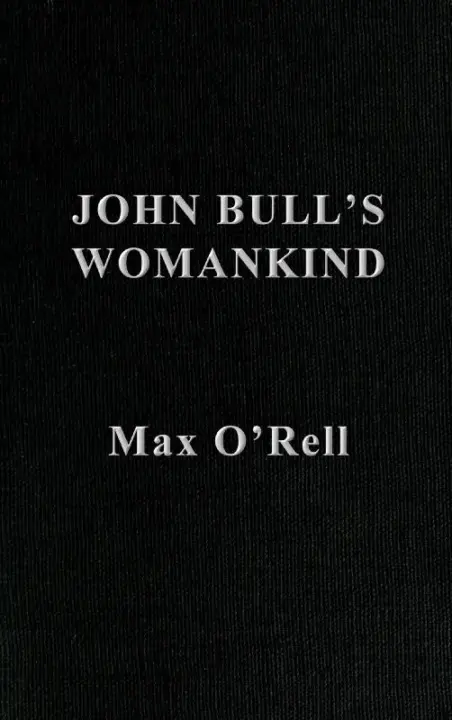
John Bull’s Womankind (Les Filles de John Bull)
Max O'Rell
THE CLASSIC COLLECTION · 1888
"John Bull, Junior; or, French as She is Traduced" by Max O'Rell is a humorous literary work written in the late 19th century. The book explores cultural differences between the French and the British, framed through the experiences of a Frenchman navigating life in England. O'Rell's unique perspective promises witty observations about social norms, language challenges, and the quirks of schoolboys, making it a compelling read for those interested in cultural satire. The opening of the book introduces the author's background as a Frenchman who has moved to England, reflecting on his early life, aspirations, and the distinctive characteristics of English schoolboys. It recounts his youthful infatuations and ambitions to become an artist, alongside amusing anecdotes about his experiences with theater and the military. The author sets the tone for the book by expressing both fondness and bemusement at the cultural peculiarities he encounters, establishing a humorous foundation for the exploration of Franco-British relationships that will unfold throughout the narrative.
Introduction adapted from the source catalogue; source summaries may be automatically generated.
Free to read · English · 32,890 words · No account needed
MAKE TIME FOR A GOOD BOOK
On by default. Untick to stop anonymous reading totals. Each page counts after 10 seconds in view. How this works.
Anonymous counting is on unless you have switched it off.
If you set an exercise to English boys, to be written out on the spot, they all set off quickly, the question being, as they look at one another:
"Who shall have finished first?"
This I hold to be due to the influence of athletics.
"Please, sir, I've done!" will exclaim the winner triumphantly, as he looks at the rest of the class still busy scratching their paper.
You generally like to know what boys intend to be, in order to direct your attention more specially to the subjects they will require to be grounded in for such or such an examination.
Most boys from twelve to fourteen years old will tell you "they do not know," when you ask them what they will be. Many of them are undecided, many indifferent; some are shy, and afraid you will think it conceited of them to believe they are fit to be one day doctors, officers, barristers, clergymen, etc.
A few answer "I don't know," on the tune of "What is that to you?"
As it is always impolitic to take more interest in people than they do themselves, you do not insist.
Once I asked a nice and clever little boy what he wanted to be.
This little boy's papa was at the time enjoying the well-salaried far niente of a chaplaincy attached to an old philanthropical institution that had not had any inmates for many years past.
"Please, sir, I want to be like papa," he answered, ingenuously.
My young friend T. had no taste for languages, except, perhaps, bad language, if I am to believe certain rumors of a punishment inflicted upon him by the head-master not long ago.
He prepares for the army, but I doubt whether he will succeed in entering it, unless he enlists. I regret it for her Majesty's sake, for he would make a capital soldier. He is a first-rate athlete, resolute, strong, and fearless. He would never aim at becoming a field-marshal, and I hold that his qualities ought to weigh in an examination for the army as much as a little Latin and Greek.
I never heard of great generals being particularly good at Latin, except Julius Caesar, who wrote his Commentaries on the Gallic Wars in that language, and without a dictionary, they say.
My young friend is the kind of boy who, in the army, would be sure to render great service to his country; for, whether he killed England's enemy or England's enemy killed him, it would eventually be for the good of England.
Your reading position is saved on this browser. Take it to another device with a library code. Reading pages adapt to text, rather than matching a printed edition.
BEHIND THE BOOK
This eBook is for the use of anyone anywhere in the United States and most other parts of the world at no cost and with almost no restrictions whatsoever. You may copy it, give it away or re-use it under the terms of the Project Gutenberg License included with this eBook or online at www.gutenberg.org. If you are not located in the United States, you will have to check the laws of the country where you are located before using this eBook. Read the source licence.
The original source file, including credits and licence, is retained by this library. Request an original-format copy at no charge. Please include the book title and Project Gutenberg identifier #33564.
KEEP YOUR CURIOSITY GOING
Coulson Kernahan

Maurice Baring
Frances Wright
Cécile Tormay

Frederic Jesup Stimson

W. H. P. (William Henry Pope) Jarvis