THE CLASSIC COLLECTION✦The Star of IndiaCLASSIC FREE BOOKS
The Star of India
Edward Sylvester Ellis
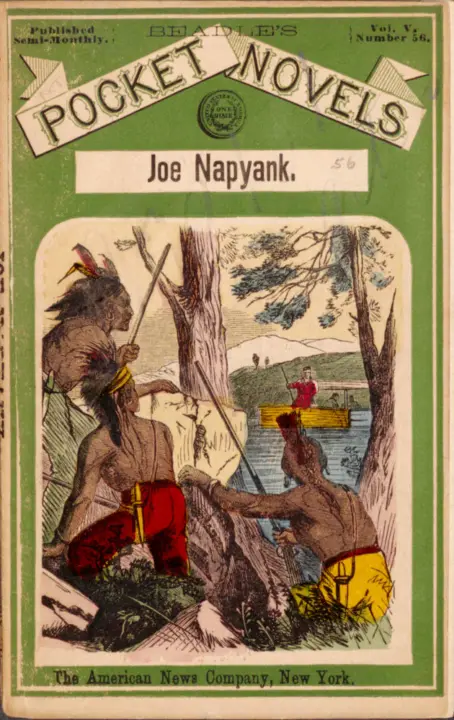
THE CLASSIC COLLECTION · 1885
"Joe Napyank; or, The River Rifles" by Edward Sylvester Ellis is a historical adventure novel written in the late 19th century. The story follows Joe Napyank, a determined and resourceful hunter navigating the dangerous waters of the Ohio River during a tumultuous time punctuated by interactions with Native Americans. The narrative introduces a group of pioneers, including Joe and Theophilus McGowan, as they face threats in their quest for settlement and survival in the uncharted wilderness. The beginning of the novel sets the stage on the Ohio River, where Joe Napyank reflects on his exhaustive journey while scanning the river for companions. Soon after, he encounters McGowan and the crew of a flat-boat who are wary of potential danger from lurking Native Americans. As tensions rise, Joe’s keen instincts and the group’s dynamic are clearly showcased, particularly when they are suddenly threatened by hostile forces. The complexity of their relationships, particularly with Ruth McGowan, is hinted at, while the persistently looming danger amplifies the sense of adventure and survival that threads throughout the narrative.
Introduction adapted from the source catalogue; source summaries may be automatically generated.
Free to read · English · 29,426 words · No account needed
MAKE TIME FOR A GOOD BOOK
On by default. Untick to stop anonymous reading totals. Each page counts after 10 seconds in view. How this works.
Anonymous counting is on unless you have switched it off.
What puzzled the whites was to tell the distance this was away. Stoddard and Smith at first glimpse thought it within thirty feet, but continually after it seemed fully a hundred yards. Regularly forward it continued to glide, until finally it disappeared as if it had been the ember of a torch suddenly thrust beneath the surface of the water.
During all the time not the slightest ripple was heard as explanatory of the singular occurrence. Smith turned toward the hunter,
“What is the meaning of that?”
“Some more of the blasted heathen.”
“How, I don’t understand.”
“In a canoe. Didn’t you see ’em?”
“I saw nothing but the light.”
“One of ’em was smoking—that was what you seen.”
“How far away were they?”
“Just make a guess.”
“A hundred yards I should say.”
“What do you think?” added the hunter addressing McGowan.
“I should say fully that, if not more.”
Joe indulged in a suppressed laugh before he made answer.
“You’re both mistook. I could put out that pipe with a mouthful of
tobacco juice.”
“Impossible! they must have been within a dozen feet of us—not a bit
more.”
“And they wan’t neither. Didn’t you see the canoe?”
“I never once caught sight of it!”
“I seen it as it went by.”
“What a narrow escape!” exclaimed McGowan, appreciating the great danger which had passed them so closely.
“How did you know they were coming?” inquired Stoddard.
“I hear the noise of their paddles.”
“You have sharper ears than any of us if that is the case.”
“Not at all; I expected maybe there was something up, so I jest let my ear drop below the surface, and then heard the paddles. You could have done the same if you only thought of it.”
“But we did not; which is generally the difference between us. They might have run into us before. I should have seen them.”
“Just let your ears drop under water, and tell me whether you can hear anything,” said the hunter.
Stoddard Smith did as was requested, and detected faintly but distinctly the dip of a paddle. He spoke in considerable excitement,
“They’re coming back again.”
“Not quite, I guess; it is the same ones going away.”
“God grant they may remain away,” exclaimed McGowan, in an under tone, “They have caused us enough agony already.”
At this juncture the hunter admonished silence, and for some time nothing more was said. Soon, however, young Smith observed Joe struggling as though he were endeavoring to change the position of the raft.
“Make for the Kentucky shore,” he whispered. “It is time we began to
hunt the land.”
Your reading position is saved on this browser. Take it to another device with a library code. Reading pages adapt to text, rather than matching a printed edition.
Edward Sylvester Ellis
Edward Sylvester Ellis
Edward Sylvester Ellis
Edward Sylvester Ellis
BEHIND THE BOOK
This eBook is for the use of anyone anywhere in the United States and most other parts of the world at no cost and with almost no restrictions whatsoever. You may copy it, give it away or re-use it under the terms of the Project Gutenberg License included with this eBook or online at www.gutenberg.org. If you are not located in the United States, you will have to check the laws of the country where you are located before using this eBook. Read the source licence.
The original source file, including credits and licence, is retained by this library. Request an original-format copy at no charge. Please include the book title and Project Gutenberg identifier #66157.
KEEP YOUR CURIOSITY GOING
Cécile Tormay

Moritz Busch
Coulson Kernahan
John L. Ransom

Maurice Baring
Frances Wright