THE CLASSIC COLLECTION✦From the four windsCLASSIC FREE BOOKS
From the four winds
John Galsworthy
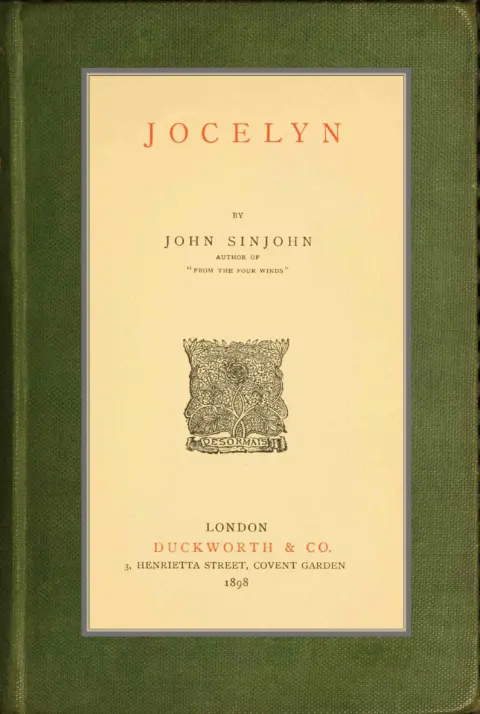
THE CLASSIC COLLECTION · 1898
"Jocelyn" by John Sinjohn is a novel written in the late 19th century. The narrative introduces us to the emotionally complex character of Giles Legard, who grapples with feelings of isolation and longing in his life, especially amidst his interactions with the vibrant and youthful Jocelyn. As themes of love, companionship, and the struggles of self-identity unfold, the backdrop of the Italian Riviera enhances the sense of longing and the contrast between the tranquil yet stagnant life he shares with his ailing wife and the invigorating presence of Jocelyn. At the start of the story, we find Giles Legard in a contemplative mood while sitting on a terrace, reflecting on his life and marriage to Irma, a Polish woman confined to the role of an invalid. As he engages with her at their hotel, he is reminded of his feelings towards the lively young woman, Jocelyn, who brings a rush of emotions to the surface. The narrative delves into the complexities of Giles's relationships, painting a vivid picture of his internal struggles and the intense emotional backdrop as he finds himself drawn to Jocelyn amidst the struggles of his marriage. The feeling of yearning for something more and the push and pull between duty and desire create a rich, evocative atmosphere, setting the stage for the development of their relationship.
Introduction adapted from the source catalogue; source summaries may be automatically generated.
Free to read · English · 58,004 words · No account needed
MAKE TIME FOR A GOOD BOOK
On by default. Untick to stop anonymous reading totals. Each page counts after 10 seconds in view. How this works.
Anonymous counting is on unless you have switched it off.
Nielsen sat at a given table, watching the game; he looked sad, expressionless. He played from the marked cards in his hands and the figures in his head; he awaited combinations. He staked rarely, content with a five per cent. profit upon his outlay of the afternoon. Presently some one appropriated his stake--he looked at the man, mildly hurt, but said nothing; shortly afterwards some one appropriated his neighbour’s stake--he at once exploded in defence; with words he cudgelled the appropriator, he cudgelled the croupiers, he brought the table about his ears, his face grew white, his eyes red, he held on to his point and gained it, then became once more sad and expressionless. For the rest he gambled undeviatingly--a mere matter of business.
Presently they came away, leaving Nielsen waiting patiently for a certain combination. As Jocelyn passed his chair he leant back, and twisted his rather short neck round to say, in a pathetic whisper, and with a shrug of his shoulders--
“Ça ne va pas, ce soir, I wait and wait, but the brread and butter does not come, and now you are going away, that is drreadful, don’t you know.” He had to twist back again in a hurry to mark his card with the last number.
Jocelyn, looking back, thought that he resembled a well-groomed seal
watching a hole for fish.
Mrs. Travis, playing her new “system” with assiduous ignorance, had lost all her own money, had borrowed Jocelyn’s, and lost that. She left the “Rooms” stiff with anger, erect, annoyed with her croupier, whom she believed capable of predicting the coming numbers if he would, strongly convinced that if she had brought more money she must have won, secretly ruffled with Jocelyn for not having more to lend her.
Very little was said on the return journey; Mrs. Travis’s quick green eyes seemed restlessly on the watch for something to resent, Jocelyn was tired, Giles moody. Only when they neared the hotel, he touched her sleeve gently, saying--
“You know we are off to-morrow?”
“Yes,” she answered, “I am so sorry.”
She stopped, and a faint colour came into her cheeks.
“I shall miss our walks dreadfully, and Shika--poor boy: he won’t get his cake. Will you remember to give it him every afternoon?”
“No,” said Giles shortly, “I’ll bring him over for you to give it.”
“Oh!” she said, drawing little circles in the dust with the end of her parasol. He was standing in front of her, tall and straight, with his hat off, and a very grave face. She looked up at him quickly, and held out her hand with a smile.
Your reading position is saved on this browser. Take it to another device with a library code. Reading pages adapt to text, rather than matching a printed edition.
John Galsworthy
John Galsworthy
John Galsworthy
John Galsworthy
BEHIND THE BOOK
This eBook is for the use of anyone anywhere in the United States and most other parts of the world at no cost and with almost no restrictions whatsoever. You may copy it, give it away or re-use it under the terms of the Project Gutenberg License included with this eBook or online at www.gutenberg.org. If you are not located in the United States, you will have to check the laws of the country where you are located before using this eBook. Read the source licence.
The original source file, including credits and licence, is retained by this library. Request an original-format copy at no charge. Please include the book title and Project Gutenberg identifier #73672.
KEEP YOUR CURIOSITY GOING
Coulson Kernahan

Maurice Baring
Frances Wright
Cécile Tormay

Frederic Jesup Stimson

W. H. P. (William Henry Pope) Jarvis