
The Lone Wolf Returns
Louis Joseph Vance
THE CLASSIC COLLECTION · 1913
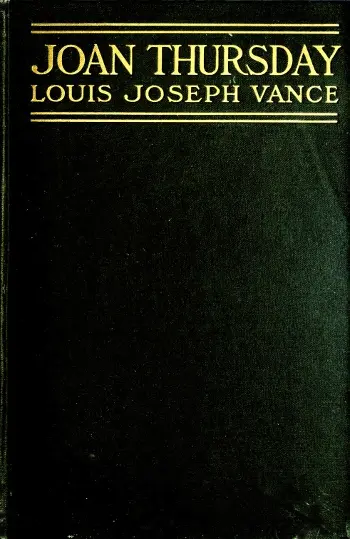
"Joan Thursday: A Novel" by Louis Joseph Vance is a fictional work written in the early 20th century. This novel introduces the main character, Joan Thursby, a young shop girl struggling to make her way in a harsh urban environment characterized by poverty and gender-based challenges. As the story unfolds, it seems poised to explore themes of personal aspiration, societal constraints, and the pursuit of freedom against the backdrop of early 1900s New York. The beginning of "Joan Thursday" presents a day in the life of Joan, who is fatigued after a long day of work at a department store. As she waits for a crowded streetcar, her exhaustion is palpable, paralleling her feelings of frustration and despair. Faced with disrespect and harassment from men, Joan contemplates her lost job and uncertain future, revealing her inner struggles against societal expectations. When she finally returns to her family's tenement, she is determined to escape her current life, which she perceives as devoid of hope. Her tumultuous home life is marked by her father's gambling addiction and her family's oppressive circumstances, setting the stage for Joan's bold decision to seek a different path in the world.
Introduction adapted from the source catalogue; source summaries may be automatically generated.
Free to read · English · 110,541 words · No account needed
MAKE TIME FOR A GOOD BOOK
On by default. Untick to stop anonymous reading totals. Each page counts after 10 seconds in view. How this works.
Anonymous counting is on unless you have switched it off.
"Odd as it may sound," she said in a mocking voice, "I have my secrets."
Her back was to the moon, her face a pallid oval framed in ebony, illegible; but the moonlight was full upon his face, and she who would might read. His disadvantage was obvious. It wasn't fair....
Lounging, she crossed her knees, puffed thrice and cast the cigarette into the gulf. Abruptly she sat forward, studying him intently. He was disturbed with a singular uneasiness.
"Jack," said Venetia very quietly, "is it true that you love me?"
"Good lord!" he cried, sitting up.
"Is it true?"
He blinked. His head was whirling. He said nothing; sank back; quite automatically puffed with such fury that in a trice he had reduced the cigarette to an inch of glowing coal; scorched his fingers and threw it from him.
Then he gasped stupidly: "Venetia!"
"Is it true?"
She had not moved. The question had the force of stubborn purpose through its very monotony, a monotony of inflexion no less than of repetition. Her accents were both serious and sincere. She was in earnest; she meant to know.
"But, Venetia--"
"Or have you been just making believe, all this long time?"
"It--I--why--of course it's true!" he stammered lamely.
"Then why haven't you ever told me so?"
There sounded reproach, not unkindly, but real. He shook his wits
together.
"How could I guess you'd care to know?"
"Do you know me so little as to think I'd resent it, if I happened not
to care?"
"I--don't know--didn't think of it that way. In fact--you've knocked me
silly!"
"But why? Because I've been straightforward? Dear boy!"--she lifted a hand to him: he took it in trembling--"you're twenty-seven, I'm twenty-three. We know one another pretty well: we know ourselves--at least slightly. Why can't we face things--facts--as man and woman, not as children? What's the good of make-believe? If this thing lies between us, let's be frank about it!"
He hesitated, doubting, searching her face. Her look was very sweet and kind. Of a sudden he cried "Venetia!" came to his knees beside her chair, snatched her hand and crushed it between his own, to his lips.
"I love you--I've always loved you!..."
He felt the velvet of her lips, her breath, upon his forehead; and made as if to clasp her to him. But she slipped back, straightening an arm to fend him off.
"No," she whispered--"not now--not here. Dear boy, get up! Think--this moonlight--anybody might see--"
"I love you!"
"I know and, dear, I'm glad--so glad! But--you made me ask you!"
"I couldn't help that, Venetia: I was--afraid; I hardly dared to dream--of this. You were--you are--above, beyond--"
Your reading position is saved on this browser. Take it to another device with a library code. Reading pages adapt to text, rather than matching a printed edition.
Louis Joseph Vance
Louis Joseph Vance
Louis Joseph Vance
Louis Joseph Vance
BEHIND THE BOOK
This eBook is for the use of anyone anywhere in the United States and most other parts of the world at no cost and with almost no restrictions whatsoever. You may copy it, give it away or re-use it under the terms of the Project Gutenberg License included with this eBook or online at www.gutenberg.org. If you are not located in the United States, you will have to check the laws of the country where you are located before using this eBook. Read the source licence.
The original source file, including credits and licence, is retained by this library. Request an original-format copy at no charge. Please include the book title and Project Gutenberg identifier #36502.
KEEP YOUR CURIOSITY GOING
Coulson Kernahan

Maurice Baring
Frances Wright
Cécile Tormay

Frederic Jesup Stimson

W. H. P. (William Henry Pope) Jarvis