
The Lone Wolf Returns
Louis Joseph Vance
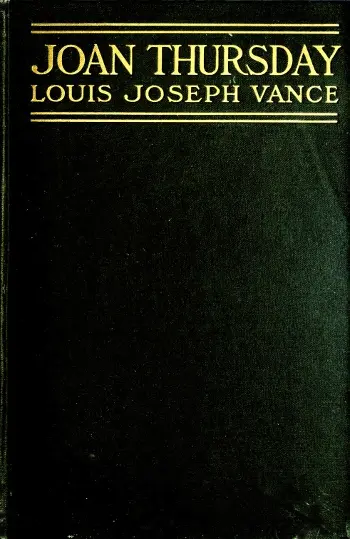
THE CLASSIC COLLECTION · 1913
"Joan Thursday: A Novel" by Louis Joseph Vance is a fictional work written in the early 20th century. This novel introduces the main character, Joan Thursby, a young shop girl struggling to make her way in a harsh urban environment characterized by poverty and gender-based challenges. As the story unfolds, it seems poised to explore themes of personal aspiration, societal constraints, and the pursuit of freedom against the backdrop of early 1900s New York. The beginning of "Joan Thursday" presents a day in the life of Joan, who is fatigued after a long day of work at a department store. As she waits for a crowded streetcar, her exhaustion is palpable, paralleling her feelings of frustration and despair. Faced with disrespect and harassment from men, Joan contemplates her lost job and uncertain future, revealing her inner struggles against societal expectations. When she finally returns to her family's tenement, she is determined to escape her current life, which she perceives as devoid of hope. Her tumultuous home life is marked by her father's gambling addiction and her family's oppressive circumstances, setting the stage for Joan's bold decision to seek a different path in the world.
Introduction adapted from the source catalogue; source summaries may be automatically generated.
Free to read · English · 110,541 words · No account needed
MAKE TIME FOR A GOOD BOOK
On by default. Untick to stop anonymous reading totals. Each page counts after 10 seconds in view. How this works.
Anonymous counting is on unless you have switched it off.
There was an open taxicab waiting in front of the door. As she came out, Butch bent over and cranked the motor. Straightening up, he waved her curtly into the body of the car.
"Jump in and shut the door," he ordered briefly, climbing into the
driver's seat.
"But--Butch--"
"Doncha hear me? Get in and shut that door. We got no time to waste
chinnin' here."
Abashed and frightened, the girl obeyed.
Immediately Butch had the cab in motion, tearing eastward at lawless speed through streets whose long ranks of yawning windows, seen fugitively in the formless dusk of early morning, seemed to look down leering, as if informed with terrible intelligence.
She shut out the sight of them with hands that covered her face until the swift rush of cool air steadied and sobered her, so that she grew calmer in the knowledge that, in veritable fact (and this was all that really mattered) "nobody knew"....
Then, sitting up, she composed herself, and with deft fingers completed the adjustment of her garments. By the time she had finished her toilet, aided by a small mirror inset between the forward windows, Butch was stopping the cab before the East Seventy-sixth Street tenement.
Bending back, he unlatched the door and swung it open.
"You go on up," he ordered. "I'll be around before long--gotta run this machine back to the garage."
Joan stepped quickly to the sidewalk, and shut the door.
"All right," she responded, and added, almost timidly, avoiding her brother's eyes: "Thank you, Butch."
He grunted unintelligibly and, as Joan moved up the stoop, threw in the power again and drew swiftly away down the street.
For an instant Joan held back in the vestibule, sickened to recognize anew the home of dirt and squalor she had fled, a long lifetime since, it seemed, and struggling with almost invincible repugnance for the ordeal awaiting her at the head of those five weary flights.
Then, more through instinct than of her will, her finger pressed the call-button beneath the Thursby letter box.
The latch clicked. She pushed the door open, moved reluctantly into the shadows and addressed herself wearily to the stairs, inhaling with a keen physical disgust the heavy and malodorous atmosphere in which her youth had been shaped toward womanhood.
As the dining-room door admitted her, she checked again, almost tempted to question the soundness of those faculties which insisted that more than a year had passed, rather than an hour or two, since she had left that mean and sordid place.
Your reading position is saved on this browser. Take it to another device with a library code. Reading pages adapt to text, rather than matching a printed edition.
Louis Joseph Vance
Louis Joseph Vance

Louis Joseph Vance

Louis Joseph Vance
BEHIND THE BOOK
This eBook is for the use of anyone anywhere in the United States and most other parts of the world at no cost and with almost no restrictions whatsoever. You may copy it, give it away or re-use it under the terms of the Project Gutenberg License included with this eBook or online at www.gutenberg.org. If you are not located in the United States, you will have to check the laws of the country where you are located before using this eBook. Read the source licence.
The original source file, including credits and licence, is retained by this library. Request an original-format copy at no charge. Please include the book title and Project Gutenberg identifier #36502.
KEEP YOUR CURIOSITY GOING
Coulson Kernahan

Maurice Baring
Frances Wright
Cécile Tormay

Frederic Jesup Stimson

W. H. P. (William Henry Pope) Jarvis