THE CLASSIC COLLECTION✦When I was your ageCLASSIC FREE BOOKS
When I was your age
Laura Elizabeth Howe Richards
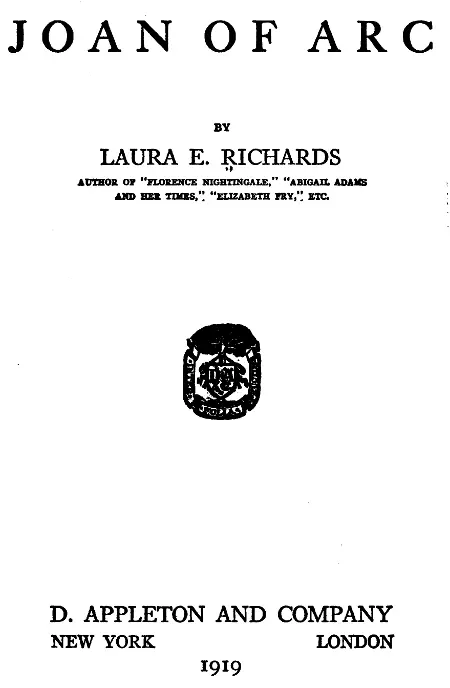
THE CLASSIC COLLECTION · 1919
"Joan of Arc" by Laura Elizabeth Howe Richards is a historical account written in the early 20th century. The book explores the life and legacy of Joan of Arc, focusing on her role as a peasant girl who rose to become a military leader during the Hundred Years' War. It delves into her visions and the socio-political turmoil of 15th-century France that shaped her extraordinary journey. At the start of the narrative, readers are introduced to the context in which Joan of Arc emerged as a pivotal figure. The text vividly outlines the suffering of France during the Great War and draws historical parallels, emphasizing that France has endured countless conflicts in its history. It establishes the atmosphere of despair and chaos brought on by internal strife and foreign invasion, setting the stage for Joan’s emergence. Her early life in Domrémy is depicted as serene yet shadowed by the conflicts of the time, hinting at her destined path. The beginning also hints at the miraculous events that will propel her into a leadership role, as she receives divine visions urging her to aid the king of France and reclaim her country.
Introduction adapted from the source catalogue; source summaries may be automatically generated.
Free to read · English · 51,315 words · No account needed
MAKE TIME FOR A GOOD BOOK
On by default. Untick to stop anonymous reading totals. Each page counts after 10 seconds in view. How this works.
Anonymous counting is on unless you have switched it off.
"I appeal to God, the supreme Judge, against the wrongs that have been
done me."
At this moment Cauchon entered the prison. He must see with his own eyes how his victim received her condemnation. She turned upon him, and uttered the words which, wherever his name is spoken, whenever his image is conjured up, are written in flame upon his forehead:
"Bishop of Beauvais, it is through you I die. I summon you before your
God and mine!"
Presently she composed herself; made confession to one of the monks, and asked for the Sacrament. After some haggling among her persecutors the elements were brought to her, albeit in slovenly fashion, bare of the priestly pomp which was their due.
So we come to the 30th day of May, of the year 1431. At nine in the morning Joan left her prison for the last time. She was in woman's dress. Over her shoulders was the long black robe of the Inquisition, on her head a paper cap or mitre, bearing the words: "Heretic, Relapsed, Apostate, Idolater." As the cart in which she stood rumbled through the streets, the Maid of France lifted up her voice and wept over the city of her death.
"Rouen, Rouen, mourrai-je içi? Seras-tu ma maison? Ah, Rouen, j'ai grand peur que tu n'aies à souffrir de ma mort."[70]
Hearing these words, the people around her, even the English soldiers, wept for pity. It is recorded that as the tumbril jolted its way over the stones, a man in priest's dress was seen pressing through the crowd, trying desperately to force a way to the cart. It was Loiseleur, the spy, come in an agony of repentance, to fling himself before the saint he had helped to condemn and implore her pardon. The soldiers repulsed him brutally; would have slain him but for Warwick's intervention. The crowd closed over him.
There were three scaffolds in Rouen Old Market that morning of May. On one of them the Maid was set to hear her last sermon preached by Nicholas Midi, of Rouen and Paris; on another sat judges and spectators, a goodly company; Cardinal Beaufort, Warwick, the "Father of Courtesy," Cauchon and all his priestly bloodhounds, who yet could not see blood shed.
The third scaffold was a heap of plaster, piled high with fagots, from which rose the stake. It bore the legend: "Jeanne, self-styled the Maid, liar, mischief-maker, abuser of the people, diviner, superstitious, blasphemer of God, presumptuous, false to the faith of Christ, boaster, idolater, cruel, dissolute, an invoker of devils, apostate, schismatic, heretic."
Nicholas Midi was long in speaking, and the English waxed impatient.
Dinner time was near.
Your reading position is saved on this browser. Take it to another device with a library code. Reading pages adapt to text, rather than matching a printed edition.
Laura Elizabeth Howe Richards

Laura Elizabeth Howe Richards
Laura Elizabeth Howe Richards
Laura Elizabeth Howe Richards
BEHIND THE BOOK
This eBook is for the use of anyone anywhere in the United States and most other parts of the world at no cost and with almost no restrictions whatsoever. You may copy it, give it away or re-use it under the terms of the Project Gutenberg License included with this eBook or online at www.gutenberg.org. If you are not located in the United States, you will have to check the laws of the country where you are located before using this eBook. Read the source licence.
The original source file, including credits and licence, is retained by this library. Request an original-format copy at no charge. Please include the book title and Project Gutenberg identifier #45743.
KEEP YOUR CURIOSITY GOING
Cécile Tormay

Moritz Busch
John L. Ransom
Frances Wright
Cécile Tormay

Mabel Potter Daggett