THE CLASSIC COLLECTION✦The way the world is goingCLASSIC FREE BOOKS
The way the world is going
H. G. (Herbert George) Wells
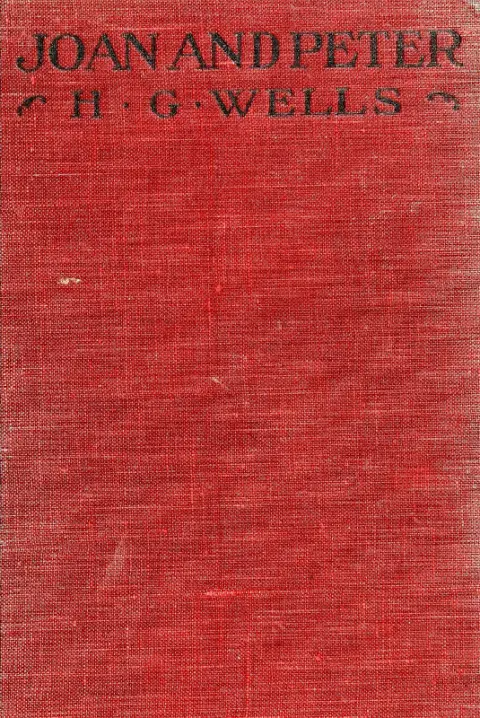
THE CLASSIC COLLECTION · 1918
"Joan and Peter: The story of an education" by H. G. Wells is a novel published in 1918. Following two orphaned children through late-Victorian and Edwardian England, the story chronicles their turbulent upbringing as competing guardians battle over their education. Peter and Joan navigate questionable schools, social upheaval, and personal conflicts while growing up as wards. As World War I erupts, their experiences crystallize into deeper understanding about life, love, and the future. Wells crafted this ambitious work as both a critique of English education and a reflection on war's impact on society.
Introduction adapted from the source catalogue; source summaries may be automatically generated.
Free to read · English · 214,559 words · No account needed
MAKE TIME FOR A GOOD BOOK
On by default. Untick to stop anonymous reading totals. Each page counts after 10 seconds in view. How this works.
Anonymous counting is on unless you have switched it off.
“Well, you haven’t been to much in the way of schools,” said Oswald.
“Are there better schools?”
“No end. We’re going to find one,” said Oswald.
“I wish school was over,” said Peter.
“Why? You’ve got no end to learn yet.”
“I want to begin,” said Peter, looking out across the tumbled gentleness
of the Weald.
“Begin school?”
“No, begin—Africa, India—doing things.”
“School first,” said Oswald.
“Are there schools where you learn about guns and animals and mountains and foreign people?” said Peter.
“There must be,” said Oswald. “We’ll find something.”
“Where you don’t do Latin and parsing and ’straction of the square
root.”
“Oh! those things have their place.”
“Did you have to do them, Uncle Nobby?”
“Rather.”
“Were they useful to you?”
“At times—in a way. Of course those things are good as training, you know—awfully good. Harden up the mental muscles, Peter.”
Peter made no reply to that.
Presently Peter said, “Shall I learn about machines?”
“When you’ve done some mathematics, Peter.”
“I’d like to fly,” said Peter.
“That’s far away yet.”
“There was a boy at that school, his father was an engineer; and he said that flying machines were coming quite soon.”
This was beyond Oswald’s range.
“The French have got a balloon that steers about,” he said. “That’s as near as we are likely to come to flying for a long time yet.”
“This boy said that he meant a real flying machine, not a balloon. It was to be heavier than air. It would fly like a kite or a bird.”
“I doubt if we’ll see that in my lifetime,” said Oswald; “or yours,” blind to the fate that had marked Peter for its own.
“H’m,” said Peter, with a shadow falling upon one of his brightest dreams. (Nobby ought to know these things. His word ought surely to be final. Still, after all, this chap’s father was an engineer.) “I’d love to fly,” said Peter.
Something with the decorative effect of a broad processional banner in a very High Church indeed, appeared upon the flagstone path. It was Aunt Phœbe.
Your reading position is saved on this browser. Take it to another device with a library code. Reading pages adapt to text, rather than matching a printed edition.
H. G. (Herbert George) Wells
H. G. (Herbert George) Wells
H. G. (Herbert George) Wells
H. G. (Herbert George) Wells
BEHIND THE BOOK
This eBook is for the use of anyone anywhere in the United States and most other parts of the world at no cost and with almost no restrictions whatsoever. You may copy it, give it away or re-use it under the terms of the Project Gutenberg License included with this eBook or online at www.gutenberg.org. If you are not located in the United States, you will have to check the laws of the country where you are located before using this eBook. Read the source licence.
The original source file, including credits and licence, is retained by this library. Request an original-format copy at no charge. Please include the book title and Project Gutenberg identifier #61426.
KEEP YOUR CURIOSITY GOING
Coulson Kernahan

Maurice Baring
Frances Wright
Cécile Tormay

Frederic Jesup Stimson

W. H. P. (William Henry Pope) Jarvis