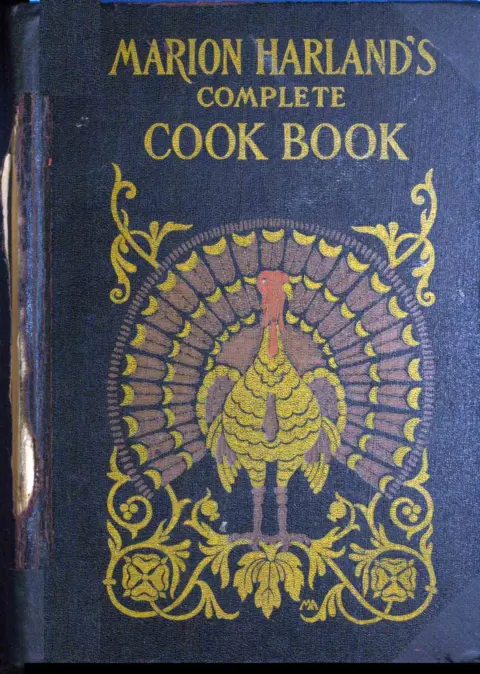
Marion Harland’s Complete Cook Book A Practical and Exhaustive Manual of Cookery and Housekeeping
Marion Harland
THE CLASSIC COLLECTION · 1873
"Jessamine: A Novel" by Marion Harland is a work of fiction written in the late 19th century. The story introduces a young girl named Jessie, who is captivated by a church ceremony and the orator, Mr. Fordham, revealing her idealistic nature and romantic yearnings. As the narrative unfolds, we encounter her interactions with various characters, including Mr. Wyllys, who enters her life amidst a celebration, setting the stage for themes of love, aspiration, and the intricacies of social dynamics. The opening of "Jessamine" presents Jessie, who is portrayed as vibrant yet physically fragile, lying in her oriel-window, lost in admiration for the powerful speaker at the church. Her affection for Mr. Fordham quickly becomes apparent, as does her sense of pride in her heritage and community's history. Meanwhile, her interaction with Mr. Wyllys reveals her desire for connection and acceptance amidst her burgeoning emotions and the consequences of her physical limitations from an injury. This portion of the novel effectively establishes the characters' relationships and hints at the potential for romantic developments as the story progresses.
Introduction adapted from the source catalogue; source summaries may be automatically generated.
Free to read · English · 103,472 words · No account needed
MAKE TIME FOR A GOOD BOOK
On by default. Untick to stop anonymous reading totals. Each page counts after 10 seconds in view. How this works.
Anonymous counting is on unless you have switched it off.
"Mr. Wyllys has heard that I am like champagne, 'stale, flat, and unprofitable'--with a dash of vinegar--when the effervescence wrought by social excitement is off," vivified, by her mirthful misrepresentation of her visitor's words, into radiance that revealed every molar, and forced her eyelids into utter retirement.
"Ah!" The doctor smiled absently, and re-bent his brows over the page, protruding his lips in a vicious pout as he read.
"He disdains to notice the slander," resumed Mrs. Baxter, unabashed at her failure to elicit a conjugal compliment. "Seriously, Mr. Wyllys, I am thankful for the guidance of reason and will that counterbalance my mercurial temperament. My spirit resembles nothing else so much as a mettled steed, whose curvettings are restrained by an inexorable rein. But for my sober judgment, Impulse would have led me into an erratic course, I fear."
Relaxing the tension of the fingers and wrist that had pulled hard at an imaginary curb, and unclenching the teeth from their bite upon the word "inexorable," she sighed, reflectively.
"The combination is rare--" commenced the gentleman.
"It is preposterous!" ejaculated the doctor, closing the
Russian-leather album with a concussion like the report of a
pocket-pistol.
"I think not, dear," said the wife, gently corrective. "It is, as
Mr. Wyllys says, a rare combination, but certainly not an impossible
one."
"It is preposterous," reiterated the doctor, with a ruinous tug at his cravat, "that a rational creature, who can read and write, should waste time in disfiguring good, honest paper with such incongruous, not to say blasphemous, nonsense as I find here. It was bad enough for mediaeval monks to deck the Word of Life in the motley wear of a harlequin. Greek, German, black-letter text, are, all of them, stumbling-blocks to the unlearned, diversions to the thoughtless. But when the sacred Scriptures are bedizened into further illegibility by paint and gilding, and illustrated by birds, beasts, and even fishes, daubed upon fields, azure, argent, and verde, the offence becomes an abomination. Such profanation is offered that divinest of pastorals, the twenty-third psalm, in this volume," elevating it in strong disgust.
Mrs. Baxter arose and took it from his hand in time to save it from being tossed to the table or floor.
"Tastes differ, my dear husband," was all she said, but her forbearance and real sweetness of temper called forth a look of unfeigned respect from the amused spectator.
"I wouldn't keep it in the parlor, if I were in your place, Jane," the doctor expostulated, seeing her deposit the folio upon a stand beyond his reach.
"I will not ask you to look at it again, love,"--still amiably.
Your reading position is saved on this browser. Take it to another device with a library code. Reading pages adapt to text, rather than matching a printed edition.
Marion Harland
Marion Harland
Marion Harland
Marion Harland
BEHIND THE BOOK
This eBook is for the use of anyone anywhere in the United States and most other parts of the world at no cost and with almost no restrictions whatsoever. You may copy it, give it away or re-use it under the terms of the Project Gutenberg License included with this eBook or online at www.gutenberg.org. If you are not located in the United States, you will have to check the laws of the country where you are located before using this eBook. Read the source licence.
The original source file, including credits and licence, is retained by this library. Request an original-format copy at no charge. Please include the book title and Project Gutenberg identifier #36414.
KEEP YOUR CURIOSITY GOING
Coulson Kernahan

Maurice Baring
Frances Wright
Cécile Tormay

Frederic Jesup Stimson

W. H. P. (William Henry Pope) Jarvis