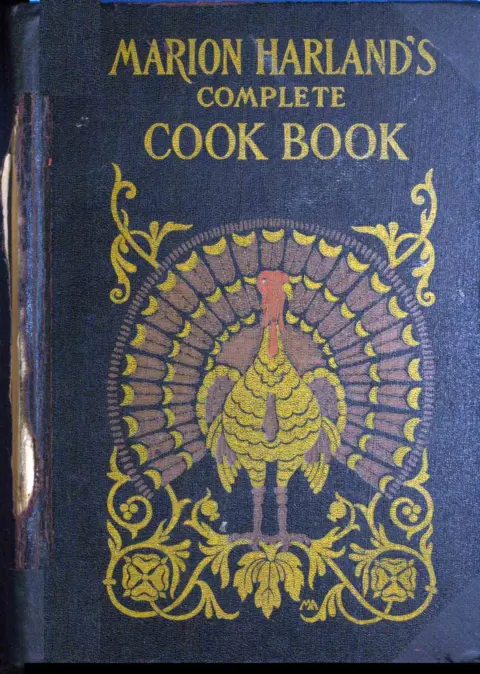
Marion Harland’s Complete Cook Book A Practical and Exhaustive Manual of Cookery and Housekeeping
Marion Harland
THE CLASSIC COLLECTION · 1873
"Jessamine: A Novel" by Marion Harland is a work of fiction written in the late 19th century. The story introduces a young girl named Jessie, who is captivated by a church ceremony and the orator, Mr. Fordham, revealing her idealistic nature and romantic yearnings. As the narrative unfolds, we encounter her interactions with various characters, including Mr. Wyllys, who enters her life amidst a celebration, setting the stage for themes of love, aspiration, and the intricacies of social dynamics. The opening of "Jessamine" presents Jessie, who is portrayed as vibrant yet physically fragile, lying in her oriel-window, lost in admiration for the powerful speaker at the church. Her affection for Mr. Fordham quickly becomes apparent, as does her sense of pride in her heritage and community's history. Meanwhile, her interaction with Mr. Wyllys reveals her desire for connection and acceptance amidst her burgeoning emotions and the consequences of her physical limitations from an injury. This portion of the novel effectively establishes the characters' relationships and hints at the potential for romantic developments as the story progresses.
Introduction adapted from the source catalogue; source summaries may be automatically generated.
Free to read · English · 103,472 words · No account needed
MAKE TIME FOR A GOOD BOOK
On by default. Untick to stop anonymous reading totals. Each page counts after 10 seconds in view. How this works.
Anonymous counting is on unless you have switched it off.
"I am sorry you did not arrive in season to participate in the celebration of our Centennial. You know, I suppose, that Mr. Fordham is the orator of the day?"
Warily observant, with eyes that habitually looked careless, and were never off guard, Mr. Wyllys remarked the smile and glance through the window at the church, which accompanied this bit of information, but his reply evinced no knowledge of aught beyond what was conveyed by her words.
"I should be ashamed to confess it, but I was not aware until this moment that any public celebration was going on, unless it were a religious service in the church--a saint's day or other solemn festival. Is this, then, the Anniversary of a notable event in the history of your lovely valley?"
There was a tincture of commiseration for his ignorance mingled with her surprise at the question that must have diverted the stranger if his sense of humor was keen. Her answer was grave as befitted the importance of the subject.
"The founder of this colony among the hills was a direct descendant of the Scotch Covenanters--one David Dundee, from whom the settlement took its name. He emigrated with a large family of sturdy boys and girls, and his report of the rich lands and genial climate of his new home drew after him many others--all from his native land--most of them his former friends and neighbors. They cleared away forests, built houses, dug, and ploughed, and reaped, and worshipped GOD after the fashion of their fathers, having, within fifteen years after David Dundee's establishment of himself and household here, erected the substantial church you see over there. At the time of the breaking out of the French and Indian war, there was not a more prosperous and happy community in the State. In response to the call to arms, the bravest and best of the young and middle-aged men formed themselves into a company and marched away to fight as zealously and conscientiously as they had felled the woods and tilled the ground. A mere handful--and most of these infirm from age and disease--remained with the women and children, upon whom devolved much and heavy labor if they would retain plenty and comfort in their homes. They were literally hewers of wood and drawers of water; they sowed the fields and gardens, and gathered in the crops with their own hands--these heroic great-grandmothers of ours!--herded their cattle and repaired their houses, besides performing the ordinary tasks of housewives. And--one and all--they learned and practised the use of fire-arms, kept muskets beside cradles and kneading-troughs, and when they met for worship on Sabbath, mothers carried their babies on the left arm, a gun upon the right. One day, late in April--perhaps as fair and sweet a day as this--news came to this secluded hamlet that a large body of 'the enemy'--chiefly Indians and half-breeds--was approaching. Providentially, old David Dundee was at home on a furlough of three days--he asked no more--that he might rally somewhat after the amputation of his left arm in hospital. He had the church bell rung (it was a present from a Scottish lord, and it hangs still in the steeple), and after a brief consultation upon the green in front of the 'kirk,' with the wisest of his neighbors--a council of war from which women were not excluded--he collected the entire population into the church, first allowing them one hour in which to bury or otherwise secrete their valuables. The feebler women and the children were sent, for safety, into the cellar, which extends under the whole building; the lower parts of the windows were barricaded with feather-beds and mattresses, with loop-holes through which guns could be thrust, and these stout-hearted matrons and young girls volunteered to defend. The men were mustered in the galleries. A sentinel from the bell-tower soon gave warning that the foe was in sight. From their loop-holes the colonists saw their houses and barns fired, their horses and other stock maimed and butchered, gardens, fields, and orchards wantonly laid waste; but not a woman wept or a man swore or groaned in the crowded church. On they came, flushed with success, ravening for human blood. David Dundee spoke twice before the uproar without made hearing, even of his stentorian voice, impossible. 'Haud your fire 'till ye hear me gie the word!' he said, when his small army looked to him for orders, as savages and half-breeds rushed forward to surround the building. A minute later--'The Lord have maircy upon their souls, for we'll hae nane upon their bodies! Fire!'
Your reading position is saved on this browser. Take it to another device with a library code. Reading pages adapt to text, rather than matching a printed edition.
Marion Harland

Marion Harland
Marion Harland
Marion Harland
BEHIND THE BOOK
This eBook is for the use of anyone anywhere in the United States and most other parts of the world at no cost and with almost no restrictions whatsoever. You may copy it, give it away or re-use it under the terms of the Project Gutenberg License included with this eBook or online at www.gutenberg.org. If you are not located in the United States, you will have to check the laws of the country where you are located before using this eBook. Read the source licence.
The original source file, including credits and licence, is retained by this library. Request an original-format copy at no charge. Please include the book title and Project Gutenberg identifier #36414.
KEEP YOUR CURIOSITY GOING
Coulson Kernahan

Maurice Baring
Frances Wright
Cécile Tormay

Frederic Jesup Stimson

W. H. P. (William Henry Pope) Jarvis