THE CLASSIC COLLECTION✦An American tragedy, v. 2CLASSIC FREE BOOKS
An American tragedy, v. 2
Theodore Dreiser
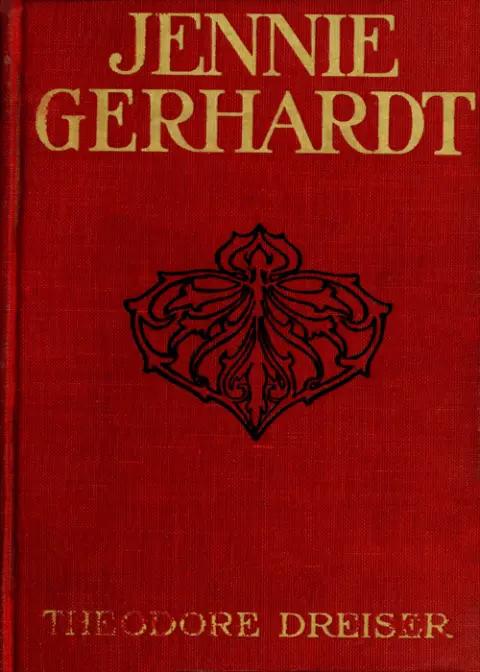
THE CLASSIC COLLECTION · 1911
"Jennie Gerhardt: A Novel" by Theodore Dreiser is a novel published in 1911. It follows Jennie, a destitute young woman who becomes involved with two men above her social station. First, a senator who dies before they can marry, leaving her pregnant. Then Lester Kane, a wealthy manufacturer's son who takes her as his mistress. Their relationship faces mounting pressure from his family and society's class barriers, forcing difficult choices about love, security, and sacrifice.
Introduction adapted from the source catalogue; source summaries may be automatically generated.
Free to read · English · 129,154 words · No account needed
MAKE TIME FOR A GOOD BOOK
On by default. Untick to stop anonymous reading totals. Each page counts after 10 seconds in view. How this works.
Anonymous counting is on unless you have switched it off.
"The families of the poor," he thought.
"Well, you take this from me," he insisted, drawing a purse from
his coat. "And I'll see you very soon again. There's no escape,
sweet."
"No, no," she protested. "I won't. I don't need it. No, you mustn't
ask me."
He insisted further, but she was firm, and finally he put the money
away.
"One thing is sure, Jennie, you're not going to escape me," he said soberly. "You'll have to come to me eventually. Don't you know you will? Your own attitude shows that. I'm not going to leave you alone."
"Oh, if you knew the trouble you're causing me."
"I'm not causing you any real trouble, am I?" he asked. "Surely
not."
"Yes. I can never do what you want."
"You will! You will!" he exclaimed eagerly, the bare thought of this prize escaping him heightening his passion. "You'll come to me." And he drew her close in spite of all her protests.
"There," he said when, after the struggle, that mystic something between them spoke again, and she relaxed. Tears were in her eyes, but he did not see them. "Don't you see how it is? You like me too."
"I can't," she repeated, with a sob.
Her evident distress touched him. "You're not crying, little girl,
are you?" he asked.
She made no answer.
"I'm sorry," he went on. "I'll not say anything more to-night. We're almost at your home. I'm leaving to-morrow, but I'll see you again. Yes, I will, sweet. I can't give you up now. I'll do anything in reason to make it easy for you, but I can't, do you hear?"
She shook her head.
"Here's where you get out," he said, as the carriage drew up near the corner. He could see the evening lamp gleaming behind the Gerhardt cottage curtains.
"Good-by," he said as she stepped out.
"Good-by," she murmured.
"Remember," he said, "this is just the beginning."
"Oh no, no!" she pleaded.
He looked after her as she walked away.
"The beauty!" he exclaimed.
Jennie stepped into the house weary, discouraged, ashamed. What had she done? There was no denying that she had compromised herself irretrievably. He would come back.
He would come back. And he had offered her money. That was the
worst of all.
Your reading position is saved on this browser. Take it to another device with a library code. Reading pages adapt to text, rather than matching a printed edition.
Theodore Dreiser
Theodore Dreiser
Theodore Dreiser
Theodore Dreiser
BEHIND THE BOOK
This eBook is for the use of anyone anywhere in the United States and most other parts of the world at no cost and with almost no restrictions whatsoever. You may copy it, give it away or re-use it under the terms of the Project Gutenberg License included with this eBook or online at www.gutenberg.org. If you are not located in the United States, you will have to check the laws of the country where you are located before using this eBook. Read the source licence.
The original source file, including credits and licence, is retained by this library. Request an original-format copy at no charge. Please include the book title and Project Gutenberg identifier #28988.
KEEP YOUR CURIOSITY GOING
Coulson Kernahan

Maurice Baring
Frances Wright
Cécile Tormay

Frederic Jesup Stimson

W. H. P. (William Henry Pope) Jarvis