THE CLASSIC COLLECTION✦My diaries, being a personal narrative of events 1888-1914, Part 2 (1900-1914)CLASSIC FREE BOOKS
My diaries, being a personal narrative of events 1888-1914, Part 2 (1900-1914)
Wilfrid Scawen Blunt
THE CLASSIC COLLECTION · 1905
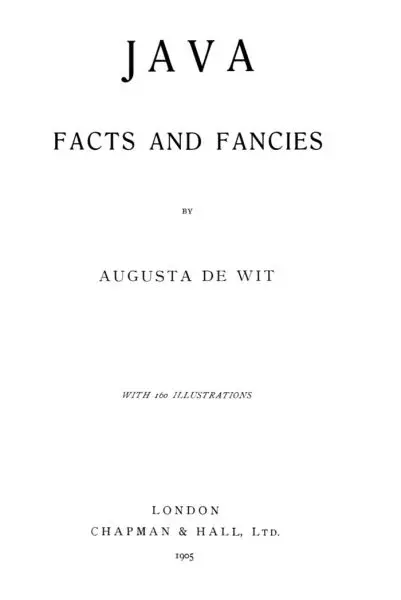
"Java, Facts and Fancies" by Augusta de Wit is a descriptive travelogue written in the early 20th century. The book vividly captures the author's experiences and observations during her time in Java, highlighting the natural beauty, culture, and daily life of the area. With 160 illustrations accompanying the text, it promises an immersive journey through the landscapes and society of Java. At the start of the narrative, the author reflects on her initial misconceptions about Java, viewing it as a fantastical land filled with dreams and fancies. She describes her arrival during the rainy season, where the scene is painted with soft hues and delicate natural elements, contrasting sharply with the more tumultuous realities of the environment. The opening portion depicts her first impressions of Batavia, showcasing the unique blend of local customs, tropical settings, and the numerous native boats that populate the waters, creating an enchanting yet complex portrait of life in this vibrant region.
Introduction adapted from the source catalogue; source summaries may be automatically generated.
Free to read · English · 47,299 words · No account needed
MAKE TIME FOR A GOOD BOOK
On by default. Untick to stop anonymous reading totals. Each page counts after 10 seconds in view. How this works.
Anonymous counting is on unless you have switched it off.
Carriers walking by the side of their lumbering, bullock-drawn "pedati," which creaks so leisurely along the sun-scorched roads; labourers on their way to the rice fields, the light wooden ploughshare across their shoulders, driving the patient yoke of oxen before them; women from the hill-villages around, who come to the Bogor market in holiday attire, a chaplet of jessamine blossoms twisted into their "kondeh"--all turn aside from the road, to murmur a short prayer, and offer a handful of flowers, of frankincense and yellow boreh unguent, or even Chinese joss-sticks and small paper lanterns on the consecrated spot. Whether this be an act of homage to those ancient kings and heroes, whose rude effigies adorn the stones, and whose spirits are believed still to haunt the spot; or simply a fetishistic adoration of these blocks of granite and the curious signs engraved thereon, it is difficult to decide; the worshippers themselves hardly seem to know. When asked, they reply that they do as their fathers did before them, and so, therefore, must be right; unless, indeed, they merely smile, and offer the somewhat irrelevant remark that they are true Moslemin. This, indeed, every native of Java (save such few as have been converted to the Christian religion) professes himself to be. And, in a measure, the Javanese are Mohammedans; they recite the Mohammedan prayers and Confession of Faith, go to the Messigit--which is Javanese for mosque--when it suits them, keep the Ramadan very strictly; also, if they can afford it, they perform that most sacred duty of the Mohammedan, the Mecca pilgrimage, and, returning thence, live for ever on the purses of their admiring co-religionists. But for the rest, one may apply to them Napoleon's dictum concerning the Russians--mutatis mutandis. Scratch the Muslim, and you will find the Hindoo; scratch the Hindoo, and you will find the fetish-adoring Pagan. In the same way, too, as they confuse religious beliefs, they distort historical facts and traditions so as to make them tally with the prevalent opinions of the day. This Batu Tulis, for instance; though they venerate it as a record of the Hindoo empire, they yet, at the same time, honour it as a monument of the Mohammedan conquest. According to them, these roughly-fashioned stones, of which, they say, there are over eight hundred dispersed throughout the neighbourhood, are the transformed shapes of Siliwangi, last King of Padjadjaran, and his followers, who, in this spot, their last refuge on flight from the victorious Muslim hosts, were turned into stones by Tuan Allah, as a punishment for their persistent refusal to embrace El-Islam; and the superscription celebrating the Hindoo prince they make out to be the record of this miracle. A touch of romance clings to the grim legend like a tender-petalled flower to a rock. It concerns the impress of a foot, visible on one of the slabs, and a fair princess who left it there, many centuries ago. Alone of all that multitude that fled with Siliwangi, she, the consort of valiant Poerwakali, his son, escaped the general doom, through the influence of an Arab priest who had converted her to the true religion. She could not, however save her husband, whom, before her very eyes, she saw turned into a stone. But, in her faithful heart, love could not die, though the loved one was dead. The victor, vanquished in his turn by her incomparable beauty, implored her in vain. She would not be separated from her husband's inanimate shape, and, building herself a little hut under the waringin trees, she still, day by day, repaired to the stone, which bore Poerwakali's semblance, with sacrifices and prayers, and tears. And, often, in a transport of love and grief, she would throw her arms about the inert mass, closely embracing it, and, into its deaf ear, murmur soft words, and vows of eternal loyalty, and bitter-sweet memories of the days that were no more. Her tears, still flowing, fell on the stone underfoot, day by day, month by month, year by year, until at last it became soft and yielding as clay, and received and retained the impress of those tender feet, which for so long had known no other resting place.
Your reading position is saved on this browser. Take it to another device with a library code. Reading pages adapt to text, rather than matching a printed edition.
BEHIND THE BOOK
This eBook is for the use of anyone anywhere in the United States and most other parts of the world at no cost and with almost no restrictions whatsoever. You may copy it, give it away or re-use it under the terms of the Project Gutenberg License included with this eBook or online at www.gutenberg.org. If you are not located in the United States, you will have to check the laws of the country where you are located before using this eBook. Read the source licence.
The original source file, including credits and licence, is retained by this library. Request an original-format copy at no charge. Please include the book title and Project Gutenberg identifier #43665.
KEEP YOUR CURIOSITY GOING
Wilfrid Scawen Blunt
Wilfrid Scawen Blunt

E. W. (Edgar Watson) Howe
Francis Greenleaf Allinson & Anne C. E. (Anne Crosby Emery) Allinson
Cyrenus Cole

John Martineau