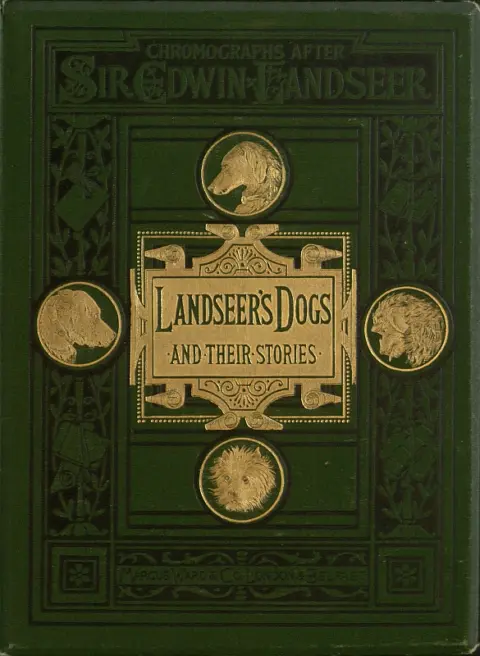
Landseer’s Dogs and Their Stories
Sarah Tytler
THE CLASSIC COLLECTION · 1880
"Jane Austen and Her Works" by Sarah Tytler is a biographical account written in the late 19th century. This work delves into the life and literary contributions of Jane Austen, highlighting her evolution as a writer. It likely discusses the themes and characters of her most renowned novels such as "Pride and Prejudice," "Emma," and "Sense and Sensibility," while also providing insights into the social context of her time. The opening of the book sets a reflective tone by establishing the significance of Jane Austen's literary achievements against the backdrop of her life. It portrays her as a remarkable woman whose early works foreshadowed her later masterpieces, while emphasizing her close relationship with her family and the supportive environment that nurtured her talent. Tytler emphasizes the importance of understanding the interplay between Austen's life and her novels, suggesting that their characteristics reflect enduring human nature. Thus, the initial chapters frame Austen as a writer of great sensitivity and insight, who captured the complexities of relationships and social manners in her works.
Introduction adapted from the source catalogue; source summaries may be automatically generated.
Free to read · English · 129,653 words · No account needed
MAKE TIME FOR A GOOD BOOK
On by default. Untick to stop anonymous reading totals. Each page counts after 10 seconds in view. How this works.
Anonymous counting is on unless you have switched it off.
[20] Weymouth and Ramsgate, among sea-bathing places, seemed to rise most readily before her mind, though she alluded also to Southend and Cromer--not to say described Lyme--which she made her own.
[21] The fashion was a little absurd in its stateliness. Ladies were wont to wear nodding plumes of ostrich feathers, as at the Queen’s drawing-rooms, standing upright on the head, till they added a foot, at least, to the fair amazons’ height.
[22] Let us echo Henry Tilney’s praise of muslin. Will its simple, elegant, once wide reign never return? The prevalence of calico balls is a poor substitute for its sway.
[23] The old-fashioned term “quiz” was freely applied last century. It was originally associated with the first specimen of eye-glass, through which the short-sighted were supposed to quiz their neighbours. I should suppose Jane Austen must have been called a quiz in her day. The accusation was half coveted, half dreaded, according to the temper of the individual who incurred it.
[24] The remonstrance is still needed.
[25] Since these words were written we have had the whole of the “Waverley Novels,” not to mention more modern gains added to our wealth of excellent English works of fiction.
[26] There is this to be said for the sensational horrors which enchanted the girls of the last century, that these horrors, when founded on the model of Mrs. Radcliffe’s romances, were well principled, and free from inherent moral coarseness and license of tone.
[27] Perhaps the number of jilts in the last century have to do with spontaneous combustion where hearts were concerned.
[28] Some of the beautiful portraits of the last century (one, if I recollect rightly, which represents Mrs. Sheridan and her sister) give an idea how daintily becoming, how perfectly elegant, these muslin costumes could be.
[29] Wood and water always figure largely in Jane Austen’s landscapes.
[30] The furor about the “Mysteries of Udolpho,” in its day, was, indeed, not confined to school-girls. It extended over the whole reading world. It was European, as well as English.
[31] Such was the style of travelling en grand seigneur last century.
[32] What a quaint, pretty picture the young man in his coachman’s great-coat, the girl in her riding-habit and straw bonnet, which she is soon so anxious to protect from the rain, would make, taken as she stepped in or stepped out of Henry’s “curricle!”
[33] Even a good clergyman measured his duties differently last century.
[34] Mrs. Radcliffe, who appears to have been unable to stand a joke on her romances, even from their admirers, and who was much hurt by a laughing reference of Sir Walter Scott’s in “Waverley,” would have looked aghast at this levity.
Your reading position is saved on this browser. Take it to another device with a library code. Reading pages adapt to text, rather than matching a printed edition.
BEHIND THE BOOK
This eBook is for the use of anyone anywhere in the United States and most other parts of the world at no cost and with almost no restrictions whatsoever. You may copy it, give it away or re-use it under the terms of the Project Gutenberg License included with this eBook or online at www.gutenberg.org. If you are not located in the United States, you will have to check the laws of the country where you are located before using this eBook. Read the source licence.
The original source file, including credits and licence, is retained by this library. Request an original-format copy at no charge. Please include the book title and Project Gutenberg identifier #70809.
KEEP YOUR CURIOSITY GOING
Cécile Tormay

Moritz Busch
Coulson Kernahan
John L. Ransom

Maurice Baring
Frances Wright