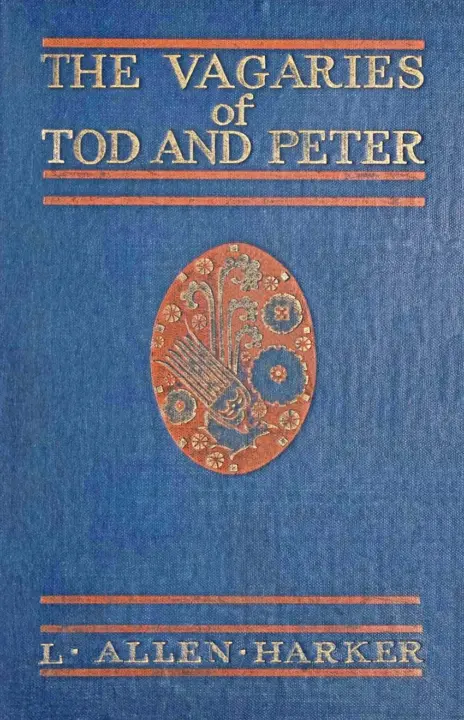
The Vagaries of Tod and Peter
L. Allen (Lizzie Allen) Harker
THE CLASSIC COLLECTION · 1917
"Jan and Her Job" by L. Allen Harker is a novel written during the early 20th century. The story centers around the main character, Janet Ross, who is trying to navigate complex familial obligations and personal challenges after arriving in Bombay to assist her ailing sister, Fay Tancred. The novel tackles themes of responsibility, resilience, and the relationships between women as they confront social and personal turmoil. At the start of the book, Janet embarks on a voyage to India, where she is both mysterious and observant, capturing the attention of fellow passengers. Her experience is marked by a mix of intrigue and foreboding, particularly as she contemplates the circumstances awaiting her in Bombay, including her sister's ill health and troubled family situation. As Janet grapples with the reality of her new role, she reflects on her past, her family, and her feelings of duty, setting the stage for the emotional complexities that unfold in her journey of care and sacrifice. The opening portion sets an intimate tone, inviting readers to empathize with Janet as she prepares to take on the burden of her sister's family while uncovering the deeper, challenging layers of their lives.
Introduction adapted from the source catalogue; source summaries may be automatically generated.
Free to read · English · 86,341 words · No account needed
MAKE TIME FOR A GOOD BOOK
On by default. Untick to stop anonymous reading totals. Each page counts after 10 seconds in view. How this works.
Anonymous counting is on unless you have switched it off.
Poor Meg vowed (though she knew she would break her vow the very first time she was tempted) that never again would she tamper with Holy Writ, and for some weeks she coldly avoided both Jophez and Mophez as topics of conversation.
Meg could never resist playing at things, and what "Clipture" the children learned from Jan in the morning they insisted on enacting with Meg later in the day.
Sometimes she was seized with misgiving as to the propriety of these representations, but dismissed her doubts as cowardly.
"After all," she explained to Jan, "we only play the very human bits. I never let them pretend to be anybody divine ... and you know the people--in the Old Testament, anyway--were most of them extremely human, not to say disreputable at times."
It is possible that "Clipture's" supreme attraction for the children was that it conveyed the atmosphere of the familiar East. The New Testament was more difficult to play at, but, being equally dramatic, the children couldn't see it.
"Can't we do one teeny miracle?" Tony would beseech, but Meg was firm; she would have nothing to do with either miracles nor yet with angels. Little Fay ardently desired to be an angel, but Meg wouldn't have it at any price.
"You're not in the least like an angel, you know," she said severely.
"What for?"
"Because angels are perfectly good."
"I could pletend to be puffectly good."
"Let's play Johnny Baptist," suggested the ever-helpful Tony, "and we could pittend to bring in his head on a charger."
"Certainly not," Meg said hastily. "That would be a horrid game."
"Let me be the daughter!" little Fay implored, "and dance in flont of
Helod."
This was permitted, and Tony, decorated with William's chain, sat gloomily scowling at the gyrations of "the daughter," who, assisted by William, danced all over the nursery: and Meg, watching the representation, decided that if the original "daughter" was half as bewitching as this one, there really might have been some faint excuse for Herod.
Hannah had no idea of these goings-on, or she would have expected the roof to fall in and crush them. Yet she, too, was included among the children's prophets, owing to her exact and thorough knowledge of "Clipture." Hannah's favourite part of the Bible was the Book of Daniel, which she knew practically by heart; and her rendering of certain chapters was--though she would have hotly resented the phrase--extremely dramatic.
It is so safe and satisfying to know that your favourite story will run smoothly, clause for clause, and word for word, just as you like it best, and the children were always sure of this with Hannah.
Your reading position is saved on this browser. Take it to another device with a library code. Reading pages adapt to text, rather than matching a printed edition.
L. Allen (Lizzie Allen) Harker
L. Allen (Lizzie Allen) Harker
L. Allen (Lizzie Allen) Harker
L. Allen (Lizzie Allen) Harker
BEHIND THE BOOK
This eBook is for the use of anyone anywhere in the United States and most other parts of the world at no cost and with almost no restrictions whatsoever. You may copy it, give it away or re-use it under the terms of the Project Gutenberg License included with this eBook or online at www.gutenberg.org. If you are not located in the United States, you will have to check the laws of the country where you are located before using this eBook. Read the source licence.
The original source file, including credits and licence, is retained by this library. Request an original-format copy at no charge. Please include the book title and Project Gutenberg identifier #29945.
KEEP YOUR CURIOSITY GOING
Coulson Kernahan

Maurice Baring
Frances Wright
Cécile Tormay

Frederic Jesup Stimson

W. H. P. (William Henry Pope) Jarvis