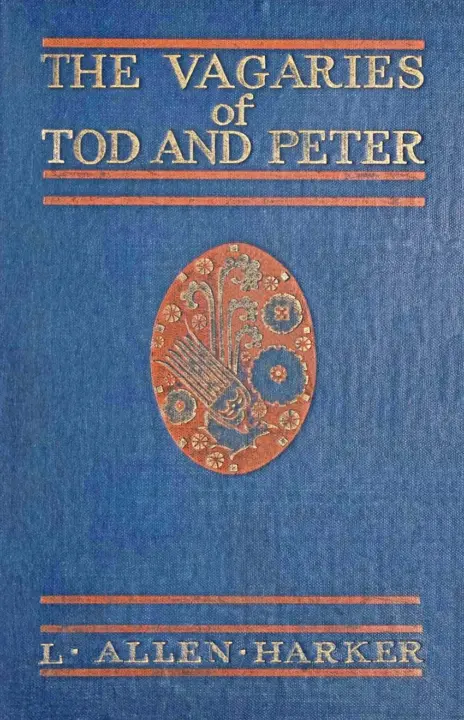
The Vagaries of Tod and Peter
L. Allen (Lizzie Allen) Harker
THE CLASSIC COLLECTION · 1917
"Jan and Her Job" by L. Allen Harker is a novel written during the early 20th century. The story centers around the main character, Janet Ross, who is trying to navigate complex familial obligations and personal challenges after arriving in Bombay to assist her ailing sister, Fay Tancred. The novel tackles themes of responsibility, resilience, and the relationships between women as they confront social and personal turmoil. At the start of the book, Janet embarks on a voyage to India, where she is both mysterious and observant, capturing the attention of fellow passengers. Her experience is marked by a mix of intrigue and foreboding, particularly as she contemplates the circumstances awaiting her in Bombay, including her sister's ill health and troubled family situation. As Janet grapples with the reality of her new role, she reflects on her past, her family, and her feelings of duty, setting the stage for the emotional complexities that unfold in her journey of care and sacrifice. The opening portion sets an intimate tone, inviting readers to empathize with Janet as she prepares to take on the burden of her sister's family while uncovering the deeper, challenging layers of their lives.
Introduction adapted from the source catalogue; source summaries may be automatically generated.
Free to read · English · 86,341 words · No account needed
MAKE TIME FOR A GOOD BOOK
On by default. Untick to stop anonymous reading totals. Each page counts after 10 seconds in view. How this works.
Anonymous counting is on unless you have switched it off.
Captain Middleton settled it by shaking each offered paw and saying very seriously: "You must stay and take care of the ladies, William. I trust you." William looked wistfully after the tall figure that went down the road with the queer, light, jumpetty tread of all men who ride much.
Then he trotted after Jan and the children and was exuberantly glad to
see Meg again.
She declared herself quite rested; heard that they had seen Captain Middleton, and met unmoved the statement that he was coming to tea.
But she didn't look nearly so well rested as Jan had hoped she would.
After the children's dinner Meg went on duty, and Jan saw no more of the nursery party till later in the afternoon. The creaking wheels of two small wheelbarrows made Jan look up from the letters she was writing at the knee-hole table that stood in the nursery window, and she beheld little Fay and Tony, followed by Meg knitting busily, as they came through the yew archway on to the lawn.
Meg subsided into one of the white seats, but the children processed solemnly round, pausing under Jan's window.
"I know lots an' lots of Clipture," her niece's voice proclaimed proudly as she sat down heavily in her wheelbarrow on the top of some garden produce she had collected.
"How much do you know?" Tony asked sceptically.
"Oh, lots an' lots, all about poor little Jophez in the bullushes, and
his instasting dleams."
"Twasn't Jophez," Tony corrected. "It was Mophez in the bulrushes, and he didn't have no dreams. That was Jophez."
"How d'you know," Fay persisted, "that poor little Mophez had no dleams? Why shouldn't he have dleams same as Jophez?"
"It doesn't say so."
"It doesn't say he didn't have dleams. He had dleams, I tell you; I know he had. Muts nicer dleams van Jophez."
"Let's ask Meg; she'll know."
Jan gave a sigh of relief. The children had not noticed her, and Meg had
a fertile mind.
The wheelbarrows were trundled across the lawn and paused in front of Meg, while a lively duet demanded simultaneously:
{"Did little Mophez have dleams?"
{"Didn't deah littoo Mophez have dleams?"
When Meg had disentangled the questions and each child sat down in a wheelbarrow at her feet, she remarked judicially: "Well, there's nothing said about little Moses' dreams, certainly; but I should think it's quite likely the poor baby did have dreams."
"What sort of dleams? Nicer van sheaves and sings, wasn't they?"
"I should think," Meg said thoughtfully, "that he dreamed he must cry very quietly lest the Egyptians should hear him."
"Deah littoo Mophez ... and what nelse?"
Your reading position is saved on this browser. Take it to another device with a library code. Reading pages adapt to text, rather than matching a printed edition.
L. Allen (Lizzie Allen) Harker
L. Allen (Lizzie Allen) Harker
L. Allen (Lizzie Allen) Harker
L. Allen (Lizzie Allen) Harker
BEHIND THE BOOK
This eBook is for the use of anyone anywhere in the United States and most other parts of the world at no cost and with almost no restrictions whatsoever. You may copy it, give it away or re-use it under the terms of the Project Gutenberg License included with this eBook or online at www.gutenberg.org. If you are not located in the United States, you will have to check the laws of the country where you are located before using this eBook. Read the source licence.
The original source file, including credits and licence, is retained by this library. Request an original-format copy at no charge. Please include the book title and Project Gutenberg identifier #29945.
KEEP YOUR CURIOSITY GOING
Coulson Kernahan

Maurice Baring
Frances Wright
Cécile Tormay

Frederic Jesup Stimson

W. H. P. (William Henry Pope) Jarvis