THE CLASSIC COLLECTION✦James’s Account of S. H. Long’s Expedition, 1819-1820, part 2CLASSIC FREE BOOKS
James’s Account of S. H. Long’s Expedition, 1819-1820, part 2
Edwin James & Stephen H. (Stephen Harriman) Long & Thomas Say
THE CLASSIC COLLECTION · 1905
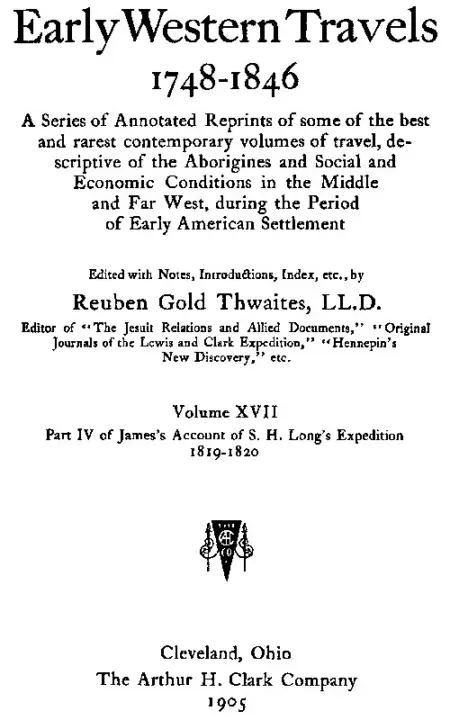
"James's Account of S. H. Long's Expedition, 1819-1820, Part 4" by Edwin James et al. is a historical account penned in the early 20th century. This work is part of a series documenting early western travels in America, detailing the social and economic conditions encountered during the early years of American settlement. It focuses on the exploration of the region around the Arkansas River and interactions with various Native American tribes, offering a glimpse into the lives of both the indigenous peoples and early settlers. The opening of the account details the journey of Major Long and his party as they travel from Belle Point to Cape Girardeau in the Arkansas territory. The narrative describes their interactions with local tribes, including the Cherokee and the Osages, and the social dynamics at play amid ongoing tensions. As they progress, the party notes the geography and natural resources of the area, reflecting on the changing landscape and the impact of human presence, while highlighting instances of hospitality and hospitality challenges from local settlers. This portion sets the stage for understanding the complex relationships and the transformations occurring in the American frontier during this period.
Introduction adapted from the source catalogue; source summaries may be automatically generated.
Free to read · English · 87,473 words · No account needed
MAKE TIME FOR A GOOD BOOK
On by default. Untick to stop anonymous reading totals. Each page counts after 10 seconds in view. How this works.
Anonymous counting is on unless you have switched it off.
He that makes signs as he walks, wa-bom-en-e
He that walks behind, a-ga-ha-mo-ne
He that hunts as he walks, o-na-mun-ne
The walking cloud, mah-pe-mun-ne
The strong walker, wash-ka-mun-ne
He who walks when fruit is ripe, se-da-mun-ne
He who cries as he walks, ha-ga-mun-ne
He who walks beyond others, ko-she-ha-mun-ne
He who arrived in haste, wash-con-he
He who is not afraid of tracks, se-gra-na-pa-ba
The white horse, shon-ga-ska
Seven, pa-num-ba
Ace of spades, o-ka-de-ga-rong
Little cook, o-hon-‡jin-ga
Head wind or North wind, ke-ma-ha
Big skunk, mon-ga-tun-ga
Prairie wolf, mon-e-kus-se
Swan, me-hus-ca-tun-ga
He who walks double, nom-ba-mon-ne
Black breast, mon-ga-sab-ba
No hand, nom-ba-ning-ga
Brave, wa-shu-sha
No knife, ma-he-ning-ga
Two tails, sin-da-num-ba
The top of the tent-poles which are tied together, te-she-mo-ha
Big bullet, ma-ze-mat-tunga
Medicine mouth, e-wa-ho-ba
He who carries real medicines, mac-ca-n-e
Wet mockeson, hom-pa-no-ca
Big leggings, o-tant-tun-ga
Smoke maker, shu-da-goch-ha
Two faces, in-da-nom-ba
The twins, nom-ba-dant
Yellow knife, ma-he-ze
The first moon, me-ta-e
Na-sa-za
{lxxxiii} Village, towoin
Me-hun-guh
First thunder, ti-en-e
Female sun, me-teh-ha
Female moon, me-um-bun-ne
Female axe, mas-up-pa-me
Female deer that looks, wa-tum-bun-ne
The first thunder that falls, ta-ingga-ra
O-maw-haw Interjections and Exclamations
Zt!--This is used by the men when contemplating a fine trinket, looking-glass, &c.; they sometimes say zt-o-dah!
Sheh-zt-zt-zt! or wah-zt-zt-zt! or oah-zt-zt-zt! is used by the men for driving dogs out of mischief.
Eh-zt-zt-zt-zt! by the women on the same occasion.
Heh! an inspiration--used by the women when a sudden but
trifling accident occurs--as it is also used by the white
females.
Ke-a!--the first syllable nasal--by the women for calling their
dogs.
Wo-oh! by the men for calling their dogs or horses. It is a sound very similar to that used by the whites to halt horses.
Wah-man-gar-ing-ga! Be off, or go away--spoken in anger--this would be the last word, an attack would succeed if disregarded.
O-hoh! (drawn out very long) used to one who has been troubling them a long time--it would precede the preceding exclamation in the gradation of displeasure.
Ge-ga-ha! wah-ge-ga-ra! o-hoh-ge-gar-a!--the successive expressions of impatience in calling a person to come.
Hi-o! The answer of a squaw to one who calls.
Ha! The answer of a man to one who calls.
Da-dansh-ta-a! An exclamation similar in signification to O,
alas, me!
{lxxxiv} Sioux, (Yancton band,) Language
American, me-na-has-hah--Long knife
British, sa-kin-da-sha. This appears to be an adopted word.
Physician, wa-pe-a-we-a-cha-sha
Village, o-tong-y-a
Eagle, ho-yah
Green, to-we-toy-ya, or "the blue to dye with"--they have no
other word for this colour.
Warm, mach-ta
Pawnees, pa-dan-o-ta
Sioux, da-co-ta
Run, e-ong-ka
Leap, e-ep-se-sha
Fight, ke-che-za
Eat, wo-tah
Drink, ya-ta-kong
Talk, e-ah
Good, wash-ta
Gunpowder, cha-hun-da
Thirteen, a-ka-ya-me-ne
Nineteen, a-ka-nuh-pet-che-wung
Twenty, wek-chem-in-eh-nom-pa
Twenty-one, wekcheminehnompah-a-ka-ong-ge
Thirty, wekcheminuh-ya-me-ne
Your reading position is saved on this browser. Take it to another device with a library code. Reading pages adapt to text, rather than matching a printed edition.
Edwin James & Stephen H. (Stephen Harriman) Long & Thomas Say
Edwin James & Stephen H. (Stephen Harriman) Long & Thomas Say
Edwin James & Stephen H. (Stephen Harriman) Long & Thomas Say
BEHIND THE BOOK
This eBook is for the use of anyone anywhere in the United States and most other parts of the world at no cost and with almost no restrictions whatsoever. You may copy it, give it away or re-use it under the terms of the Project Gutenberg License included with this eBook or online at www.gutenberg.org. If you are not located in the United States, you will have to check the laws of the country where you are located before using this eBook. Read the source licence.
The original source file, including credits and licence, is retained by this library. Request an original-format copy at no charge. Please include the book title and Project Gutenberg identifier #48481.
KEEP YOUR CURIOSITY GOING
Wilfrid Scawen Blunt
Wilfrid Scawen Blunt

E. W. (Edgar Watson) Howe
Cécile Tormay

Moritz Busch
John L. Ransom