THE CLASSIC COLLECTION✦James’s Account of S. H. Long’s Expedition, 1819-1820, part 2CLASSIC FREE BOOKS
James’s Account of S. H. Long’s Expedition, 1819-1820, part 2
Edwin James & Stephen H. (Stephen Harriman) Long & Thomas Say
THE CLASSIC COLLECTION · 1905
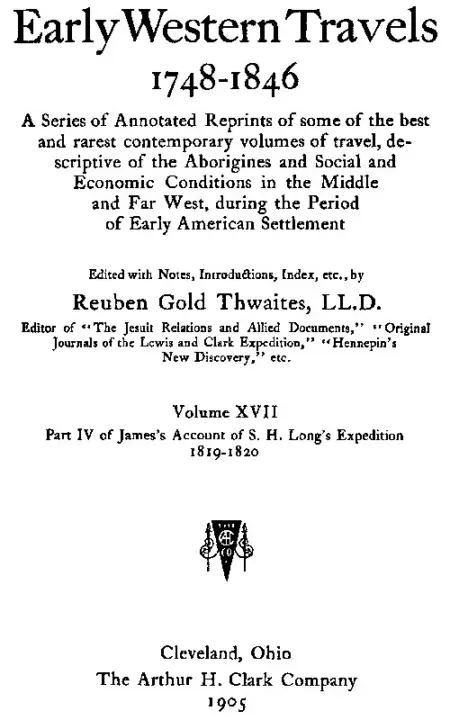
"James's Account of S. H. Long's Expedition, 1819-1820, Part 4" by Edwin James et al. is a historical account penned in the early 20th century. This work is part of a series documenting early western travels in America, detailing the social and economic conditions encountered during the early years of American settlement. It focuses on the exploration of the region around the Arkansas River and interactions with various Native American tribes, offering a glimpse into the lives of both the indigenous peoples and early settlers. The opening of the account details the journey of Major Long and his party as they travel from Belle Point to Cape Girardeau in the Arkansas territory. The narrative describes their interactions with local tribes, including the Cherokee and the Osages, and the social dynamics at play amid ongoing tensions. As they progress, the party notes the geography and natural resources of the area, reflecting on the changing landscape and the impact of human presence, while highlighting instances of hospitality and hospitality challenges from local settlers. This portion sets the stage for understanding the complex relationships and the transformations occurring in the American frontier during this period.
Introduction adapted from the source catalogue; source summaries may be automatically generated.
Free to read · English · 87,473 words · No account needed
MAKE TIME FOR A GOOD BOOK
On by default. Untick to stop anonymous reading totals. Each page counts after 10 seconds in view. How this works.
Anonymous counting is on unless you have switched it off.
{lxxix} Having but a small number of words of the two following Languages, it is thought proper to insert them separately from the above comparative tables, in order that the columns may not be too much extended.
Shos-ho-ne Language
Good, sant
Bad, kate-sant
Salmon, au-gi
Come, ke-ma
Large, pe-up
Big river, pau-pe-up
To eat, bo-re-can
White people, tab-ba-bo--people of the sun
Go, nu-me-a-ro
To copulate, yo-co
To see, ma-bo-ne
Did not see it, ka-en-ma-bo-na
To love, kom-muh
A great many, shant
Bison, kot-zo
Antelope, wa-re
Elk, pa-re
Awl, we-u
Beaver, ha-nish
Friend, hants
Woman, wipe
Water, pa
Horse, bunk-o
No, ka-he
Tash-e-pa, pierced nose--a nation of the Columbia
Paw-kees, black feet Indians
Pun-ash, root eaters--a band of Shoshones who call a horse
toish, and a squaw mo-co-ne
Up-sa-ro-ka, or Crow Language
White people, mash-te-se-re--yellow eyes
Pawkees or Black-feet, e-chip-e-ta
Poor, bats-ish-cat
Powerful or strong, bats-atsh
Good, e-tschick
Bad, kab-beak
Bison, be-sha
Bison bull, che-ra-pa
Beaver, be-rap-pa
Tobacco, o-pa
Where, sho
Far, ham-a-ta
Mountain, am-a-†ha-ba
Elk, e-che-re-ca-te--little horse
Finished or completed, kar-a-ko-tuk
Knife, mit-se
What, sa-pa
Near, ash-ka
Friend, she-ka
To eat, ba-boush-mek
Gunpowder, be-rups-spa
Little, e-ro-ka-ta
Name which they give to the Sioux nation,
mar-an-sho-bish-ko--or the cut throats
Young woman, me-ka-ta
Water, me-ne
Fire, be-da
Wood, mon-a
River, an-sha
Horse, e-che-ra
No, bar-a-ta
{lxxx} The following promiscuous words are added for the further information of the philologist.
Wah-tok-ta-ta, or Oto Language
White people, maz-onk-ka--iron makers
Americans, ma-he-hun-jeh--big knife
British, ra-gar-rash-ing, probably not an Oto word
Ioway nation, pa-ho-ja--gray snow
Missouri nation, ne-o-ta-tcha--those who build a town at the
mouth of a river
Mississippi river, ne-o-hun-je--the river that enlarges as it runs, or ne-ber-a-‡je, water of knowledge
Missouri river, ne-su-ja--smoky water
Osage river, ne-ska--white water
Grand river, nesh-na-hun-ja--big water
Konzes river, to-pe-o-ka--good potatoe river
Nodowa river, ne-a-ton-wa--jump over river, or ne-wa-ton
Walk, ma-ne
Distant, har-re
Deer, tah-che
Green, toh-tsche
Platte river, ne-bras-ka--or flat water
Little Platte river, ne-breska-ingya--little flat water
Tarkio river, tar-ke-u
Nemehaw river, ne-mo-ha-hun-ge
Little Nemehaw river, ne-mo-haing-ya
Nishnabatona river, nish-na-bot-ona--canoe making river
Weeping water river, ne-ha-ga--weeping water
Saline creek, nes-co--salt water
Loup fork of the Platte river, Pawneeomawhaw-ne-etow-wa
Elk-horn creek, wa-ta-tung-ya
Konza river, Konza-ne-etow-wa--or the river belonging to the
Konzas
Run, nong-a
Leap, ta-wa
Fight, a-ke-ra-ga
Eat, wa-ro-ja
Drink, rat-tong
Steal, mo-no
Talk, e-cha
Strength, bre-hra
Weakness, wa-ha-ha
Poor, wa-was-tong
Near, as-ke
Different, e-tan-tong
Good, pe-ay
Bad, pish-co-na
Mockeson, a-ko-je
Gunpowder, ak-ho-je
Ball, ma-za-muh
Looking-glass, ma-zo-ka-tou-a
Long, thra-ja
Short, su-is-cha
Broad, ar-ru-cha-hun-ja
Thick, sho-ga
Thin, bra-ka
Your reading position is saved on this browser. Take it to another device with a library code. Reading pages adapt to text, rather than matching a printed edition.
Edwin James & Stephen H. (Stephen Harriman) Long & Thomas Say
Edwin James & Stephen H. (Stephen Harriman) Long & Thomas Say
Edwin James & Stephen H. (Stephen Harriman) Long & Thomas Say
BEHIND THE BOOK
This eBook is for the use of anyone anywhere in the United States and most other parts of the world at no cost and with almost no restrictions whatsoever. You may copy it, give it away or re-use it under the terms of the Project Gutenberg License included with this eBook or online at www.gutenberg.org. If you are not located in the United States, you will have to check the laws of the country where you are located before using this eBook. Read the source licence.
The original source file, including credits and licence, is retained by this library. Request an original-format copy at no charge. Please include the book title and Project Gutenberg identifier #48481.
KEEP YOUR CURIOSITY GOING
Wilfrid Scawen Blunt
Wilfrid Scawen Blunt

E. W. (Edgar Watson) Howe
Cécile Tormay

Moritz Busch
John L. Ransom