THE CLASSIC COLLECTION✦James’s Account of S. H. Long’s Expedition, 1819-1820, part 2CLASSIC FREE BOOKS
James’s Account of S. H. Long’s Expedition, 1819-1820, part 2
Edwin James & Stephen H. (Stephen Harriman) Long & Thomas Say
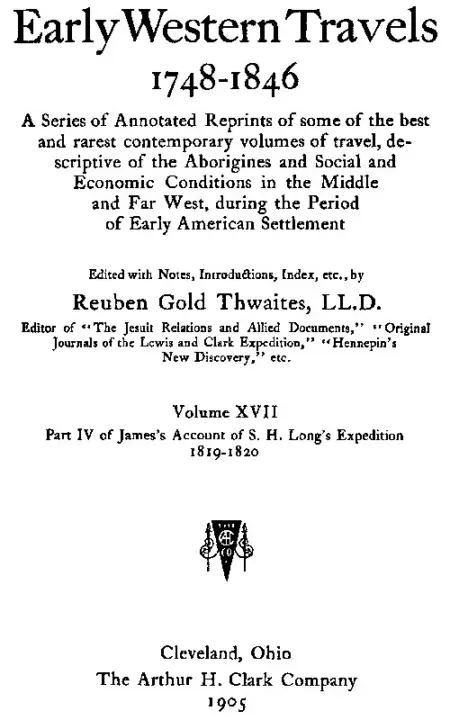
THE CLASSIC COLLECTION · 1905
"James's Account of S. H. Long's Expedition, 1819-1820, Part 4" by Edwin James et al. is a historical account penned in the early 20th century. This work is part of a series documenting early western travels in America, detailing the social and economic conditions encountered during the early years of American settlement. It focuses on the exploration of the region around the Arkansas River and interactions with various Native American tribes, offering a glimpse into the lives of both the indigenous peoples and early settlers. The opening of the account details the journey of Major Long and his party as they travel from Belle Point to Cape Girardeau in the Arkansas territory. The narrative describes their interactions with local tribes, including the Cherokee and the Osages, and the social dynamics at play amid ongoing tensions. As they progress, the party notes the geography and natural resources of the area, reflecting on the changing landscape and the impact of human presence, while highlighting instances of hospitality and hospitality challenges from local settlers. This portion sets the stage for understanding the complex relationships and the transformations occurring in the American frontier during this period.
Introduction adapted from the source catalogue; source summaries may be automatically generated.
Free to read · English · 87,473 words · No account needed
MAKE TIME FOR A GOOD BOOK
On by default. Untick to stop anonymous reading totals. Each page counts after 10 seconds in view. How this works.
Anonymous counting is on unless you have switched it off.
Sandstone of Transition. Old Red Sandstone of Werner?--Throughout the whole extent of the transition formation before mentioned, a sandstone occurs, evidently belonging to the oldest depositions of that rock. It is for the most part distinctly stratified, and in all cases its stratifications are inclined. It consists of grains of quartz, united by a scanty cement, and usually more or less rounded, as if by attrition and the operation of currents of water. Their fragments vary in magnitude from the finest sand to boulders of several pounds weight. Among the Alleghany mountains are many extensive beds of puddingstone or coarse conglomerate, usually coloured by oxide of iron. It is also to be observed, that this formation of transition sandstone sometimes embraces extensive beds, whose integrant particles have by no means the appearance of having been rounded by attrition. As in the case of almost all the rocks of secondary formation, there appear to have been periods during the time of its deposition when the waters of the superincumbent ocean ceased to throw down the mechanical débris of former rocks, and deposited earthy matter from a state of chymical solution. It is perhaps one of the most interesting and most difficult problems which remain unsolved, to account for the alternation through the whole series of lower secondary and fletz rocks, of {329} beds of strata of mechanical with those of chymical deposition.
The Alleghany mountains in New York, Pennsylvania, Maryland, and Virginia, are made up principally of rocks belonging to the transition class, and among these sandstone is perhaps of more frequent occurrence than any other aggregate. We are aware that Maclure has not considered the sandstones of the Alleghany mountains generally, as belonging to the old red sandstone formation of Werner; and it must be acknowledged there is some difference, at least in colour, between the ferruginous sand-rock, which commences on the shore of Tappan bay near Nyac, and extends south and west by the way of Newark, Amboy, and Brunswick, in New Jersey, and that which forms the body of the Cove, Sideling and Alleghany ridges farther to the west. But we cannot discover so marked a difference between the sandstone of the localities last mentioned, and that which occurs about the South mountain in Pennsylvania, that at Hagerstown in Maryland, and near Harper's ferry, in Virginia, which Maclure considers as the old red sandstone. Indeed, this last appears to us in almost every respect to resemble the inclined sandstone which prevails so generally throughout the middle and eastern ridges of the Alleghany mountains in Pennsylvania and Maryland. We have already stated the opinion, in part sanctioned by the observations of Maclure, that the old red sandstone is the great substratum of the part of the secondary formation south of Lake Ontario. If this be the case, what stratum, if not the old red sandstone, should be seen emerging from beneath that secondary along its south-eastern margin? We will not, however, contend for the name. It is sufficient for our purpose to state, that the sandstone so abundant in all the principal ridges accessory to the Alleghany on the east, has the character of a rock belonging to the transition class of the Wernerians; that is, its {330} strata have a somewhat regular dip and inclination; it contains no beds of bituminous coal, though many of anthracite, and few organised remains. Near the summit of the ridge called particularly the Alleghany, the change to secondary begins to appear. Without the interposition of any other stratum, and without any sudden change of features, the strata of sandstone become nearly horizontal, assuming gradually all the characters of secondary rocks. About one mile west of the summit of the Alleghany, on the road from Philadelphia to Pittsburgh, the first indications of coal are observed. Descending into the vallies, the transition strata again emerge to the light. The same thing happens in the case of Coatskill and other mountains west of the Hudson, their basis being of transition, and their summits crossed with secondary.
Your reading position is saved on this browser. Take it to another device with a library code. Reading pages adapt to text, rather than matching a printed edition.
Edwin James & Stephen H. (Stephen Harriman) Long & Thomas Say
Edwin James & Stephen H. (Stephen Harriman) Long & Thomas Say
Edwin James & Stephen H. (Stephen Harriman) Long & Thomas Say
BEHIND THE BOOK
This eBook is for the use of anyone anywhere in the United States and most other parts of the world at no cost and with almost no restrictions whatsoever. You may copy it, give it away or re-use it under the terms of the Project Gutenberg License included with this eBook or online at www.gutenberg.org. If you are not located in the United States, you will have to check the laws of the country where you are located before using this eBook. Read the source licence.
The original source file, including credits and licence, is retained by this library. Request an original-format copy at no charge. Please include the book title and Project Gutenberg identifier #48481.
KEEP YOUR CURIOSITY GOING
Wilfrid Scawen Blunt
Wilfrid Scawen Blunt

E. W. (Edgar Watson) Howe
Cécile Tormay

Moritz Busch
John L. Ransom