THE CLASSIC COLLECTION✦James’s Account of S. H. Long’s Expedition, 1819-1820, part 2CLASSIC FREE BOOKS
James’s Account of S. H. Long’s Expedition, 1819-1820, part 2
Edwin James & Stephen H. (Stephen Harriman) Long & Thomas Say
THE CLASSIC COLLECTION · 1905
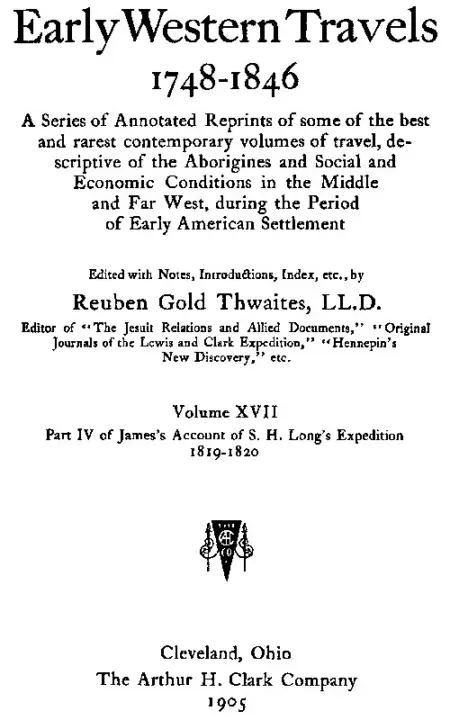
"James's Account of S. H. Long's Expedition, 1819-1820, Part 4" by Edwin James et al. is a historical account penned in the early 20th century. This work is part of a series documenting early western travels in America, detailing the social and economic conditions encountered during the early years of American settlement. It focuses on the exploration of the region around the Arkansas River and interactions with various Native American tribes, offering a glimpse into the lives of both the indigenous peoples and early settlers. The opening of the account details the journey of Major Long and his party as they travel from Belle Point to Cape Girardeau in the Arkansas territory. The narrative describes their interactions with local tribes, including the Cherokee and the Osages, and the social dynamics at play amid ongoing tensions. As they progress, the party notes the geography and natural resources of the area, reflecting on the changing landscape and the impact of human presence, while highlighting instances of hospitality and hospitality challenges from local settlers. This portion sets the stage for understanding the complex relationships and the transformations occurring in the American frontier during this period.
Introduction adapted from the source catalogue; source summaries may be automatically generated.
Free to read · English · 87,473 words · No account needed
MAKE TIME FOR A GOOD BOOK
On by default. Untick to stop anonymous reading totals. Each page counts after 10 seconds in view. How this works.
Anonymous counting is on unless you have switched it off.
They are, almost without exception, addicted to habits of extreme indolence; self-preservation, self-defence, and recreation being their usual incitements to action. The laborious occupations of the men consist almost exclusively in hunting, warfare, and tending their horses. Their amusements are principally horse-racing, gambling, and sports of various kinds. The cultivation of corn and other vegetables, {248} the gathering of fuel, cooking, and all other kinds of domestic drudgery, is the business of the women, the men deeming it degrading to their dignity to be occupied in employments of this kind. Their religion consists in the observance of a variety of rites and ceremonies, which they practise with much zeal and ardour. Their devotional exercises consist in singing, dancing, and the performance of various mystical ceremonies, which they believe efficacious in healing the sick, frustrating the designs of their enemies, and in giving success to any enterprize in which they may be embarked.
Amongst all these tribes and nations secret associations or councils are common, the proceedings of which are held sacred, and not to be divulged, except when the interests of the people are thought to require a disclosure. To these councils, which they denominate medicine, or rather magic feasts, none are admitted but the principal men of the nation, or such as have signalized themselves by their exploits in battle, hunting, stealing horses, or in any of the pursuits accounted laudable by the Indians.
In these assemblies the policy of making war or peace, and the manner in which it is to be effected, also all matters involving the interests of the nation, are first discussed. Having thus been the subject of deliberation in solemn council (for the proceedings at these feasts are conducted with the greatest solemnity,) the decision, of whatever nature it may be, is published to the people at large by certain members of the council performing the office of criers. On such occasions, the criers not only proclaim the measures that have been recommended, but explain the reasons of them, and urge the people zealously to support them. It is also the business of the criers, who are generally men of known valour and approved habits, and are able to enforce their precepts by the examples they have set, to harangue the people of their village daily, and exhort them to such a course {249} of life as is deemed praiseworthy. On such occasions, which are usually selected in the stillness of the morning or evening, the crier marches through the village, uttering his exhortation in a loud voice, and endeavouring to inculcate correct principles and sentiments. The young men and children of the village are directed how to demean themselves, in order to become useful and enjoy the esteem of good men, and the favour of the good spirit. In this way they are incited to wage war or sue for peace; and to practise according to their ideas of morality and virtue; and may be swayed to almost any purpose that their elders, for such are their men of medicine (or as the term imports, magic wisdom), think proper to execute. They appear to have no laws, except such as grow out of habitual usages, or such as are sanctioned by common consent. The executive of their government seems to be vested in the chiefs and warriors; while the grand council of the nation is composed of the medicine council above mentioned, at which the principal chief presides. In all their acts of devotion, as also on all occasions where their confidence is to be won, or their friendship to be plighted, the smoking of tobacco seems to be invariably regarded as an inviolable token of sincerity. They believe in the existence of a Supreme Being, whom they denominate "Master of Life" or "Good Spirit," but of his attributes their ideas are vague and confused. They are generally in the habit of offering in sacrifice a portion of the game first taken on a hunting expedition, a part of the first products of the field, and often a small portion of the food provided for their refreshment. In smoking, they generally direct the first puff upward, and the second downward to the earth, or the first to the rising and the second to the setting sun; after which they inhale the smoke into their lungs, and puff it out through the nostrils for their own refreshment.
Your reading position is saved on this browser. Take it to another device with a library code. Reading pages adapt to text, rather than matching a printed edition.
Edwin James & Stephen H. (Stephen Harriman) Long & Thomas Say
Edwin James & Stephen H. (Stephen Harriman) Long & Thomas Say
Edwin James & Stephen H. (Stephen Harriman) Long & Thomas Say
BEHIND THE BOOK
This eBook is for the use of anyone anywhere in the United States and most other parts of the world at no cost and with almost no restrictions whatsoever. You may copy it, give it away or re-use it under the terms of the Project Gutenberg License included with this eBook or online at www.gutenberg.org. If you are not located in the United States, you will have to check the laws of the country where you are located before using this eBook. Read the source licence.
The original source file, including credits and licence, is retained by this library. Request an original-format copy at no charge. Please include the book title and Project Gutenberg identifier #48481.
KEEP YOUR CURIOSITY GOING
Wilfrid Scawen Blunt
Wilfrid Scawen Blunt

E. W. (Edgar Watson) Howe
Cécile Tormay

Moritz Busch
John L. Ransom