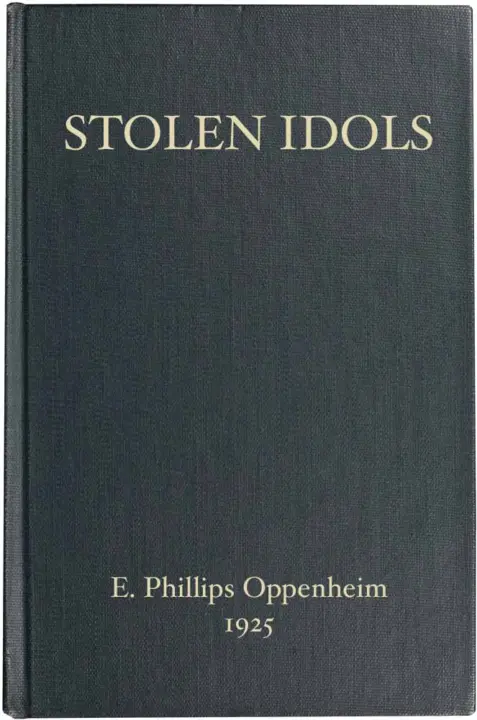
Stolen Idols
E. Phillips (Edward Phillips) Oppenheim
THE CLASSIC COLLECTION · 1921
"Jacob's Ladder" by E. Phillips Oppenheim is a novel written in the early 20th century. The story follows Jacob Pratt, a man who faces humiliation and financial ruin when he files for bankruptcy. Struggling with his disgrace, Jacob's life takes a dramatic turn two years later when he unexpectedly inherits a fortune, giving him the chance to reshape his identity and confront those who once looked down on him. At the start of the book, Jacob Pratt grapples with the aftermath of his bankruptcy, feeling unworthy and isolated from society. Despite a neat home and loyal landlady, he endures a painfully awkward commute to the city, where he faces the disdain of former acquaintances, including a creditor who publicly humiliates him. However, as the narrative unfolds, his fortunes change when he receives an unexpected inheritance, setting the stage for his journey of rediscovery and the ultimate quest to reclaim his dignity. The opening lays the groundwork for Jacob’s transformation and the complex social dynamics he navigates as he re-enters a world from which he had previously fallen.
Introduction adapted from the source catalogue; source summaries may be automatically generated.
Free to read · English · 62,698 words · No account needed
MAKE TIME FOR A GOOD BOOK
On by default. Untick to stop anonymous reading totals. Each page counts after 10 seconds in view. How this works.
Anonymous counting is on unless you have switched it off.
"Nothing doing, child of my heart," the young man sighed. "Cleaned out
my pocketbook last race."
The young lady turned to her parents, who both seemed suddenly
absorbed in the crowd below.
"Bother!" she exclaimed. "And the numbers are up already!"
"Will you allow me?" Jacob ventured, producing his pocketbook and handing a five-pound note to Felixstowe. "You'll have to hurry."
Lady Mary smiled at him sweetly and abandoned a furtive attempt to
open her bag.
"Do you go to many race meetings, Mr. Pratt?" she asked.
He shook his head.
"Very few," he answered. "As a matter of fact, this is my first
Ascot."
She looked at him in surprise.
"Are you an American, then, or Colonial?"
"No, I am English, but it is only during the last year or so that I have had any time or money to spare for amusements of this sort."
"How interesting!" she murmured a little vaguely. "Now tell me, have they started? We must watch."
The race was a good one. In the last stretch, Gerrard's Cross came away and won easily by three lengths. There was a scene of measured enthusiasm in the little box.
"Your horse has won, my dear," the Marquis informed his daughter, lowering his glasses. "I congratulate you."
The Marchioness indicated her approval by a more or less genial smile. Lady Mary's blue eyes danced with pleasure.
"You dear person, Mr. Pratt!" she exclaimed. "This is my first winner, and I did want one so badly. I wonder what price Jack will get."
The young man returned presently with a bundle of notes in his hand.
"Nines I got," he announced. "Here's your fiver, Jacob. Forty-five of the best for you, Mary. Lucky old dear!"
The girl grasped the notes joyfully.
"But surely these aren't all mine? I said one pound. Some of this must
belong to Mr. Pratt?"
Jacob shook his head, interrupting Felixstowe's reluctant
confirmation.
"Not at all," he protested politely. "As a matter of fact, I have won a great deal of money myself on the race. I gave your brother a five-pound note because I could not find a smaller one. So much the better for you."
The girl gave a little sigh of content. Jacob, turning around, was suddenly aware of a look of relief on the part of her distinguished father and mother. The latter smiled approvingly at Jacob, who was preparing to take his leave.
"You must come and call some afternoon, Mr. Pratt," she said graciously. "We shall be glad to see you in Belgrave Square."
"I shall be very pleased," Jacob replied.
"And thank you," Lady Mary whispered.
Your reading position is saved on this browser. Take it to another device with a library code. Reading pages adapt to text, rather than matching a printed edition.
E. Phillips (Edward Phillips) Oppenheim
E. Phillips (Edward Phillips) Oppenheim
E. Phillips (Edward Phillips) Oppenheim
E. Phillips (Edward Phillips) Oppenheim
BEHIND THE BOOK
This eBook is for the use of anyone anywhere in the United States and most other parts of the world at no cost and with almost no restrictions whatsoever. You may copy it, give it away or re-use it under the terms of the Project Gutenberg License included with this eBook or online at www.gutenberg.org. If you are not located in the United States, you will have to check the laws of the country where you are located before using this eBook. Read the source licence.
The original source file, including credits and licence, is retained by this library. Request an original-format copy at no charge. Please include the book title and Project Gutenberg identifier #32732.
KEEP YOUR CURIOSITY GOING
Coulson Kernahan

Maurice Baring
Frances Wright
Cécile Tormay

Frederic Jesup Stimson

W. H. P. (William Henry Pope) Jarvis