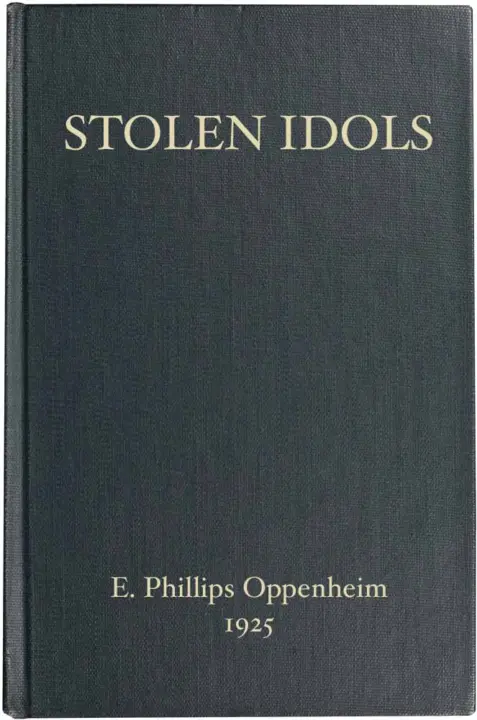
Stolen Idols
E. Phillips (Edward Phillips) Oppenheim
THE CLASSIC COLLECTION · 1921
"Jacob's Ladder" by E. Phillips Oppenheim is a novel written in the early 20th century. The story follows Jacob Pratt, a man who faces humiliation and financial ruin when he files for bankruptcy. Struggling with his disgrace, Jacob's life takes a dramatic turn two years later when he unexpectedly inherits a fortune, giving him the chance to reshape his identity and confront those who once looked down on him. At the start of the book, Jacob Pratt grapples with the aftermath of his bankruptcy, feeling unworthy and isolated from society. Despite a neat home and loyal landlady, he endures a painfully awkward commute to the city, where he faces the disdain of former acquaintances, including a creditor who publicly humiliates him. However, as the narrative unfolds, his fortunes change when he receives an unexpected inheritance, setting the stage for his journey of rediscovery and the ultimate quest to reclaim his dignity. The opening lays the groundwork for Jacob’s transformation and the complex social dynamics he navigates as he re-enters a world from which he had previously fallen.
Introduction adapted from the source catalogue; source summaries may be automatically generated.
Free to read · English · 62,698 words · No account needed
MAKE TIME FOR A GOOD BOOK
On by default. Untick to stop anonymous reading totals. Each page counts after 10 seconds in view. How this works.
Anonymous counting is on unless you have switched it off.
"Thought I'd look you up, old thing," he said. "Not much chance of a powwow at Russell Square. As soon as you and I get a word together, that chap Hartwell comes butting in, or else Phil Mason has a bundle of prospectuses to show you. What-ho the giddy night club! What-ho the Trinidad Oil Wells!"
Jacob coughed.
"There is one thing about Russell Square which puzzles me," he confided, "and that is, except for the people you have mentioned, I seem to be the only pupil."
Lord Felixstowe smiled knowingly.
"They've got a few old crooks come later in the day," he said. "The reason you don't meet any one else there is because they like to keep you to themselves."
"I can't see what they gain by that," Jacob confessed, a little
mystified.
The young lordling assumed the patient air of one having to deal with a person of inferior intelligence.
"Come, come," he remonstrated, "you must know that they're trying to
milk you for a bit. Hasn't Mason suggested your financing his night
club?"
"Some sort of a proposition was made," Jacob acknowledged. "I
declined."
"And Hartwell? Has he mentioned some oil wells in Trinidad?"
"He has," Jacob admitted. "I happen to be doing rather well in oils in
another direction."
"You haven't turned up early one day and found Grace in tears with a dressmaker's bill on her knee, have you?"
"That, I presume, is to arrive. Lady Powers is dining with me next
Sunday."
"Mind your P's and Q's, then," the young philosopher advised. "She's a fly little hussy. You see, Pratt, I know the world a bit. Seems to me I might be rather useful to you--in fact that's why I came here this morning."
"It is very kind of you," Jacob said. "In what way, may I ask?"
"You see," Lord Felixstowe proceeded, hitching up his trousers and drawing his chair a little nearer, "I know the ropes, Pratt, and you don't. You're a very decent fellow who's made a pot of money, and naturally, just at first, you don't know where you are. You want to get on, eh, to know the right sort of people, go to the right sort of places, be seen about with the right sort? Between ourselves, old thing, Hartwell and Mason aren't the right sort. Suits me to pick their brains a bit, now and then, when the oof's coming along slowly, but then I can do what I like--you can't."
"Let me have your concrete proposition, Lord Felixstowe," Jacob suggested, with a faint smile at the corner of his lips.
Your reading position is saved on this browser. Take it to another device with a library code. Reading pages adapt to text, rather than matching a printed edition.
E. Phillips (Edward Phillips) Oppenheim
E. Phillips (Edward Phillips) Oppenheim
E. Phillips (Edward Phillips) Oppenheim
E. Phillips (Edward Phillips) Oppenheim
BEHIND THE BOOK
This eBook is for the use of anyone anywhere in the United States and most other parts of the world at no cost and with almost no restrictions whatsoever. You may copy it, give it away or re-use it under the terms of the Project Gutenberg License included with this eBook or online at www.gutenberg.org. If you are not located in the United States, you will have to check the laws of the country where you are located before using this eBook. Read the source licence.
The original source file, including credits and licence, is retained by this library. Request an original-format copy at no charge. Please include the book title and Project Gutenberg identifier #32732.
KEEP YOUR CURIOSITY GOING
Coulson Kernahan

Maurice Baring
Frances Wright
Cécile Tormay

Frederic Jesup Stimson

W. H. P. (William Henry Pope) Jarvis