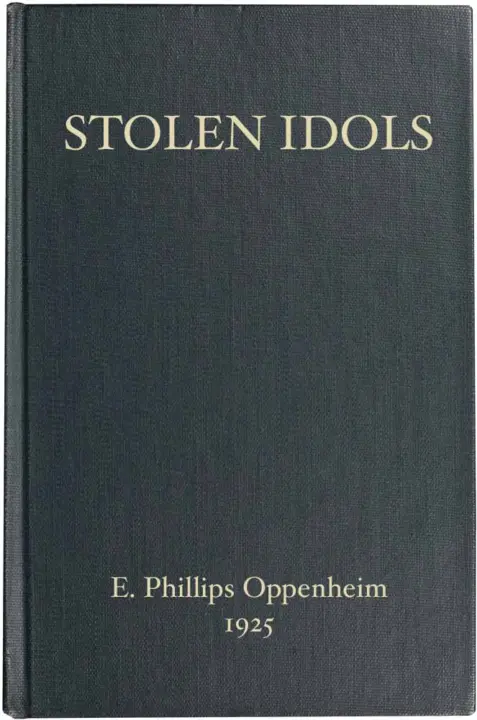
Stolen Idols
E. Phillips (Edward Phillips) Oppenheim
THE CLASSIC COLLECTION · 1921
"Jacob's Ladder" by E. Phillips Oppenheim is a novel written in the early 20th century. The story follows Jacob Pratt, a man who faces humiliation and financial ruin when he files for bankruptcy. Struggling with his disgrace, Jacob's life takes a dramatic turn two years later when he unexpectedly inherits a fortune, giving him the chance to reshape his identity and confront those who once looked down on him. At the start of the book, Jacob Pratt grapples with the aftermath of his bankruptcy, feeling unworthy and isolated from society. Despite a neat home and loyal landlady, he endures a painfully awkward commute to the city, where he faces the disdain of former acquaintances, including a creditor who publicly humiliates him. However, as the narrative unfolds, his fortunes change when he receives an unexpected inheritance, setting the stage for his journey of rediscovery and the ultimate quest to reclaim his dignity. The opening lays the groundwork for Jacob’s transformation and the complex social dynamics he navigates as he re-enters a world from which he had previously fallen.
Introduction adapted from the source catalogue; source summaries may be automatically generated.
Free to read · English · 62,698 words · No account needed
MAKE TIME FOR A GOOD BOOK
On by default. Untick to stop anonymous reading totals. Each page counts after 10 seconds in view. How this works.
Anonymous counting is on unless you have switched it off.
"I seem to have startled you all a bit, what?" Jacob continued, with the air of one thoroughly enjoying the sensation he had produced. "I've got my ticket all right. Here you are," he went on, producing it,--"first-class to Liverpool Street. Thought I'd like to have a look at you all once more. Sorry to see you're not looking quite your old self, Mr. Bultiwell. Nasty things, these bad debts, eh? Three last week, I noticed. You'll have to be careful down Bristol way. Things there are pretty dicky."
"It would be more becoming on your part, sir," Mr. Bultiwell
pronounced furiously, "if you were to hold your tongue about bad
debts."
Jacob snapped his fingers.
"I don't owe any man a farthing," he declared.
"An undischarged bankrupt--"
"Sold again," Jacob interrupted amiably. "Got my discharge last week."
Mr. Bultiwell found his tongue at the same time that he lost his
temper.
"So that's the reason you're butting in here amongst gentlemen whom you've lost the right to associate with!" he exclaimed. "You think because you're whitewashed by the courts you can count yourself an honest man again, eh? You think that because--"
"Wrong--all wrong," Jacob interrupted once more, with ever-increasing geniality. "You'll have to guess again."
Mr. Groome--the very superior Mr. Groome, who had married a relative of Mr. Bultiwell's, and who occasionally wore an eyeglass and was seen in the West End--intervened with gentle sarcasm.
"Mr. Pratt has perhaps come to tell us that it is his intention to celebrate the granting of his discharge by paying his debts in full."
Jacob glanced at the speaker with the air of one moved to admiration.
"Mr. Groome, sir," he pronounced, "you are a wizard! You must have seen right through into the breast pocket of my coat. Allow me to read you a couple of letters."
He produced these amazing documents, leisurely unfolding the first. There was no question of newspapers now.
"You will remember," he said, "that I came to grief because I stood bondsman to my brother, who was out prospecting for oil lands in America. 'Disgraceful speculation' Mr. Bultiwell called it, I think. Well, this letter is from Sam:"
Ritz-Carlton Hotel,
New York.
My dear Jacob,
I cabled you this morning to prepare for good news, so don't get heart failure when you receive this letter. We've struck it rich, as I always told you we should. I sold the worse half of our holdings in Arizona for four million dollars last week, and Lord knows what we'll get for the rest. I've cabled you a hundred thousand pounds, to be going on with, to the Bank of England.
Your reading position is saved on this browser. Take it to another device with a library code. Reading pages adapt to text, rather than matching a printed edition.
E. Phillips (Edward Phillips) Oppenheim
E. Phillips (Edward Phillips) Oppenheim
E. Phillips (Edward Phillips) Oppenheim
E. Phillips (Edward Phillips) Oppenheim
BEHIND THE BOOK
This eBook is for the use of anyone anywhere in the United States and most other parts of the world at no cost and with almost no restrictions whatsoever. You may copy it, give it away or re-use it under the terms of the Project Gutenberg License included with this eBook or online at www.gutenberg.org. If you are not located in the United States, you will have to check the laws of the country where you are located before using this eBook. Read the source licence.
The original source file, including credits and licence, is retained by this library. Request an original-format copy at no charge. Please include the book title and Project Gutenberg identifier #32732.
KEEP YOUR CURIOSITY GOING
Coulson Kernahan

Maurice Baring
Frances Wright
Cécile Tormay

Frederic Jesup Stimson

W. H. P. (William Henry Pope) Jarvis